Drain the War Chest: Ukraine's Drone Blitz Is Systematically Destroying Russia's Baltic Oil Lifeline
Ukraine struck Russia's fourth-largest oil refinery and a key Baltic export port on Sunday. The campaign that began two weeks ago has now effectively shut down 60 percent of Russia's Baltic oil export capacity - targeting the Kremlin's ability to fund the war while peace talks remain dead in the water.

It started as a tactical experiment and became a strategic campaign. Beginning the night of March 20-21, Ukrainian drone forces began hitting Russia's two primary Baltic Sea oil export terminals - the ports of Ust-Luga and Primorsk - in a pattern of sustained, escalating strikes designed to do one thing: cut off the Kremlin's cash flow.
On Sunday, April 5, the campaign reached a new phase. Ukrainian drone forces commander Robert Brovdi confirmed overnight strikes on Russia's Baltic port of Primorsk - where a fuel reservoir in the port area leaked after being hit by shrapnel - and on the NORSI oil refinery in the Nizhny Novgorod region of central Russia. NORSI is Russia's fourth-largest refinery and its second-largest producer of petrol, capable of processing 16 million metric tonnes of oil per year, roughly 320,000 barrels per day. It is now on fire.
The strikes came as Russian governor Gleb Nikitin confirmed that two facilities at the NORSI plant were hit, along with a power station and several houses nearby. Leningrad region governor Alexander Drozdenko confirmed the Primorsk hit, initially reporting a damaged pipeline before clarifying that a fuel reservoir had been struck by shrapnel and was leaking.
This is not a one-off. What Ukraine has constructed is a systematic petroleum stranglehold - methodically shutting down Russia's capacity to export the oil revenue that funds its war.
The Baltic Chokepoints: Why Ust-Luga and Primorsk Matter

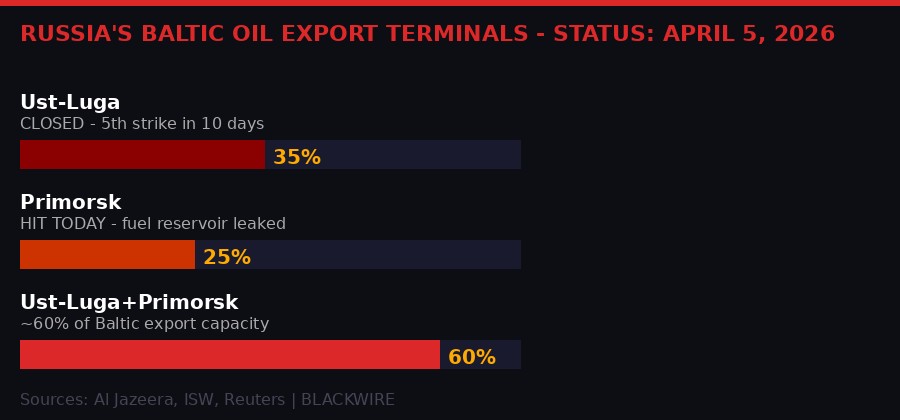
Ust-Luga and Primorsk are not incidental infrastructure. Together, they account for approximately 60 percent of Russia's Baltic Sea oil export capacity, according to reporting from Reuters and Al Jazeera citing industry estimates. For Russia, these ports are the jugular vein of its petroleum export system - the mechanism through which Kremlin revenue from oil sales gets converted into military budgets, ammunition purchases, and soldier salaries.
Ust-Luga, located between the Finnish border and St. Petersburg, is operated by Russia's state oil transport company Transneft. It has been struck five times in ten days. The port was also attacked in March when an oil depot was set ablaze. By April 1, Ukrainian drone forces confirmed strikes again. By mid-week, reports indicated the port had been effectively closed - a stunning operational achievement given the port's distance from Ukrainian-controlled territory.
Primorsk, which sits just south of Ust-Luga in the Leningrad region, handles significant crude oil volumes for European and Asian buyers. Ukraine hit both terminals simultaneously on March 27, triggering force majeure warnings from Russian oil companies that they might not be able to honor supply contracts from major Baltic ports.
That warning - force majeure from a nuclear-armed petrostate - landed like a depth charge in global energy markets. Russia was essentially admitting that its own oil industry could not guarantee delivery.
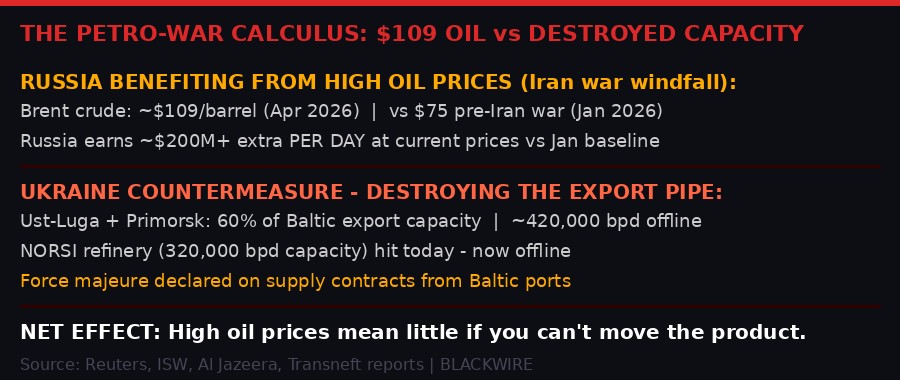
At the time the campaign launched, Russia was enjoying an unexpected windfall. The US-Israel war on Iran that began in late February had sent oil prices surging past $109 per barrel, creating a bonanza for any oil exporter with the infrastructure to move product. Moscow stood to pocket hundreds of millions of dollars per day in additional revenue compared to pre-war baselines.
Ukraine saw the math and decided to break the equation. If Russia cannot export the oil, high prices mean nothing. The campaign that began on March 20 is the kinetic answer to Russia's energy windfall.
The choice of targets was not random. Ust-Luga and Primorsk are located in the Leningrad region - deep in Russian territory, hundreds of kilometers from Ukraine's borders. Reaching them requires drones capable of extended range operations, navigating heavy Russian electronic warfare corridors, and arriving with enough operational capacity to strike meaningful targets. That Ukraine can do this repeatedly - five confirmed strikes on Ust-Luga alone in ten days - says something significant about the capabilities Ukraine has developed and what it is willing to deploy.
NORSI: Hitting Russia Where It Produces

Sunday's strike on the NORSI refinery is qualitatively different from hitting export terminals. Primorsk and Ust-Luga are chokepoints - remove them and oil piles up at the wellhead or sits in storage. Hitting NORSI disrupts production at the refinery level, affecting fuel supplies domestically as well as export revenue.
The NORSI complex in Nizhny Novgorod is Russia's second-largest petrol producer. When two of its facilities are simultaneously struck and catch fire - as happened Sunday night - the operational disruption ripples through Russia's internal fuel supply chain. Governor Nikitin confirmed two facilities at the plant were hit. He also confirmed a power station was damaged, which suggests the attack was coordinated to maximize disruption rather than simply spark fires that can be extinguished.
This follows an earlier strike on the Bashneft-Novoil Oil Refinery in the Russian republic of Bashkortostan, reported by Russian opposition outlet Astra, which occurred on approximately March 24. Ukraine has now struck refineries in Nizhny Novgorod, Bashkortostan, and the Ryazan region - spanning a geographic arc from central Russia to the Urals.
The pattern is deliberate. Ukraine is not just targeting export infrastructure - it is degrading refining capacity across the entire supply chain. Each successive strike forces Russia to make harder choices about where to allocate remaining capacity: domestic fuel, military logistics, or export sales.
Nizhny Novgorod is 400 kilometers east of Moscow. It is not a border town or a disputed territory. It is the heart of Russia's industrial interior. Striking there sends a message beyond the tactical: Ukraine's reach is extensive, its targeting is precise, and its willingness to escalate into Russian heartland territory is no longer theoretical.
Russia's Oil Infrastructure Damage - Running Total (April 5, 2026)
- Ust-Luga (Baltic, Leningrad region): Struck 5+ times since March 21. Effectively closed as of April 1. Handles approximately 35 percent of Russia's Baltic export capacity.
- Primorsk (Baltic, Leningrad region): Struck multiple times including March 27 and April 5. Fuel reservoir leaking. Handles approximately 25 percent of Baltic capacity.
- NORSI Refinery (Nizhny Novgorod): Struck April 5. Russia's 4th largest refinery, 2nd largest petrol producer. Approximately 320,000 bpd capacity now offline.
- Bashneft-Novoil (Bashkortostan): Struck approximately March 24. Significant central Russia refining capacity disrupted.
- Ust-Luga Oil Depot: Set ablaze in March. Separate from the main port terminal strikes.
- Aggregate estimate: At some point in late March, approximately 40 percent of Russia's total oil exporting capabilities were simultaneously offline. (Source: Al Jazeera, industry reports)
The Petro-War Calculus: High Prices, No Pipe
The strategic logic underpinning Ukraine's oil campaign deserves examination. Russia's war in Ukraine costs approximately $300 million per day in direct military expenditure, according to estimates from Western defense think tanks. Oil and gas revenues - which constitute roughly half of Russia's federal budget in high-price environments - are the primary mechanism by which Putin finances that cost.
When the US-Israel conflict against Iran began in late February 2026 and sent Brent crude above $100 per barrel, Russia found itself in an unexpected position: a pariah state with a windfall. At $109 per barrel, Russia earns roughly $200 million per day more than it did in January at pre-war baseline prices. That surplus directly translates to more weapons, more shells, more drone components, and more mercenary contracts.
Ukraine's commanders understood this dynamic. The drone campaign against Baltic export infrastructure began within weeks of oil prices spiking - a direct tactical response to an economic development. Ukrainian Defence Minister Mykhailo Fedorov stated in early April that Ukraine had systematically increased drone purchases and ammunition in Q1 2026, with purchases in the first three months equalling more than half of all 2025 purchases combined. The oil campaign is part of that accelerated operational tempo.
The underlying equation is brutal in its simplicity: high oil price times zero export volume equals zero revenue. Ukraine cannot control global oil prices, which are driven by the Gulf crisis. But Ukraine can control how much oil Russia actually manages to sell. Destroying the terminals is the kinetic answer to a geopolitical problem Ukraine cannot solve through diplomacy.
The disruption is already measurable. Russian oil companies warned buyers about potential force majeure on supply contracts from major Baltic ports. At one point, Ust-Luga and Primorsk's simultaneous impairment meant roughly 420,000 barrels per day of Baltic export capacity was offline. With NORSI now also struck, production and refining losses compound the export losses. Russia's windfall from $109 oil is being systematically neutralised at the point of infrastructure.
The strategy is economically coherent in a way that few battlefield tactics are. Russia's economy is a petrostate economy. Its military budget is an oil-price budget. Attack the export mechanism and you are not fighting Russia's army - you are fighting Russia's war funding. Ukraine has found its way into the enemy's treasury through the back door.
The Slowing Grind: Russia's Ground Offensive Stalls

The oil campaign coincides with a significant shift on the ground in eastern Ukraine. Data from the Institute for the Study of War (ISW), a Washington-based think tank, documents a striking deceleration in Russia's rate of territorial advance over 18 months.
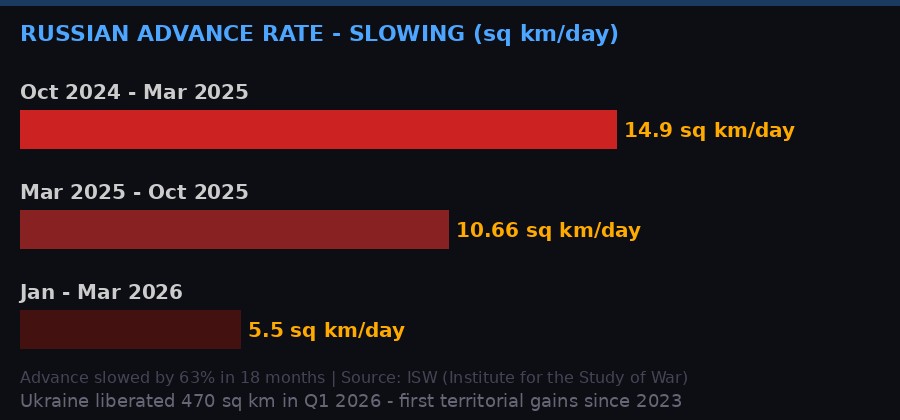
Between October 2024 and March 2025, Russian forces advanced at approximately 14.9 square kilometers per day - a pace that, if sustained, would eventually grind through Ukrainian defenses. By the following six months, that rate had fallen to 10.66 square kilometers per day. In the first three months of 2026, the rate dropped to 5.5 square kilometers per day - a 63 percent reduction from the peak. The ISW noted its conservative mapping methodology likely underestimates the true slowdown.
Ukrainian commander-in-chief Oleksandr Syrskii attributed the deceleration directly to drone warfare. "In March, the number of combat sorties of drone interceptors and the number of targets destroyed increased by almost 55 percent compared to February," Syrskii wrote on Telegram. He noted that FPV drones - first-person view remote-controlled attack drones - are now responsible for approximately 90 percent of Russian casualties.
That statistic deserves to sit for a moment. Nine in ten Russian soldiers killed or wounded on the Ukrainian front are falling to a category of weapon that barely existed in that combat role four years ago. Ukraine has built an industrial drone warfare system faster than Russia can adapt to counter it.
Ukraine also reported genuine territorial gains. Syrskii confirmed that Ukraine had reclaimed 470 square kilometers of occupied territory in Q1 2026 - the country's first net territorial gains since 2023. The ISW, using more conservative mapping methodology, confirmed at least 334 square kilometers of Ukrainian advances, noting their methodology likely underestimates actual Ukrainian gains.
Zelenskyy himself assessed the front-line situation on Friday as "the best it has been in 10 months." He noted that Russia's planned March offensive had been thwarted entirely. He predicted Russia would respond by "stepping up assault operations" - which is consistent with the 339-drone barrage Kyiv reported on Wednesday night, the largest single overnight drone attack recorded in the war.
The Ryazan region's governor, Pavel Malkov, signed a decree on March 20 forcing businesses with 150 or more employees to select two to five workers per company to sign military service contracts. That is not the action of a military confident in its volunteer recruitment pipeline. It is the signature of a conscription system under visible strain, compelling private businesses to serve as a secondary draft mechanism.
When a government starts conscripting through corporate mandates, the volunteer supply has been exhausted. Russia is burning through soldiers faster than it can replace them through conventional means. The combination of slowing ground advances, mandatory corporate conscription, and now sustained attacks on oil export infrastructure paints a picture of a war machine under significant systemic stress - even if that stress has not yet translated into battlefield collapse.
Baltic Spillover: When War Crosses NATO Borders

The long-range drone campaign targeting Baltic infrastructure has introduced a complication with serious alliance implications: geographic spillover. Ukraine's drones, operating at extended range to reach Ust-Luga, Primorsk, and now Nizhny Novgorod, are crossing international airspace and in some cases crashing or depositing debris in NATO member states.
Estonia's armed forces confirmed that several drones appeared to have strayed from Ukraine while headed toward Russia. Finnish police reported that a drone detected in Finland was carrying explosives - the first time Ukrainian war ordnance had entered Finnish territory since the country's 2023 NATO accession. Latvian police launched an investigation after drone debris was found on their territory. Lithuania reported incidents in the same period.
On Sunday, a Ukrainian drone crashed in Finland - the first confirmed case of a Ukrainian war drone coming down on Finnish soil. Finland shares a 1,340-kilometer border with Russia and joined NATO precisely because of fear of Russian aggression. Now Ukrainian drones are also crossing into Finnish territory, creating a category problem for alliance coherence.
None of these states have issued formal complaints to Kyiv. All understand the operational context - these are drones aimed at Russia that went off course, not deliberate attacks on NATO members. But the incidents are documented, investigated, and create political pressure. NATO member states where Ukrainian war drones are crashing face domestic political questions about the risks of hosting an ally whose weapons are regularly entering their airspace.
The incidents also raise technical questions about Ukraine's long-range drone systems when operating against heavy electronic warfare. Russia deploys layered GPS jamming and spoofing capabilities around key targets. Drones that lose navigation in those environments do not simply stop - they continue flying until fuel is exhausted or until impact. In the Baltic corridor, that means NATO soil is occasionally the final destination of drones that were supposed to hit Russian refineries. The problem will not resolve itself; it will grow as Ukraine's long-range campaign expands.
Ukraine's Gulf Pivot: Drone Expertise as Diplomatic Currency
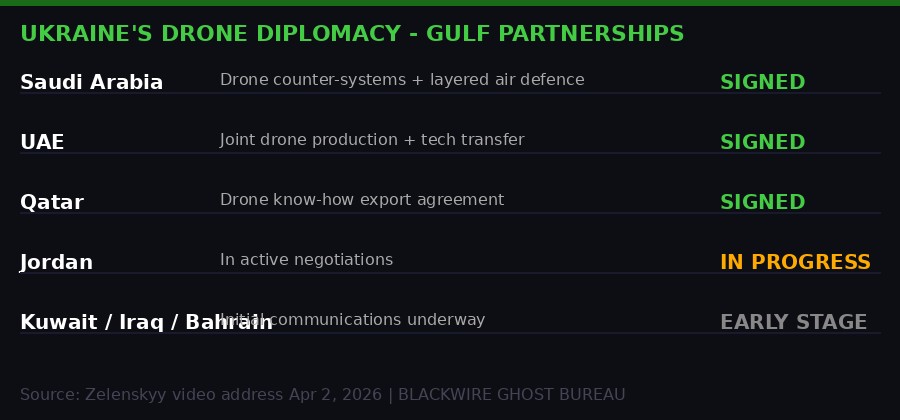
The same drone technology that Ukraine is deploying against Russia is now being offered to the Gulf states currently absorbing Iranian drone attacks. In what amounts to a remarkable wartime pivot, Ukraine has turned its drone warfare expertise into diplomatic and commercial currency.
In a video address in early April, Ukrainian President Zelenskyy disclosed the scope of these agreements: "We already have agreements with Saudi Arabia, the UAE and Qatar. We are working with Jordan. We are in communication with Kuwait, now also Iraq and Bahrain." The deals involve exporting Ukrainian drone know-how in exchange for joint drone production support - a technology transfer for hardware transfer arrangement that benefits both parties.
The timing is not coincidental. The Gulf states are currently experiencing sustained Iranian drone attacks on civilian infrastructure as part of Tehran's asymmetric response to US-Israeli strikes on Iran. Kuwait's power and desalination plants were struck overnight Saturday. The UAE's Borouge petrochemical plant was hit. Bahrain's Gulf Petrochemical Industries Company was attacked. Saudi Arabia intercepted missiles early Sunday morning.
These states need counter-drone systems and doctrine urgently. Ukraine, which has spent four years developing the world's most battle-tested drone warfare methodology under live combat conditions against a near-peer adversary, has precisely what they need. Zelenskyy's Gulf tour in late March - during which he signed air defence deals with UAE and Qatar - was not diplomatic goodwill. It was arms marketing by a country that needs to generate new support streams.
The strategic implications extend further. Ukraine's drone tech deals with Gulf states create military relationships that could eventually translate into material support for Kyiv. They also establish Ukraine as a relevant military technology player at a moment when Western attention is split between the Iran conflict and the ongoing war in eastern Europe. Kyiv is not waiting for the world to refocus. It is building new partnerships in the spaces the world is currently focused on.
"They are interested in our experience in countering drones and building a layered system-wide defence against modern threats." - Ukrainian President Volodymyr Zelenskyy, April 2, 2026, describing Gulf state interest in Ukrainian drone expertise
The Peace Talks Graveyard
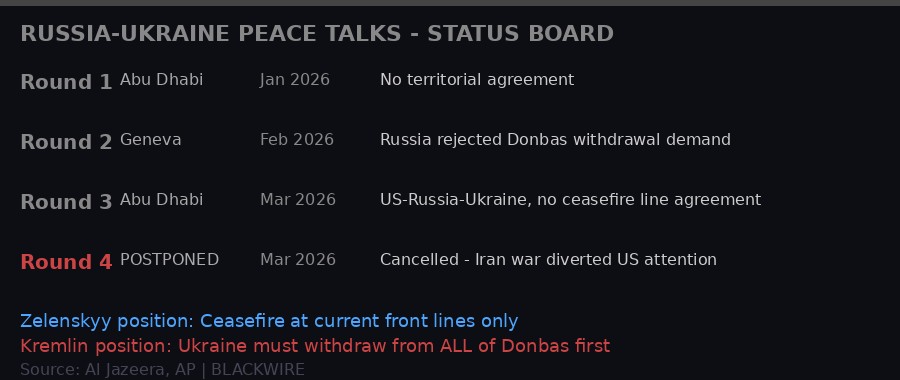
Against the backdrop of battlefield attrition and drone campaigns, the diplomatic track between Russia and Ukraine lies in suspended animation. Three rounds of high-level talks in Abu Dhabi and Geneva have produced nothing. A fourth round was postponed when the Iran war consumed US diplomatic bandwidth. No new date has been set.
The positions of the two sides remain irreconcilably distant. Zelenskyy has stated Ukraine will only accept a ceasefire along current front lines. The Kremlin's Dmitry Peskov stated that Ukrainian forces must withdraw from the entirety of Donetsk - which Russia controls about three-quarters of - as a precondition for ending the "hot phase" of the war. Zelenskyy dismissed that demand as impossible, noting it would require Ukraine to surrender territory it still holds and controls.
The gap is not a negotiating distance. It is a chasm. Russia's demand that Ukraine cede additional territory before ceasing hostilities, combined with Russia's ongoing advances however slowed, means the Kremlin still believes time and attrition are on its side. Ukraine's counter-strategy - draining Russia's war chest through oil infrastructure destruction while slowing ground advances with drones - is a bid to change that calculus before Russia is proven right.
On Wednesday, Zelenskyy held a video call with US envoys Steve Witkoff and Jared Kushner. The outcome was not publicly disclosed. The call indicates Washington has not entirely abandoned the Ukraine track despite Iran dominating the foreign policy agenda, but there is no indicator of any imminent breakthrough. The administration's attention is divided and Ukraine's leverage over Washington's calendar is limited.
"We proposed a ceasefire for Easter. In response, we're getting Shaheds." - Ukrainian President Volodymyr Zelenskyy, April 2, 2026, referencing 339 Russian drones fired overnight
The Easter ceasefire proposal - rejected by Moscow through the act of launching a 339-drone barrage - illustrates the fundamental dynamic with blunt clarity: Russia does not want a ceasefire at current lines because it believes it can still achieve more. Ukraine's drone campaign against Russian oil infrastructure is the most direct pressure Kyiv can apply to change that belief by making more cost more than Russia can afford.
Meanwhile, Russia claimed on April 1 to have taken full control of the Luhansk region - completing an objective that had eluded Moscow since the 2022 invasion. Russian Defence Ministry confirmed units of the "West" military grouping had "completed the liberation of the Luhansk People's Republic." Ukraine offered no immediate confirmation. More than 99 percent of Luhansk had been under Russian control since 2022, meaning the claimed "completion" involves small remaining areas - but the announcement was timed for political effect at a moment when Russian domestic audiences needed a victory narrative.
The Infrastructure War: A Timeline of Escalation
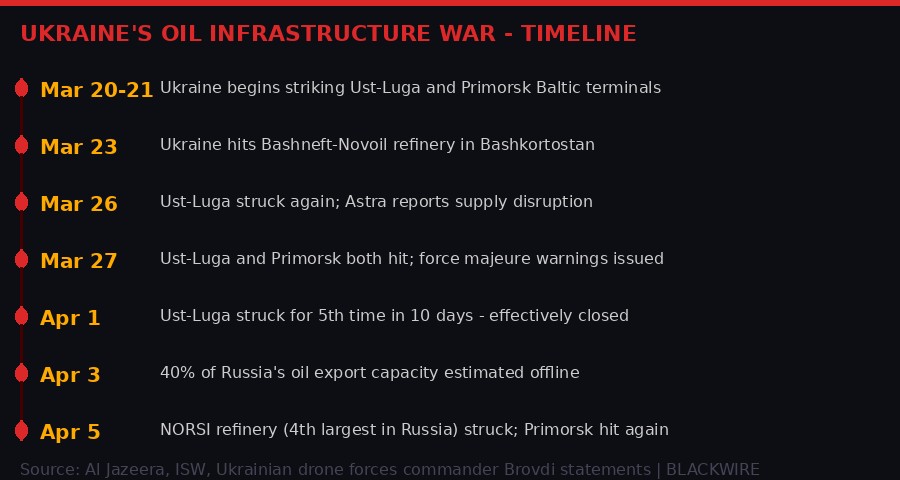
What began on March 20-21 as a strategic experiment has become a sustained two-week campaign with a clear operational pattern. The tempo of strikes has not decreased since the first hits on Ust-Luga. It has increased.
What Comes Next: Escalation Trajectories and Breaking Points

The strategic question now is whether Ukraine's oil campaign can sustain its impact faster than Russia can repair, reroute, or replace destroyed capacity. Several indicators bear watching as the third week of the campaign begins.
Russia has alternative export routes, but none that substitute at scale. The Druzhba pipeline, which crosses Ukraine, is already closed. Eastern pipelines to China via the ESPO system remain operational, but they cannot absorb the volume that the Baltic terminals handle. Russia's Black Sea exports face their own constraints in a contested maritime environment, and Arctic shipping is seasonal and lower-volume. The Baltic route is not one option among many - it is the primary mechanism for Russia's westward oil exports, and it is being dismantled.
The force majeure warnings from Russian oil companies already indicate the disruption is real enough to affect contracted supply commitments to buyers. But Russia has reserves of infrastructure repair capacity and can, at significant cost and time, rebuild damaged facilities. Refinery strikes are harder to recover from quickly than terminal strikes. NORSI at 320,000 bpd is a significant loss that cannot be compensated overnight by rerouting production.
On the Russian response side, the corporate conscription decree in Ryazan signals growing manpower pressure. Combined with the 63 percent slowdown in ground advance rates and the oil infrastructure losses, it suggests Russia's ability to sustain offensive operations at previous intensity is degrading. The question is whether degradation reaches a critical threshold before Russia finds a way to stabilise its position - through peace talks it would dictate terms to, or through some form of domestic mobilisation that restores manpower and revenue simultaneously.
For Ukraine, the constraints are also visible. Long-range drone production requires components, many of which are sourced internationally and subject to export controls. The drone overflight incidents in Finland and the Baltics create diplomatic friction with NATO members who are otherwise Ukraine's strongest supporters. There is a functional ceiling on how hard Ukraine can push in the Baltic corridor before creating a political problem with the allies it depends on for continued support. The incidents will accumulate if the campaign continues at current tempo.
The broader geopolitical environment adds pressure in both directions. The US-Israel war on Iran has diverted American attention and military resources. Europe, focused on the Gulf energy crisis and Hormuz closure, has less bandwidth for Ukraine. But Gulf states with capital and strategic interests in seeing Russia weakened are now active partners for Kyiv, as Zelenskyy's drone deals demonstrate. The two wars are not parallel tracks - they are bleeding into each other's logistics, diplomacy, and financing.
Russia's oil infrastructure was not designed to absorb sustained drone attack. The question is not whether Ukraine is damaging it - it clearly is. The question is whether the damage accumulates faster than Russia's ability to repair and reroute. After two weeks, the answer appears to be: yes, for now. Three refineries, two major Baltic export terminals, an oil depot, and a string of forced supply disruptions represent a meaningful degradation. The campaign is not over. Both sides are accelerating.
Get BLACKWIRE reports first.
Breaking news, investigations, and analysis - straight to your phone.
Join @blackwirenews on Telegram