PARIS - The words landed like a slap at an allied summit. U.S. Secretary of State Marco Rubio, standing before reporters after a Group of Seven meeting in France on Friday, was asked about Ukrainian President Volodymyr Zelenskyy's claim that Washington had privately demanded Kyiv cede its eastern Donbas region to Russia in exchange for American security guarantees.
Rubio did not deflect. He did not hedge.
"That's a lie," Rubio said, per the Associated Press. "And I saw him say that. And it's unfortunate he would say that because he knows that's not true and that's not what he was told."
That sentence - a sitting U.S. Secretary of State calling a wartime ally a liar, by name, in public, at an allied summit - is the kind of diplomatic rupture that normally takes years to repair. It happened in under ten words. And it landed on top of a Ukraine that is already losing the quiet war being waged against it by Washington's distracted attention, dwindling weapons stockpiles, and a peace process designed to make surrender look like negotiation.

What Zelenskyy Actually Said - and Why It Matters
In an interview published this week, Zelenskyy told Reuters that the United States had made its offer of security guarantees for Ukraine contingent on Kyiv ceding the Donbas region - the industrial eastern heartland long coveted by Russian President Vladimir Putin. Moscow's forces already occupy the bulk of the region. What remains under Ukrainian control is heavily fortified.
"The Americans are prepared to finalize these guarantees at a high level once Ukraine is ready to withdraw from Donbas." - Volodymyr Zelenskyy, to Reuters, this week
This is not a fringe claim. Zelenskyy is not a minor figure casually misinterpreting a diplomatic briefing. He is the head of a government that has been in direct, ongoing talks with U.S. officials for months. He said this in a formal media interview. He said it clearly.
Rubio's denial, while emphatic, came with a tell. He acknowledged that U.S. negotiators had relayed Russia's demands to Ukraine - they just weren't "advocating for it."
"We've told the Ukrainian side what the Russians are insisting on. We're not advocating for it. We've explained it to them. It's their choice to make. It's not for us to make for them." - Secretary of State Marco Rubio, G7 Paris, March 27, 2026, per AP
The distinction Rubio draws - between "relaying" Russia's territorial demands and "advocating" for them - is thinner than it sounds when you are the Ukrainian president and the country relaying those demands controls your weapons supply, your air defense missiles, and your seat at any future peace table. When a patron tells you what the other side wants, backed by the implicit threat of reduced support if talks fail, that is pressure. Calling it neutral facilitation requires significant euphemistic effort.

The Donbas: What is Actually Being Asked of Ukraine
Before measuring the diplomatic fight, it helps to understand what "ceding the Donbas" actually means on the ground.
Russia currently controls approximately 70% of the Donetsk region - the core of the Donbas. Ukraine holds the remaining 30%, anchored by what military analysts and frontline commanders have dubbed the "fortress belt": four cities - Kostiantynivka, Kramatorsk, Sloviansk, and Pokrovsk - that have resisted Moscow's advances for years of brutal, grinding warfare.
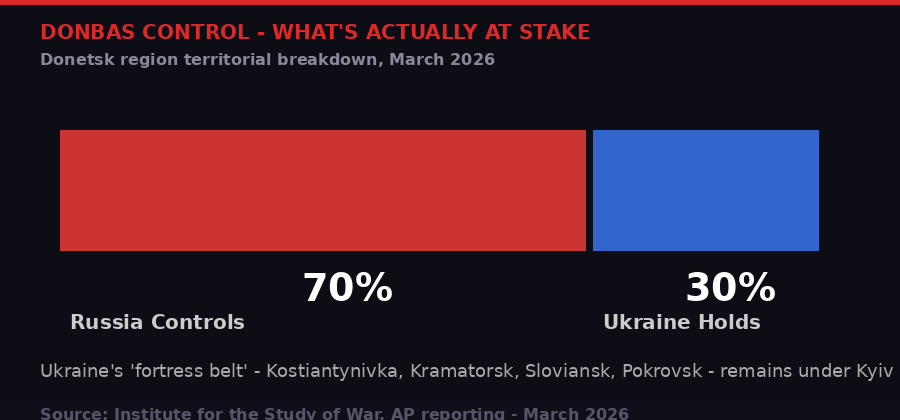
Russia now holds nearly 20% of all Ukrainian territory, per the Institute for the Study of War. But the Donbas is not just land. It is Ukraine's industrial base - coal, steel, manufacturing. Putin has wanted it since before the full-scale invasion. Handing it over would not just be a territorial concession. It would permanently arm Russia with an economic base inside what remains of Ukraine, a launchpad from which to threaten every other part of the country, according to analysts cited by AP.
Col. Pavlo Yurchuk, defending positions at the northern end of the fortress belt, has described how Russian infiltration tactics send small groups through gaps in Ukrainian lines. "These are tactical successes, not strategic ones," he told AP. "This tactic is very slow and does not solve the tasks of encirclement or control of large settlements." But it is steady. And it is accelerating during a spring offensive that has drawn almost zero global attention because the cameras are pointed at Tehran.

Patriots Are Gone. Russia Knows It.
The weapons math is stark and has been reported by multiple outlets in recent weeks. The Iran war, now in its 29th day, has fundamentally restructured where U.S. air defense resources sit.
A sizable number of U.S. Patriot air defense missiles have been moved from Europe toward the Middle East, per AP, citing U.S. defense officials who spoke on condition of anonymity. Two complete Patriot systems were sent from Germany to Turkey after Iran fired ballistic missiles toward Turkish territory since the war began. Missile stocks were drawn from various European locations to reinforce air defenses across the region.
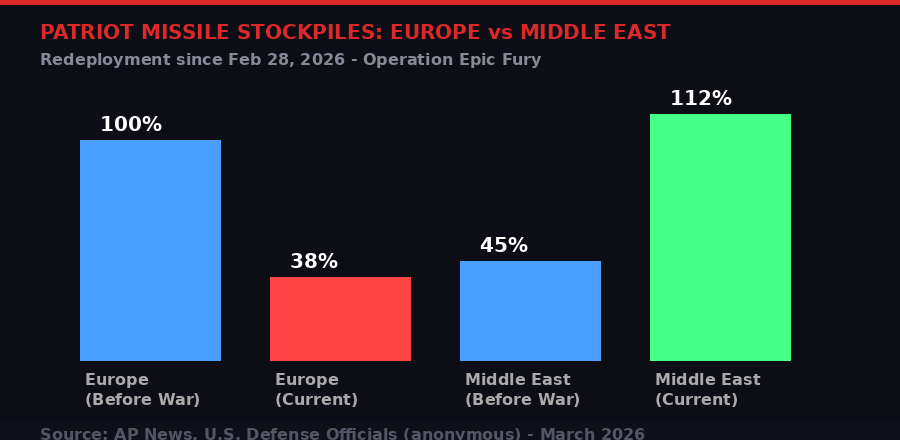
One official described the situation in blunt terms: stocks are "absolutely" dwindling in Europe, and the situation is "pretty concerning," per AP. The White House dismissed the concern - press secretary Karoline Leavitt called U.S. munitions stockpiles sufficient - but that does not change the reality of what is currently deployed where.
Zelenskyy has been specific about the math. The U.S. produces 60 to 65 Patriot missiles per month - roughly 700 to 800 per year. On the first day of the Iran war, over 800 missiles were used. Ukraine, which relied on Patriot systems as its most effective shield against Russian hypersonic and ballistic missile attacks, is now watching that shield thin in real time. Zelenskyy has warned Kyiv will "definitely" face shortages, per AP reporting.
"The U.S. produces 60 to 65 missiles per month. And on the first day in the Middle East war, 803 missiles were used." - President Volodymyr Zelenskyy, per AP
This is the material backdrop against which Rubio delivered his "liar" verdict at the G7. Ukraine is not negotiating from a position of strength. It is negotiating from inside a weapons dependency it cannot replace.
Russia's Bonus: The Oil Sanctions Waiver
The insult to Ukraine's position is compounded by what happened to Russian finances while Washington was busy fighting Iran.
Russia's economy was, only weeks ago, showing signs of strain under Western sanctions. That changed with a U.S.-issued temporary waiver on oil sanctions against Moscow. The stated purpose was pragmatic - to free up stranded Russian oil cargo and ease global supply shortages triggered by Iran's stranglehold on the Strait of Hormuz. The effect is that Russia is now banking billions in energy revenue from oil sales that would otherwise have been frozen out of the market.
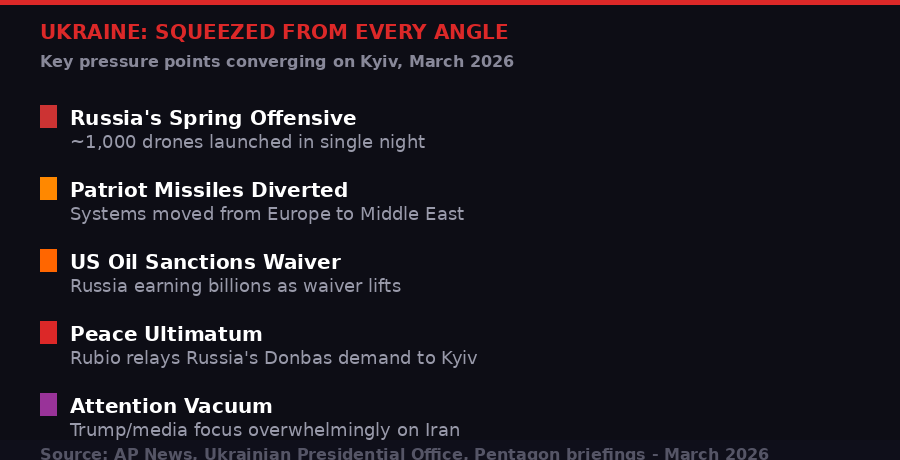
Zelenskyy called the decision "not the right one" because it directly enables Russia's military campaign - every barrel of oil that moves through the sanctions waiver helps fund the drones, glide bombs, and artillery shells landing on Ukrainian cities. The U.S. made this choice not to reward Russia but to manage a global oil crisis. The effect on Ukraine is the same regardless of intent.
The Ukraine-Russia war has now entered its fifth year. Russia currently holds nearly 20% of Ukraine. Its spring offensive is underway. And its biggest patron state is inadvertently funding the enemy's war machine while publicly calling Ukraine's president a liar.
The Russia Drone Barrage No One Reported
On Tuesday of this week, Russia fired almost 1,000 drones and 34 missiles at Ukraine in one of the single largest bombardments of the entire war. Ukraine responded the following day with almost 400 drones - the largest reported overnight Ukrainian drone strike on Russian regions and Crimea.
These are extraordinary numbers. Nearly 1,000 Russian drones in a single night. In any prior year of this war, this would have been the top story on every front page on earth. This week, it made page 12 because the Iran war is consuming all available bandwidth for conflict coverage.

The Iran war has deflected global attention from what is, by any pre-2026 metric, an extraordinarily violent escalation on Europe's eastern front. European capitals have noticed. Ukraine's fate remains Europe's top foreign policy concern, per AP analysis - but the continent's U.S. partners have made their priority hierarchy unmistakable.
The Trump administration has wound down direct peace talks with Russian and Ukrainian delegations. The Iran war has absorbed those diplomatic resources. Officials have warned that Washington could walk away from the Ukraine conflict entirely if peace efforts fail to materialize - a warning that, combined with the weapons redeployments and the oil waiver, amounts to structured pressure on Kyiv to find a deal.
The Ceasefire Geometry
Trump last week outlined five objectives for Operation Epic Fury - the air campaign against Iran. That list has expanded and shifted over the past month. The Ukraine peace process has no such stated objectives, no public benchmarks, and no visible timetable. It exists in the gap between Washington's war focus and Russia's patient territorial accumulation.
The geometry of a forced ceasefire settlement is becoming visible. Ukraine surrenders the Donbas territory Russia already occupies (70% of Donetsk). In exchange, it receives security guarantees - the nature and enforceability of which remain undefined. Trump turns Ukraine into a win. Russia banks permanent territorial gains. NATO lives with the outcome.

Rubio described the talks in Florida last week - and said no further meetings are scheduled. He also noted that while U.S. weapons bound for Ukraine have not yet been pulled to redirect toward the Middle East, it could happen "if deemed necessary." The qualifier "as of now" is doing significant work in that sentence.
Ukraine has attempted to find leverage by offering its drone expertise to Gulf states. In exchange, Kyiv wants high-end air defense missiles - the Patriots and interceptors it no longer receives from European stocks. It is a creative strategic pivot. Whether it generates enough capacity to replace what was lost remains unclear.
What Comes Next
The war with Iran is one month old as of today. Trump has suggested the U.S. may soon be "winding down" Operation Epic Fury, though analysts note that his five stated objectives - degrading Iranian missiles, destroying Iran's defense industrial base, eliminating Iran's navy and air force, removing the IRGC's grip on the Strait of Hormuz, and regime change - remain only partially achieved, per AP analysis.
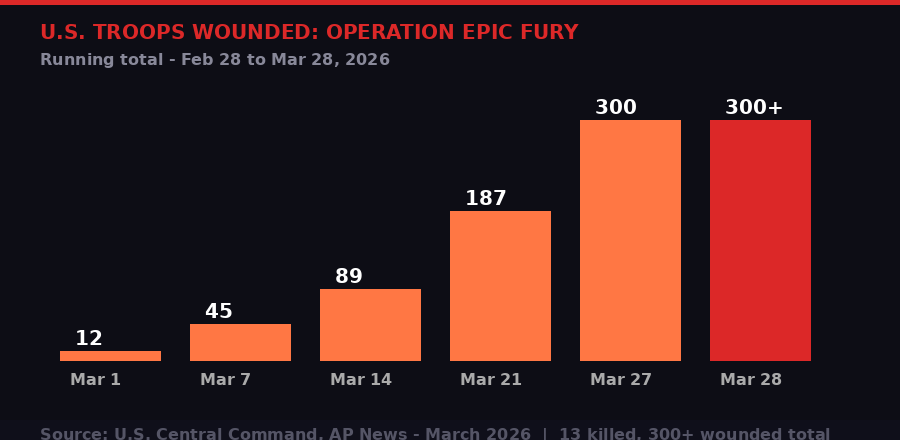
Iran struck Prince Sultan Air Base in Saudi Arabia on Friday - six ballistic missiles and 29 drones. Over two dozen U.S. troops have been wounded at that base in the past week alone. More than 300 U.S. service members have been wounded in total since February 28. Thirteen have been killed. The Houthis fired their first ballistic missiles at Israel on Saturday morning, intercepted by Israeli defenses, opening a new front that could pull the USS Gerald R. Ford carrier back into the Red Sea corridor it recently left for repairs.
The Iran war is not winding down this weekend. It may not wind down this month. And every day it continues is another day Russia presses its spring offensive through terrain the world has stopped watching, with weapons the world has stopped providing, under a diplomatic framework designed to make concession look like compromise.
Zelenskyy said on the fourth anniversary of the invasion last month that Putin "has not broken Ukrainians." That may be true. But breaking people is not the only way to take their territory. You can also wait for their allies to look the other way.
Key Numbers - Ukraine, March 28, 2026
- Russia controls ~20% of all Ukrainian territory • 70% of Donetsk region in Russian hands • ~1,000 Russian drones fired in single Tuesday night barrage • Patriot systems moved from Germany to Turkey and Middle East • U.S. produces 700-800 Patriot missiles per year • 803 Patriot-class missiles used on Day 1 of Iran war • Russia earning billions from U.S. oil sanctions waiver • Peace talks stalled - no new Florida meetings scheduled • 13 U.S. troops killed, 300+ wounded in Iran war as of March 28
Timeline: Ukraine's Squeeze - January to March 2026

The Diplomatic Autopsy
Diplomatic ruptures of the kind that happened in Paris on Friday do not happen by accident at G7 summits. Rubio chose those words. His communications team did not stop him. The statement was not walked back. The Ukrainian presidential office - notably - declined to comment on the discrepancy.
Read that silence carefully. A head of state accuses your government of coercing his country to give up its industrial heartland. Your Secretary of State publicly calls him a liar. And his office says nothing.
That silence is not weakness. It is calculation. Zelenskyy has survived four years of war by reading the politics of his allies better than almost any leader alive. He knows that fighting publicly with Washington right now - while Iran burns, while Patriots are gone, while Russia is advancing - gains him nothing and costs him everything. So he says nothing. And waits.
Russia is also waiting. Putin did not comment on the anniversary of the invasion last month. He spoke only at an FSB meeting about the "growing threat" of Ukrainian long-range drone strikes on Russian territory. The spring offensive proceeds on a schedule that does not depend on what is said at G7 summits in Paris.
Ukraine's offer to help Gulf states counter Iranian drones - in exchange for air defense missiles - is the most creative diplomatic move Kyiv has made this year. It transforms Ukraine from a supplicant into a service provider. It builds relationships with countries that have the weapons Kyiv needs. It creates leverage independent of Washington. Whether those relationships can substitute for the structural dependency Kyiv has on the U.S. defense supply chain is the question that will define the next phase of this war.
The shape of 2026 is becoming clear. The Iran war will eventually wind down. Trump will claim objectives achieved. The U.S. will want to close other files - and Ukraine is a file that has been open for four years. Pressure to close it on whatever terms are available will intensify. The window in which Kyiv can refuse and survive is narrowing with every Patriot system that moves south and every barrel of Russian oil that reaches an Asian refinery on a sanctions waiver.
Rubio called Zelenskyy a liar in Paris on Friday. That is the headline. The deeper story is what happens after. And what happens after is already underway.
Sources: Associated Press (Paris, March 27-28, 2026); AP analysis of Trump Iran war objectives; AP reporting on Patriot missile redeployment; AP on Iran attack at Prince Sultan Air Base; AP on Russia's spring offensive in Donetsk; Institute for the Study of War (territorial maps); U.S. Central Command statements; Ukrainian President Zelenskyy, via Reuters interview.
Get BLACKWIRE reports first.
Breaking news, investigations, and analysis - straight to your phone.
Join @blackwirenews on Telegram