April 3, 2026 - 12:10 PM CEST | BLACKWIRE World Desk
UN Security Council Moves to Break Iran's Hormuz Chokehold as Zarif Floats Peace Trial Balloon
Bahrain waters down its resolution to dodge a Russia-China veto. Former Iranian FM Zarif publishes peace terms in Foreign Affairs. Brent crude sits at $109. The diplomatic scramble to end a war now grinding into its 35th day hits a critical weekend.

The UN headquarters in New York, where the Security Council prepares for a pivotal vote on the Strait of Hormuz. Photo: Pixabay
The war in Iran is 35 days old and shows no sign of ending. Sirens wailed across the Persian Gulf overnight Friday as Iranian drones slammed into a Kuwait oil refinery and a desalination plant, while American and Israeli jets hit targets around Tehran and Isfahan. Oil prices climbed above $109 per barrel. Twenty thousand seafarers remain stranded on 2,000 vessels unable to transit the Strait of Hormuz.
Into this grinding stalemate, two diplomatic moves landed within hours of each other. At the United Nations in New York, Bahrain circulated a dramatically revised resolution that strips out any authorization for offensive military force to reopen Hormuz - a concession designed to prevent a Russian or Chinese veto. And in Washington, former Iranian Foreign Minister Mohammad Javad Zarif published a 2,000-word essay in Foreign Affairs magazine proposing peace terms that borrow from both sides.
Saturday's vote at the Security Council and the reception of Zarif's proposal will test whether diplomacy can find any traction in a conflict that has killed more than 1,900 Iranians, 13 American service members, and over 1,300 people in Lebanon - and sent global energy markets into their worst crisis since the 1973 Arab oil embargo.
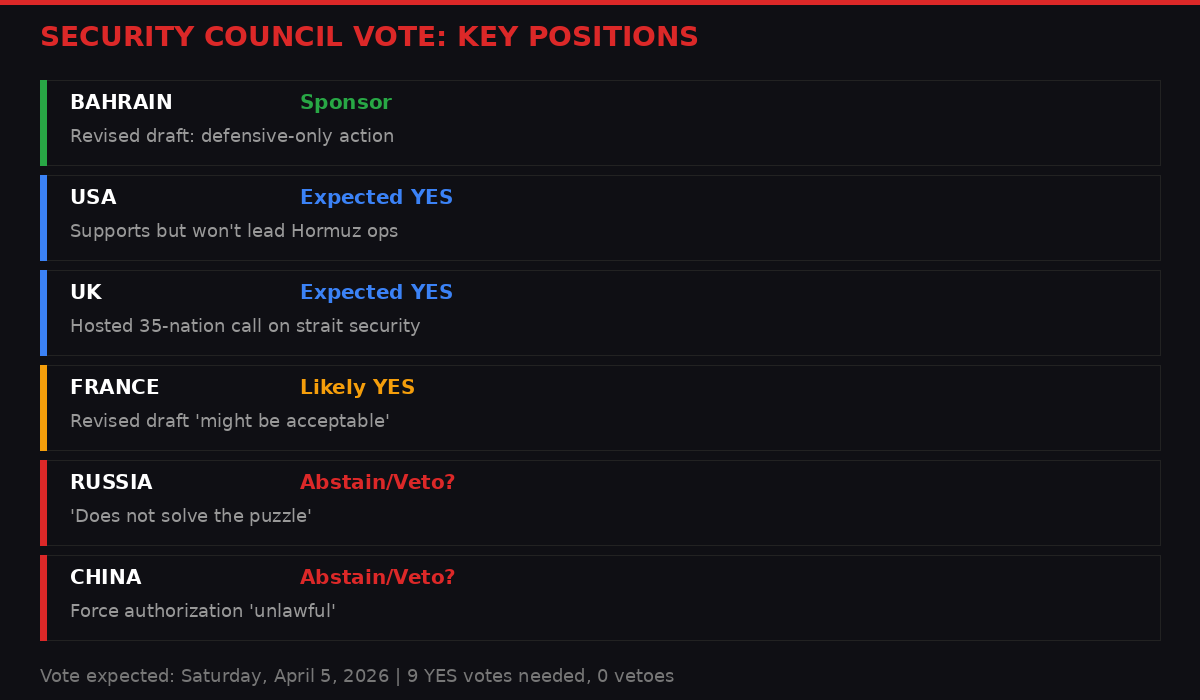
Infographic: The key players and their positions heading into Saturday's Security Council vote.
The Resolution: From "All Necessary Means" to Defensive Action Only

The diplomatic scramble to reopen Hormuz has tested every alliance in the system. Photo: Pixabay
Bahrain's original draft resolution, obtained by the Associated Press in late March, used the phrase "all necessary means" - UN diplomatic code for authorizing military force, the same language that underpinned the 1991 Gulf War and the 2011 Libya intervention. The proposal would have allowed any nation to use military action "in the Strait of Hormuz, the Gulf and the Gulf of Oman" to secure passage and deter interference with navigation.
That language never stood a chance. Russia, China, and France - three of the five veto-wielding permanent members of the Security Council - made clear they would block it.
Russia's UN Ambassador Vassily Nebenzia said the proposal "does not solve the puzzle," arguing that only an end to hostilities would reopen the strait. China's Ambassador Fu Cong called the use-of-force authorization "unlawful and indiscriminate," warning that it "would inevitably lead to further escalation of the situation and lead to serious consequences." France's Ambassador Jerome Bonnafont joined the chorus, calling for de-escalation and suggesting that only "defensive measures that avoid any broad use of force" should be considered.
The final draft, obtained Thursday by the AP, strips out every reference to offensive action. Instead, it authorizes countries "to use all defensive means necessary and commensurate with the circumstances in the Strait of Hormuz and adjacent waters" to secure passage and deter interference with international navigation "for a period of at least six months."
Countries acting alone or in "multinational naval partnerships" can take defensive measures provided they give advance notification to the Security Council. The resolution deliberately avoids specifying what "defensive" means in practice - a calculated ambiguity designed to let each veto-wielding member interpret it in a way they can live with.
The vote was originally scheduled for Friday but postponed because Good Friday is a UN holiday. It is now expected Saturday. Whether Russia and China will accept even the watered-down language remains unclear. France's ambassador signaled the revised draft "might be acceptable," but Moscow and Beijing have not tipped their hands.
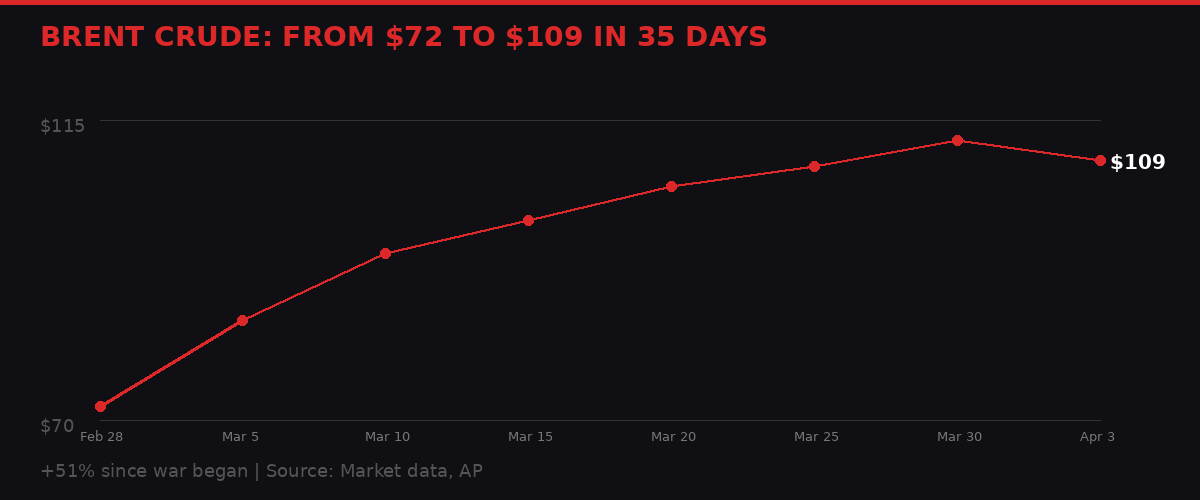
Infographic: Brent crude price trajectory since the war began on February 28, 2026.
What the Resolution Can and Cannot Do

Naval power in the Gulf has proven unable to force open the strait while the war rages. Photo: Pixabay
Even if the resolution passes unanimously, its practical impact is severely limited. No country has shown willingness to force open the Strait of Hormuz while Iran and the US-Israeli coalition are actively exchanging fire. French President Emmanuel Macron, speaking in Seoul alongside South Korean President Lee Jae Myung, called a military operation to secure the waterway "unrealistic" while hostilities continue.
The resolution's value, diplomats say, is primarily legal and political. It establishes a UN-sanctioned framework for action once fighting stops - authorizing mine-clearing operations, naval escorts for commercial vessels, and "reassurance" patrols. British Foreign Secretary Yvette Cooper, who hosted 35 nations for a call on securing the strait Thursday, said military planners from multiple countries would begin plotting post-ceasefire security operations.
The absence of the United States from those 35-nation talks was conspicuous. Trump has insisted that countries dependent on Gulf oil should "build some delayed courage" and reopen the strait themselves. He told an Easter lunch audience at the White House that America could "very easily" take Iran's oil but lamented that the American public lacked patience for such an effort.
The disconnect between Trump's rhetoric and the international community's approach has widened into a chasm. European and Asian leaders say the US started a war without consulting allies but now expects the world to fix the collateral damage. Trump says the world is freeloading on American military power. Neither side shows any willingness to bridge the gap.
There is also the question of what happens if the resolution passes but Iran continues to restrict traffic. The defensive authorization would theoretically allow escort operations, but Iran has mined approaches to the strait and deployed anti-ship missile batteries along its coastline. A defensive escort mission could easily become an offensive engagement if an Iranian mine strikes a tanker or a missile locks onto an escort warship.
"Defensive is in the eye of the beholder when you're navigating a minefield," a European diplomat told Reuters on condition of anonymity. "The line between escorting a tanker and fighting your way through is measured in seconds, not policy papers."
Zarif's Trial Balloon: A Third Way Between Capitulation and Escalation

Zarif's Foreign Affairs essay threads a needle between hardline and pragmatic factions in Tehran. Photo: Pixabay
Mohammad Javad Zarif is 66 years old. He holds a PhD from the University of Denver. He negotiated the 2015 nuclear deal that Trump pulled the US out of in 2018. He helped get reformist President Masoud Pezeshkian elected. He has no official position in the current Iranian government, and Iran's internet blackout - now in its 35th day - means most Iranians cannot read what he wrote.
But his essay in Foreign Affairs, published Friday morning, carries weight precisely because of who he is and what he represents: the pragmatic wing of Iran's leadership, the faction that believes survival requires negotiation rather than martyrdom.
"Prolonged hostility will cause a greater loss of precious lives and irreplaceable resources without actually altering the existing stalemate."
Zarif's proposal threads the needle between the US 15-point ceasefire plan and Iran's five-point counterproposal. He suggests Iran should "offer to place limits on its nuclear program and to reopen the Strait of Hormuz in exchange for an end to all sanctions - a deal Washington wouldn't take before but might accept now."
The US plan demands dismantling Iran's nuclear facilities, limiting missile production, reopening Hormuz, and accepting international inspections in exchange for sanctions relief. Iran's hardline counter-proposal demanded recognition of Iranian sovereignty over the strait, removal of all US bases from the region, war damage compensation, and guarantees against future aggression.
Zarif's formula splits the difference. Limit the nuclear program rather than dismantle it. Reopen Hormuz in exchange for comprehensive sanctions relief rather than partial concessions. His essay conspicuously avoids mentioning base removal or sovereignty claims - the two hardline demands most likely to kill negotiations.
The question is who authorized him to publish it. Zarif has enough standing to write for Foreign Affairs on his own initiative. But diplomats who know him say he would not have published something this specific without at least tacit approval from senior figures. The fact that he subsequently wrote he had been "torn" about publishing suggests he is already facing pressure from hardliners - but the piece is out, and that itself is a signal.
The timing is not coincidental. With the Security Council voting Saturday and Trump's Monday deadline for Iran to open the strait or face attacks on its power grid, Zarif's essay offers a diplomatic off-ramp at the precise moment both sides need one but neither can afford to ask for one publicly.
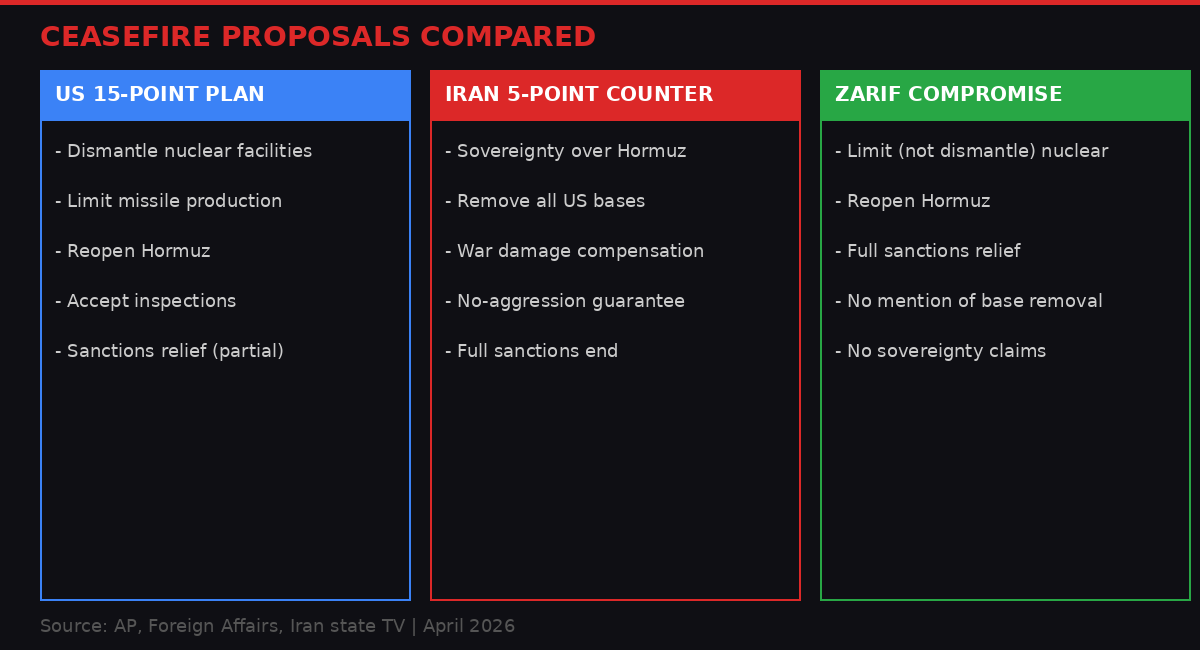
Infographic: US 15-point plan vs Iran's 5-point counter vs Zarif's compromise framework.
Day 35: The War That Refuses to Wind Down

Fires at Gulf energy infrastructure have become a near-daily occurrence. Photo: Pixabay
Friday's overnight strikes underscored the gap between Trump's claims of near-victory and the reality on the ground. Kuwait's Mina al-Ahmadi oil refinery, hit multiple times during the war, was attacked again by Iranian drones. State-run Kuwait Petroleum Corp said firefighters were battling several blazes. Separately, Kuwait confirmed "material damage" to a desalination plant - the infrastructure that produces most of the country's drinking water.
Authorities in Abu Dhabi reported falling debris at the Habshan gas facility after missile interceptions by air defense systems, with operations suspended and fires being brought under control. Saudi Arabia said it destroyed several Iranian drones. Sirens sounded in Bahrain. Israel reported incoming missiles from Iran.
The toll continues to mount. More than 1,900 people have been killed in Iran. Thirteen US service members are dead. More than 1,300 have been killed and over a million displaced in Lebanon, where Israel's ground invasion targeting Hezbollah grinds on. Nineteen have died in Israel. More than two dozen are dead in Gulf states and the occupied West Bank.
Meanwhile, 20,000 seafarers remain trapped on vessels unable to transit Hormuz. The International Maritime Organization reports 21 confirmed strikes on commercial shipping, 10 seafarers killed, and several severely injured. IMO Secretary General Arsenio Dominguez called the situation untenable, saying "fragmented responses to the crisis are no longer sufficient" and demanding humanitarian corridors for stranded crews.
Traffic through the strait has dropped 94% compared to the same period last year, according to Lloyd's List Intelligence. Saudi Arabia pumped roughly a billion barrels through alternative pipelines in March. Iraq announced it had started trucking oil across Syria to bypass the blockade entirely - an extraordinary measure that underscores how completely Iran has strangled the world's most important shipping lane.
Timeline: The Road to Saturday's Vote
- Feb 28: US and Israel launch strikes on Iran. Iran begins restricting Hormuz traffic immediately.
- Mar 1: Hormuz traffic drops. Iran imposes "toll" system, selectively allowing vessels from friendly nations.
- Mar 11: Security Council passes first Bahrain resolution (13-0, Russia/China abstaining) condemning Iranian attacks on Gulf states.
- Mar 25: Iran rejects US 15-point ceasefire plan. Iran broadcasts its own 5-point counter-proposal on state TV.
- Mar 31: Trump delivers national address claiming core objectives "nearly complete."
- Apr 1: Trump tells nation he will bomb Iran "extremely hard" for 2-3 more weeks.
- Apr 2: UK hosts 35-nation call on Hormuz security. US conspicuously absent.
- Apr 3: Bahrain circulates watered-down resolution. Zarif publishes peace terms in Foreign Affairs.
- Apr 5 (expected): Security Council vote on defensive authorization for Hormuz.
- Apr 6: Trump's deadline for Iran to reopen strait or face power grid strikes.
The Veto Calculus: Russia, China, and the Art of Abstention

The veto calculus at the Security Council is a strategic game with global consequences. Photo: Pixabay
The Security Council math is straightforward. Any of the five permanent members - the US, UK, France, Russia, and China - can kill the resolution with a single veto. The question is whether Russia and China see more benefit in blocking or allowing it.
Russia's position is complicated. Moscow has been a quiet beneficiary of the war, with European gas and oil prices surging as Gulf supplies are cut off. Russia has also been accused of sharing intelligence with Iran and allowing weapons transfers - charges Moscow denies. Nebenzia's comment that only "ending hostilities" would solve the problem is a diplomatic way of saying Russia has no interest in helping reopen a shipping lane whose closure benefits the Kremlin.
China's calculus is different but equally self-interested. Beijing is Iran's largest oil customer and has reportedly negotiated its own side deals for transit through Hormuz. Two vessels are confirmed to have paid transit fees to Iran, according to Lloyd's List Intelligence, while others were allowed through based on bilateral government agreements - almost certainly involving China. A UN resolution authorizing even defensive naval action in the strait threatens to internationalize a problem China has been solving quietly through back-channel deals with Tehran.
France's position shifted with the revised draft. Ambassador Bonnafont indicated the defensive-only language "might be acceptable," suggesting Paris will vote yes if the final text holds. The UK, which hosted Thursday's 35-nation call, is firmly behind the resolution. The US is expected to support it, though Trump's simultaneous insistence that other nations should handle Hormuz while he bombs Iran's infrastructure creates an awkward diplomatic posture.
The most likely outcome, according to three diplomats who spoke to wire services on condition of anonymity, is passage with Russian and Chinese abstention - the same pattern as the March 11 resolution. An abstention allows Moscow and Beijing to signal displeasure without blocking a measure that most of the world wants. But nothing is guaranteed. A veto from either power would be a significant escalation at the UN level and would effectively leave Hormuz without any international legal framework for reopening.
The stakes extend beyond the strait. A successful vote establishes a precedent for international action in maritime chokepoints - something both China (which controls approaches to the South China Sea) and Russia (which dominates the Turkish Straits via its Black Sea fleet) might find uncomfortable in other contexts.
The Oil Price Bomb: $109 and Climbing

Gasoline prices have surged more than 50% since the war began, hitting consumers worldwide. Photo: Pixabay
Brent crude closed Thursday at $109 per barrel. West Texas Intermediate hit $111.54. Both are up more than 50% from February 28, when the first bombs fell on Tehran. The Strait of Hormuz typically handles 20% of all globally traded oil. With 94% of that traffic gone, the world's energy markets are operating in crisis mode.
The International Energy Agency declared the situation the worst energy disruption in history, surpassing the 1973 oil embargo in both scale and speed. Strategic petroleum reserves have been tapped in the US, Europe, and Asia, but the releases have failed to arrest the price spiral. IEA Executive Director Fatih Birol warned in March that reserves could be exhausted within months if the strait remains closed.
The downstream effects are cascading through every economy on earth. US gasoline prices have crossed $4 per gallon on average - up from $2.80 in February. Jet fuel shortages are disrupting airline schedules globally. Petrochemical feedstocks are constrained, threatening production of everything from plastics to fertilizers. Food prices are climbing as transportation and fertilizer costs spike.
In Asia, the pain is acute. Japan and South Korea, which import nearly all their oil through Gulf supply chains, have activated emergency rationing protocols. India's fuel subsidy bill has exploded. China, with its side deals for Hormuz transit, is less affected but still facing higher global benchmark prices.
Trump's response has been to urge the world to "buy oil from the United States of America" - a suggestion that ignores the reality that US production, while at record levels, cannot replace Gulf output, and that US export infrastructure cannot handle the volume needed to compensate for Hormuz closure. The US is a net exporter of crude oil but lacks the refining capacity and export terminals to become the world's replacement supplier on a timeline measured in weeks.
The economic damage is not abstract. An AP-NORC poll conducted in mid-March found that 45% of Americans are "extremely" or "very" concerned about affording gasoline in the coming months, up from 30% shortly after Trump won reelection. That number has almost certainly risen since, with pump prices continuing to climb through April.
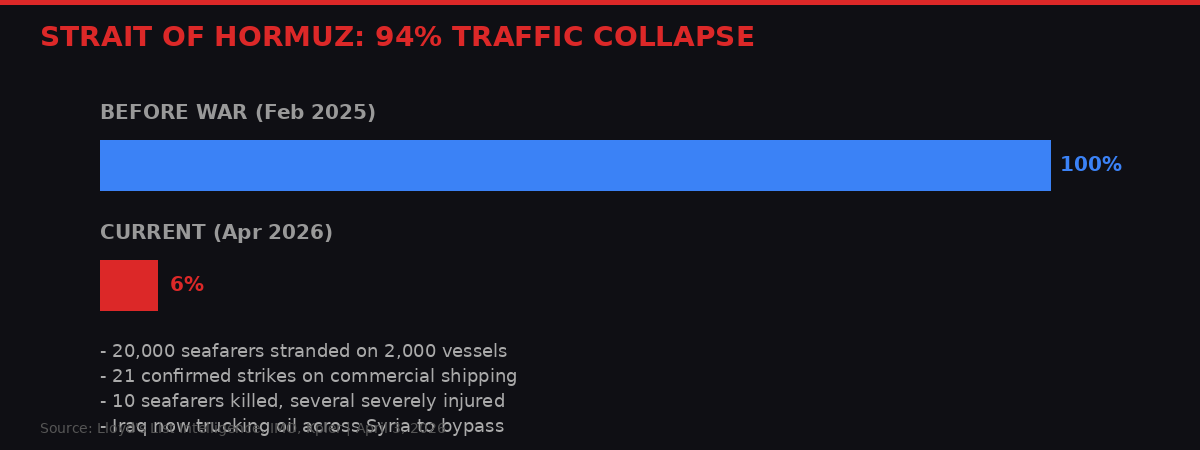
Infographic: Strait of Hormuz shipping traffic has collapsed 94% since the war began.
Trump's Monday Deadline: The Power Grid Threat

Trump's shifting deadlines and escalatory rhetoric have complicated diplomatic efforts. Photo: Pixabay
Hanging over the diplomatic maneuvering at the UN is Trump's ultimatum: reopen the Strait of Hormuz by Monday, April 6, or face US strikes on Iran's electrical power grid. The threat was first floated in late March and reiterated in Trump's Wednesday night address to the nation.
"If there is no deal, we are going to hit each and every one of their electric generating plants very hard and probably simultaneously. We have not hit their oil, even though that's the easiest target of all, because it would not give them even a small chance of survival or rebuilding. But we could hit it, and it would be gone."
The threat escalation ladder is clear. The US has so far avoided hitting Iran's oil infrastructure and power grid - the two pillars of civilian life. Bridges, military bases, nuclear facilities, and steel plants have been struck. But power plants represent a different category of target. Knocking out Iran's electrical grid would plunge 88 million people into darkness, disable water pumping stations, shut down hospitals, and create a humanitarian catastrophe of a magnitude not seen since the Iraq War.
International humanitarian law prohibits attacks on infrastructure essential for civilian survival unless it is being used for a direct military purpose. Legal scholars contacted by Reuters and the BBC have uniformly described potential power grid strikes as raising "serious questions" under the laws of armed conflict - diplomatic language for probable war crimes.
Iran's two largest steel plants, Mobarakeh and Isfahan, were already struck this week, with companies confirming shutdowns. The strikes, which Iran says were coordinated between the US and Israel, represent a significant escalation in targeting civilian economic infrastructure. Power plants would be the next step on that ladder.
The diplomatic community is treating the Monday deadline as both a genuine threat and a negotiating tactic. Trump has issued and adjusted multiple deadlines during the 35-day conflict, and his Wednesday address struck a notably softer tone than his recent social media posts. He compared the length of the Iran war favorably to World War I, World War II, Korea, Vietnam, and Iraq - an implicit acknowledgment that the public expects a timeline, even if he cannot provide one.
His plea for "patience" was a departure from the "total obliteration" rhetoric of previous weeks. Democrats seized on it. Senator Chris Murphy called the speech "grounded in a reality that only exists in Donald Trump's mind," adding: "We are losing this war. We cannot destroy all their missiles or drones, nor their nuclear program. Iran projects more power in the region than they did before the war."
Iran's Internet Blackout: 35 Days of Digital Darkness

Iran's population of 88 million has been cut off from the outside world for over five weeks. Photo: Pixabay
Perhaps the most underreported dimension of this war is Iran's internet blackout, now in its 35th day. Internet monitoring group NetBlocks reports that connectivity to the outside world remains at 1% of normal levels. More than 816 hours of near-total digital darkness for a population of 88 million people.
The blackout is not a byproduct of infrastructure damage. It is a deliberate act by the Iranian government, implemented on day one of the conflict and maintained ever since. The regime controls Iran's internet gateway and has simply shut the valves. Officials, pro-establishment journalists, and regime loyalists still have unrestricted access. Ordinary Iranians do not.
The implications are staggering. Iranians cannot access independent news about the war being fought on their soil. They cannot communicate with family abroad. They cannot verify or challenge government claims about casualties, damage, or the progress of fighting. They cannot organize protests or coordinate civilian aid. They are entirely dependent on state television for information about a conflict that has killed nearly 2,000 of their countrymen.
Some Iranians have managed to connect using Starlink satellite terminals and other methods, but access is sporadic and expensive. A few have paid large sums to get online through unofficial channels. The vast majority remain in the dark - sometimes literally, as power outages from damaged infrastructure compound the digital isolation.
NetBlocks described the situation bluntly: "The general public remain cut off from the world without vital updates and without a voice as the incident closes its fifth week." The organization has called for international pressure to restore connectivity, but with the war ongoing, no mechanism exists to force Iran's hand on domestic internet policy.
The blackout also complicates the diplomatic picture. Zarif's Foreign Affairs essay, for instance, cannot be read by the Iranian public. His proposal exists only in the international diplomatic sphere - invisible to the people whose future it would shape. The same is true for Security Council debates, UN resolutions, and international reporting on the war. Eighty-eight million people are living through a conflict they can only see through the lens their government provides.
What Saturday's Vote Means - and What It Doesn't

The economic fallout from the Hormuz closure extends far beyond oil markets. Photo: Pixabay
If the Security Council passes the Bahrain resolution Saturday, it establishes a legal framework for defensive naval action in the Strait of Hormuz. It gives countries legal cover to escort commercial vessels, clear mines, and patrol the waterway once fighting stops. It sends a signal that the international community, even divided, recognizes the Hormuz blockade as a threat to global peace and security.
What it does not do is end the war. It does not force Iran to open the strait. It does not prevent Trump from striking power plants on Monday. It does not solve the fundamental problem that two belligerents are fighting an active war in and around the most important shipping lane on earth, and neither will stop fighting because the UN passed a resolution.
The resolution's real significance may be in what it represents: the international community attempting to prepare for the day after. Mine-clearing, escort operations, insurance frameworks for commercial shipping, humanitarian corridors for stranded seafarers - all of these require legal authorization that currently does not exist. The Bahrain resolution, even in its watered-down form, provides that authorization.
Zarif's essay serves a parallel function. It is not a peace deal. It is not even a formal negotiation. It is a signal - visible to Washington, invisible to Tehran's own population - that someone on the Iranian side is thinking about how to end this. Whether that someone has the authority to act on it is the question that will determine whether this war lasts five more weeks or five more months.
The war clock is ticking. Trump's Monday deadline looms. The Security Council votes Saturday. Zarif's trial balloon hangs in the air. And in the Gulf, 20,000 sailors wait on ships going nowhere, while Iranian drones continue to find their targets in the oil fields, desalination plants, and refineries that keep the region alive.
Diplomacy has not yet found an answer. But for the first time in five weeks, it is at least asking the right questions.
Sources: Associated Press, BBC News, United Nations, Foreign Affairs, Lloyd's List Intelligence, NetBlocks, International Maritime Organization, AP-NORC polling, Kpler maritime data
Get BLACKWIRE reports first.
Breaking news, investigations, and analysis - straight to your phone.
Join @blackwirenews on Telegram