Three UN Peacekeepers Dead in 24 Hours as Israel Expands Lebanon Ground Invasion
March 31, 2026 · BLACKWIRE GHOST Bureau · Beirut / Tyre / New York

UN peacekeepers in southern Lebanon face escalating danger as Israeli forces push deeper into the country. Photo: Pexels
Three United Nations peacekeepers are dead and four more wounded after two separate explosions hit UNIFIL positions in southern Lebanon within 24 hours. The deaths come as Israeli Prime Minister Benjamin Netanyahu orders the military to expand its ground invasion toward the Litani River, and the broader US-Israeli war on Iran enters its fifth week with no ceasefire in sight.
The deadliest period for UN forces in Lebanon since the 2006 war has arrived without warning or apology. Between Sunday evening and Monday morning, blue helmets were killed by explosions whose origins remain under investigation - a diplomatic way of saying that in the crossfire between Israeli mechanized columns and Hezbollah resistance fighters, the 10,000 peacekeepers caught in the middle have become collateral.
UNIFIL has operated in southern Lebanon since 1978. It has never faced a week like this one. The force's mandate - to monitor the cessation of hostilities, accompany the Lebanese Armed Forces, and ensure humanitarian access - has become functionally impossible as Israeli armor rolls through the very terrain UNIFIL was mandated to watch over.
What follows is BLACKWIRE's full reconstruction of the past 72 hours in southern Lebanon, the diplomatic fallout, and where this second front in the broader Middle East war is heading.
The Dead: What Happened at Aadshit al-Qusayr and Bani Hayyan

Explosions have destroyed UNIFIL vehicles and positions in southern Lebanon. Photo: Pexels
The first death came Sunday night. A projectile - UNIFIL's word, deliberately vague - struck a peacekeeping position near the village of Aadshit al-Qusayr in the Nabatieh governorate. One peacekeeper was killed instantly. Another was critically injured. UNIFIL said it did not know the origin of the projectile and launched an investigation.
Indonesia's Ministry of Foreign Affairs confirmed within hours that the dead soldier was Indonesian. Three additional Indonesian peacekeepers were wounded in what Jakarta described as "indirect artillery fire" - terminology that points toward a bombardment rather than a targeted strike, though the distinction matters little to the dead.
"Indonesia strongly condemns the incident and calls for a thorough and transparent investigation. Indonesia reiterates its condemnation of Israel's attacks in southern Lebanon and calls on all parties to respect Lebanon's sovereignty and territorial integrity."
- Indonesian Ministry of Foreign Affairs, March 30, 2026
The second incident came Monday morning. Two more peacekeepers were killed when "an explosion of unknown origin destroyed their vehicle" near the village of Bani Hayyan, roughly 12 kilometers northwest of the first attack site. A third peacekeeper was severely injured. A fourth was also wounded. UNIFIL's statement was terse: "We reiterate that no one should ever have to die serving the cause of peace."
The nationalities of the second pair of dead peacekeepers had not been officially confirmed at the time of publication. UNIFIL's force comprises soldiers from 50 contributing countries, with Indonesia, Italy, France, Spain, India, Ghana, and Nepal among the largest contingents. Every troop-contributing nation is now recalculating the risk equation of keeping their soldiers in what has become an active invasion zone.
The week's toll: three dead, at least five wounded. And that number is climbing. On March 7, three Ghanaian soldiers were wounded by gunfire in a border town. Smaller incidents - positions damaged by shrapnel, observation towers rendered inoperable by nearby strikes - have gone unreported in the broader noise of a war that now stretches from the Persian Gulf to the Mediterranean coast.
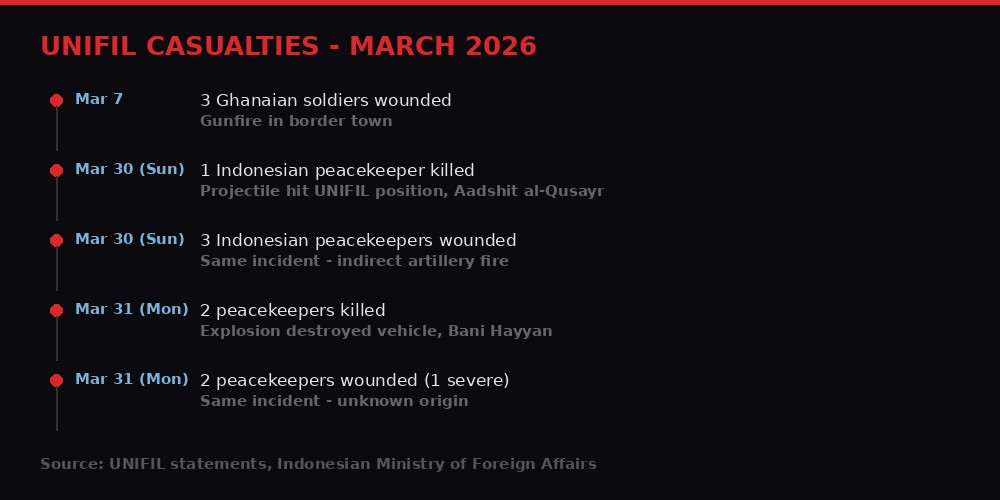
BLACKWIRE infographic: UNIFIL casualty incidents documented in March 2026.
Netanyahu's Expanding Buffer Zone: The Litani Push

Israeli forces have pushed deep into southern Lebanon with multiple divisions. Photo: Pexels
The peacekeeper deaths are a direct consequence of a strategic decision made in Jerusalem. On Sunday, March 29, Netanyahu stood at the Northern Command headquarters and announced what field commanders had already begun executing: a further expansion of the "security buffer zone" in southern Lebanon.
"I have just instructed to further expand the existing security buffer zone. We are determined to fundamentally change the situation in the north."
- Benjamin Netanyahu, March 29, 2026
Translation: Israeli forces are no longer conducting limited cross-border raids. They are occupying southern Lebanon up to the Litani River - a distance of roughly 30 kilometers from the Israeli border. This replicates, almost exactly, the Israeli occupation zone that existed between 1982 and 2000, the same occupation that gave birth to Hezbollah in the first place.
Al Jazeera's Obaida Hitto, reporting from the southern city of Tyre, described the Israeli advance as a "big strategic change." Israeli troops have reached a tributary of the Litani River south of the town of Qantara on the eastern front, near al-Muhaysibat. "This tributary that they've reached south of Qantara is just a few kilometres, and in some places, just a few hundred metres away from the actual Litani River," Hitto reported. "So this is going to turn into a big fight."
The offensive operates across multiple axes. On the western coastal highway, Israeli forces have advanced approximately 8 kilometers south of Tyre. In the east, they have reached the Litani tributary. In the central sector, five Israeli divisions are active. From Beirut's southern suburbs, Israeli jets continue to strike what the military claims are Hezbollah military sites - claims made without evidence and dismissed by journalists on the ground who say no military targets remain in areas that have already been flattened.
Zeina Khodr, Al Jazeera's correspondent in Beirut, put it plainly: "Many will say there are no military targets left in this area. This is just about collective punishment and putting pressure on Hezbollah."
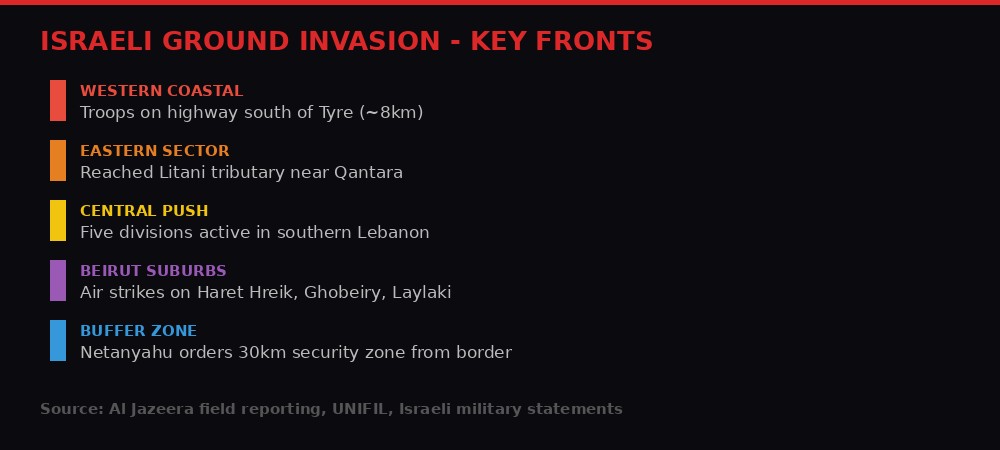
BLACKWIRE infographic: Key axes of the Israeli ground offensive in southern Lebanon as of March 31, 2026.
The Wider War: Lebanon as Iran's Second Front

Smoke rises over Beirut's southern suburbs following Israeli strikes. Photo: Pexels
Lebanon did not choose this war. Hezbollah entered it on March 2, launching rockets toward Israeli territory after the United States and Israel assassinated Iranian Supreme Leader Ali Khamenei on February 28 - the opening salvo of what has become the most destructive conflict in the Middle East since 2003.
Before that date, Hezbollah had not fired on Israel since a ceasefire took effect in November 2024. The ceasefire was holding, despite near-daily Israeli violations. Hezbollah's decision to join the Iran war - responding to what it considered an existential attack on the axis of resistance - made Lebanon a second front in a conflict that has now engulfed the entire region.
The consequences are staggering. The Lebanese Ministry of Public Health reports 1,238 people killed since March 2. Among them: 124 children. More than 3,500 wounded. At least 11 journalists killed, according to the Committee to Protect Journalists. Nine paramedics. An unknown number of rescue workers, though the word "unknown" does the heaviest lifting in this war.
The displacement is catastrophic. More than 1.2 million people have been forced from their homes - roughly one-quarter of Lebanon's population. The UN describes a "mounting humanitarian crisis." That phrasing understates what is happening. This is the deliberate depopulation of southern Lebanon, accomplished through mass forced displacement orders, sustained bombardment of civilian infrastructure, and a ground invasion designed to make return impossible.
On Saturday, a targeted Israeli airstrike in the town of Jezzine killed three journalists: Ali Shoeib, a veteran correspondent for Hezbollah's Al-Manar TV; Fatima Ftouni of Al Mayadeen; and her brother, cameraman Mohammad Ftouni. Israel's military claimed, without evidence, that Shoeib was a Hezbollah intelligence operative. It did not comment on the killing of the Ftouni siblings. They were buried Sunday in a temporary graveyard - because their hometowns are inside the occupation zone.
"If it is indeed confirmed that the journalists in question were deliberately targeted by the Israeli army, then this is extremely serious and a blatant violation of international law."
- Jean-Noel Barrot, French Foreign Minister, March 30, 2026
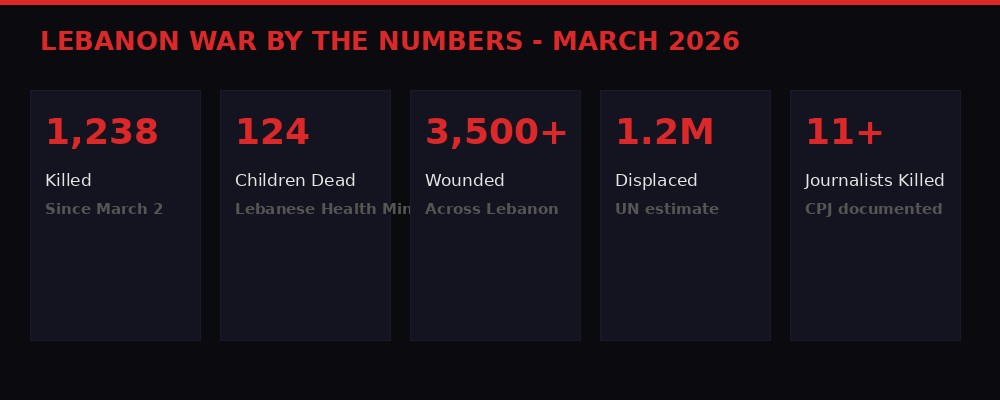
BLACKWIRE infographic: Lebanon war casualty and displacement figures as of March 31, 2026.
Global Response: France Demands Emergency UN Session

France has requested an emergency UN Security Council session over attacks on peacekeepers. Photo: Pexels
The killing of UN peacekeepers carries a different diplomatic weight than the killing of Lebanese civilians. It shouldn't, but it does. Peacekeepers are seconded by sovereign nations. When you kill one, you are not just killing a soldier - you are attacking the troop-contributing country's flag.
UN Secretary-General Antonio Guterres called on "all parties to the conflict to abide by international law and ensure the security of all UN personnel." His statement, posted after the first Indonesian death, carried the practiced helplessness of an institution that has been unable to prevent a single escalation in this war.
France moved faster. Foreign Minister Jean-Noel Barrot requested an urgent meeting of the UN Security Council, describing attacks on UNIFIL positions as "unacceptable and unjustifiable." Paris has particular interest here: French peacekeepers serve in UNIFIL, and Macron has positioned France as the primary European voice calling for negotiations.
Spain's Prime Minister Pedro Sanchez, who has been among Israel's most vocal critics in Europe, said "a new red line was crossed." He called on the Israeli government to end its military operations entirely. "Attacks on UN peacekeeping missions are an unjustifiable aggression against the entire international community," Sanchez wrote.
Ireland's Taoiseach Micheal Martin warned of "shocking escalation of violence that has injured a number of peacekeepers in recent days." Ireland also contributes troops to UNIFIL and has maintained a consistently critical stance toward Israeli operations in Lebanon.
Notably absent from the immediate condemnations: the United States and the United Kingdom. Washington, which is prosecuting the broader war on Iran alongside Israel, has not commented on the UNIFIL deaths. London, which deployed 200 troops to Bahrain and has moved HMS Prince of Wales to the region, has also been silent.
The pattern is familiar from the Gaza war. When Israeli forces killed their own hostages, there were investigations. When they killed foreign aid workers from World Central Kitchen, there were apologies. When they kill Palestinian civilians by the thousand, there are "concerns." The diplomatic response scales not with the severity of the act but with the nationality of the victim. Three UN peacekeepers are dead, and the investigation into who killed them will proceed at the pace that best serves Israel's operational timeline.
The Lebanese Army: Caught Between Occupation and Irrelevance

The Lebanese army has lost soldiers at clearly marked checkpoints hit by Israeli strikes. Photo: Pexels
On Monday, an Israeli strike killed a Lebanese soldier at a military checkpoint in southern Lebanon. The checkpoint was clearly marked as a Lebanese army position. Al Jazeera's Hitto noted that the past 48 hours have been "marked by several incidents involving UNIFIL and the Lebanese military."
The Lebanese Armed Forces (LAF) have long been caught in an impossible position. Underfunded, outgunned, and politically fractured, the army cannot challenge either Hezbollah or Israel. The Lebanese government has outlawed Hezbollah military activity - a move that has zero practical impact on the ground but satisfies a diplomatic checkbox for Western nations. Lebanon has also said it wants direct talks with Israel. Israel has not responded with anything beyond more airstrikes.
Defence Minister Israel Katz said last week that displaced residents of southern Lebanon will not be able to return to their homes until northern Israel is safe. Since Hezbollah has not been defeated, and since the broader Iran war shows no sign of ending, this condition is functionally indefinite. Southern Lebanon is under open-ended occupation. The Lebanese army has no capacity to change that. UNIFIL's mandate has been rendered meaningless by the very situation it was created to prevent.
Hezbollah chief Naim Qassem laid down his position on March 25: "Either surrender and give up our land, or inevitable confrontation and resistance." He rejected negotiations under fire as equivalent to surrender. The group continues to launch missiles into northern Israel while clashing with Israeli ground forces. On Monday, Hezbollah claimed it had targeted an Israeli naval base in Haifa with "a barrage of advanced missiles." Separately, a missile struck the Bazan oil refinery in Haifa - the second hit on the facility since the war began. A fire broke out but was contained, with no casualties reported.
The cycle is self-reinforcing. Israel invades to stop Hezbollah rockets. The invasion provokes more rockets. The rockets justify deeper invasion. The deeper invasion displaces more civilians and kills more peacekeepers. The peacekeepers' deaths provoke diplomatic outcry that changes nothing. Repeat.
Iraq: The Proxy Launchpad Nobody Can Control

Iran-aligned groups in Iraq are launching dozens of operations daily against Gulf states. Photo: Pexels
While the world focuses on Lebanon and Iran proper, a parallel war has erupted from Iraqi territory. Iran-aligned armed groups operating under the banner of the Islamic Resistance in Iraq are launching between 21 and 31 operations daily against targets across the Gulf and Jordan, according to Iraqi Major-General (ret.) Majed al-Qaisi. Since February 28, these groups have carried out more than 454 cumulative operations.
Six Arab nations - Saudi Arabia, the UAE, Qatar, Kuwait, Bahrain, and Jordan - issued an unprecedented joint condemnation last week, holding Baghdad directly responsible for failing to control armed groups operating within its borders. They invoked both UN Security Council Resolution 2817 and Article 51 of the UN Charter, the self-defense clause. That language is not diplomatic posturing. It is a legal foundation for military action against Iraqi territory.
Baghdad responded with a statement that would be comic if the stakes were lower: the Iraqi government "categorically rejected" the use of its territory for attacks on Gulf states and expressed "full readiness" to receive evidence of the attacks. This from a government that cannot drive down the highway from the Green Zone to the airport without an armed escort.
The strategy is transparent. Iran uses Iraqi proxies to bypass international resolutions and avoid direct legal responsibility. As analyst Khaled al-Jaber of the Middle East Council on Global Affairs explained: "Iran is not withdrawing from the confrontation; rather, it is redistributing it through tools that are less politically costly."
Former Kuwaiti MP Ahmed al-Mulaifi warned that if Trump follows through on threats of a ground invasion of Iran, Tehran could activate Iraqi proxies to open land fronts across the Kuwaiti and Saudi borders. The proxy launchpad is not a sideshow. It is the mechanism through which a two-party war becomes a regional conflagration.
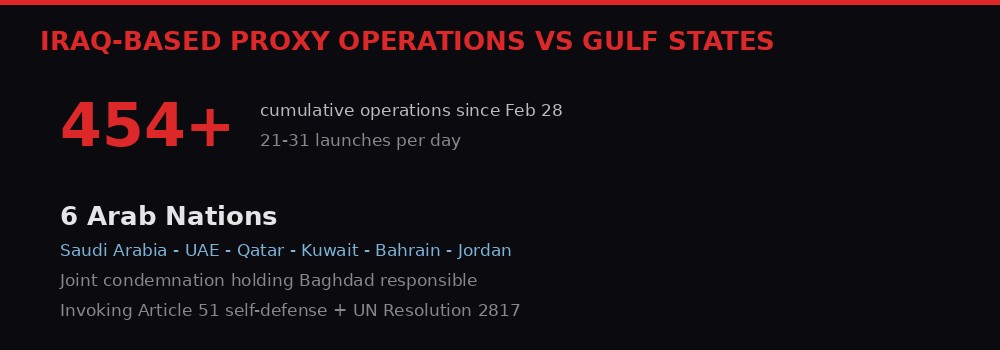
BLACKWIRE infographic: Iraqi proxy operations against Gulf states since the start of the Iran war.
Iran War Update: Day 31 and the Shadow of Ground Invasion

Oil prices have surged past $116 a barrel as the Strait of Hormuz remains effectively closed. Photo: Pexels
The US-Israeli war on Iran entered its 31st day on March 30 with no ceasefire, no credible negotiating framework, and escalating threats from Washington. Trump told the Financial Times on Sunday that he wants to "take the oil in Iran" by seizing Kharg Island, which processes 90 percent of Iran's crude exports. "Maybe we take Kharg Island, maybe we don't. We have a lot of options," he said. "Some stupid people back in the US" oppose the idea, he added.
In a social media post on Monday, Trump threatened to "blow up and completely obliterate" Iran's electric generating plants, oil wells, Kharg Island, and "possibly all desalinization plants" if a deal is not reached and the Strait of Hormuz is not reopened. Legal experts described this as textbook collective punishment and a war crime. "You can't deliberately harm an entire civilian population to pressure its government," said Yusra Suedi, assistant professor in international law at the University of Manchester.
The Pentagon is preparing for limited ground operations. The Washington Post reported Saturday that Defense Department plans include raids on Kharg Island and coastal sites near the Strait of Hormuz. The USS Tripoli delivered approximately 3,500 additional troops to the Middle East. Combined with the Boxer Amphibious Ready Group and 2,000 soldiers from the 82nd Airborne Division, nearly 7,000 additional US forces have been deployed since the war began.
Military analysts note this is insufficient for a full-scale invasion. The 2003 Iraq invasion required 150,000 US soldiers. But it is enough for what John Phillips, a British military analyst, calls "limited, high-intensity operations" - island seizures, heliborne raids on missile batteries, fast-boat neutralization along the Hormuz coast. "This could result in high casualties and could be economically crippling for Tehran," Phillips told Al Jazeera.
Iran's parliament speaker Mohammad Bagher Ghalibaf responded directly: "Our men are waiting for the arrival of the American soldiers on the ground to set them on fire and punish their regional allies once and for all."
Brent crude topped $116 a barrel on Monday. The Strait of Hormuz remains effectively closed, with only Chinese, Indian, and Pakistani-flagged vessels granted safe passage. Iran's Health Ministry reports 2,076 killed since February 28, including 216 children. At least 25 people have been killed across GCC states. The April 6 deadline Trump set for escalation against Iran's power grid looms.
The Europe Angle: Proxy Terrorism Arrives on European Soil

European capitals face a rising tide of Iran-linked proxy terrorism. Photo: Pexels
The Iran war is not contained to the Middle East. On Saturday, French police arrested three suspects - including minors - who attempted to bomb the Bank of America headquarters near the Champs-Elysees in Paris using a homemade explosive device consisting of an ignition system and five liters of fuel. Two more adults were arrested Monday. Five suspects are now in custody.
The first detainee, who claimed to be a Senegalese minor, told police he was recruited through Snapchat to carry out the bombing for 600 euros. French Interior Minister Laurent Nunez said authorities were investigating a link to the Iran war because the modus operandi was "in every respect similar" to recent attacks in the Netherlands and Belgium claimed by a group called Harakat Ashab al-Yamin al-Islamia (Islamic Movement of the Companions of the Right).
The same group claimed responsibility for an attack last week in London's Golders Green neighborhood, where four ambulances belonging to a Jewish charity were set on fire. Nunez described the operational pattern: "Typically, intelligence services of this country [Iran] operate in this way. They use proxies, a series of subcontractors, often common criminals, to carry out highly targeted actions aimed at US interests, the interests of the Jewish community, or Iranian opposition figures."
This is the war coming home to Europe. Not as a refugee crisis - that's already underway, with 1.2 million displaced in Lebanon alone - but as targeted operations against Western economic and communal infrastructure. The use of minors recruited via social media for 600 euros tells you everything about the scale: this is not a sophisticated intelligence operation. It is the weaponization of disposable young men who do not understand they are being used as Iranian foreign policy tools.
If the Strait of Hormuz remains closed and the war extends into April, expect more of this. The attacks are cheap, deniable, and achieve disproportionate psychological impact. For Iran, every firebombed ambulance in London and every failed car bomb in Paris is a reminder to European governments: you are not safe from this war either.
Timeline of Escalation: Lebanon Front, March 2-31
February 28
US and Israel launch strikes on Iran. Supreme Leader Khamenei assassinated.
March 2
Hezbollah fires rockets into northern Israel in retaliation. Israeli strikes across Lebanon begin. Intensified conflict displaces hundreds of thousands.
March 7
Three Ghanaian UNIFIL peacekeepers wounded by gunfire in southern Lebanon border town.
March 22
Israel strikes bridges across the Litani River. Lebanese President Aoun calls it a "prelude to ground invasion."
March 25
Hezbollah chief Qassem calls for "national unity" and rejects negotiations under fire. Israel announces plans for expanded buffer zone. Far-right minister Smotrich calls for annexation of southern Lebanon.
March 28
Three journalists killed in targeted Israeli airstrike in Jezzine. Nine paramedics killed the same day.
March 29
Netanyahu orders military to expand ground invasion. Israeli troops reach Litani tributary near Qantara. Five divisions active in southern Lebanon.
March 30 (Sunday)
Indonesian UNIFIL peacekeeper killed by projectile at Aadshit al-Qusayr. Three more Indonesians wounded. Lebanese soldier killed at marked checkpoint.
March 31 (Monday)
Two more UNIFIL peacekeepers killed in vehicle explosion near Bani Hayyan. Two more wounded. Haifa oil refinery struck for second time. France requests emergency UNSC session.
What Comes Next: The Litani Line and the Question Nobody Wants to Answer

The escalation cycle in southern Lebanon shows no signs of breaking. Photo: Pexels
The question nobody in any Western capital wants to answer is straightforward: what is the endgame?
Israel's stated goal is a 30-kilometer buffer zone. Hezbollah's stated position is that it will fight "without limits" to prevent permanent occupation. UNIFIL's mandate calls for monitoring a cessation of hostilities that does not exist. The Lebanese army cannot enforce anything. The US is busy prosecuting its own war against Iran and has shown no interest in restraining Israel's Lebanon operations.
Security analyst Ali Rizk warned: "We can anticipate that Netanyahu is going to go to great lengths against Lebanon, including, quite likely, with a large-scale ground offensive. And I think that unfortunately it's quite likely that the Americans are on board or do not stand against the Israeli escalation in the Lebanese arena."
The Litani River is not a natural stopping point. It is a political fiction left over from UN Resolution 1701, passed after the 2006 war. When Israeli forces reach it - and they will, given current momentum - there is nothing to prevent the buffer zone from expanding further. Smotrich has already called for annexation. Netanyahu has described this as "fundamentally changing the situation." These are not the words of a government planning to withdraw.
For UNIFIL, the options narrow to three: stay and accept casualties, withdraw and abandon the mandate, or demand a ceasefire that nobody with weapons is prepared to honor. France's emergency Security Council request will produce a session. The session will produce a statement. The statement will change nothing. Three peacekeepers will still be dead.
Egypt's President Abdel Fattah el-Sisi called on Trump to stop the war on Iran. Pakistan is hosting talks in Islamabad. The G7 said it is ready to take "necessary measures" to stabilize energy markets. None of these efforts address the core dynamic: the war is expanding because the parties prosecuting it want it to expand. Israel wants a security zone in Lebanon. Iran wants to demonstrate that attacks on its territory carry consequences. The United States wants Kharg Island's oil. Everyone else is negotiating with people who are not listening.
Three UN peacekeepers are dead. The investigation will proceed. The war will continue. That is the situation on the ground in southern Lebanon on March 31, 2026.
Sources: UNIFIL official statements; Indonesian Ministry of Foreign Affairs; Al Jazeera field reporting (Obaida Hitto, Tyre; Zeina Khodr, Beirut); Lebanese Ministry of Public Health; Committee to Protect Journalists; French National Anti-Terrorism Prosecutor's Office (PNAT); BBC News; Financial Times (Trump interview); Washington Post; Reuters; UN Secretary-General's office; Spanish PM office; Irish PM office; French Foreign Ministry.
Get BLACKWIRE reports first.
Breaking news, investigations, and analysis - straight to your phone.
Join @blackwirenews on Telegram