Val Kilmer Returns From the Dead: AI Resurrects the Actor in 'As Deep As The Grave'
An indie film is putting Val Kilmer on screen one last time using generative AI - with his family's full blessing. The precedent it sets for dead celebrities, digital ownership, and Hollywood labor will last for decades.
BLACKWIRE / Generated visual - Val Kilmer AI resurrection context art
Val Kilmer died in April 2025, having spent years diminished by the ravages of throat cancer. He couldn't speak properly in his final decade. He couldn't make it to set for the film that had cast him. But according to a report in Variety, he will still appear on screen - every inch the actor, voiced and faced - in a feature film called As Deep As The Grave, set for release in 2026.
The method: generative AI. The authorization: his children and estate. The implications: enormous.
This isn't the first time Hollywood has used AI or CGI to resurrect or rejuvenate an actor. But the Kilmer case is different from everything that came before in ways that matter. It's consensual, openly disclosed, deeply personal, and - critically - it's happening in the post-SAG-AFTRA era, when AI actors and digital likenesses are now an explicit part of union contracts. The ground rules are being written right now, and this film is one of the first test cases.
The Film: A Canyon, A Priest, and a Six-Year Journey
Timeline: The evolution of AI actors in Hollywood, 2016-2026 / BLACKWIRE infographic
As Deep As The Grave is based on the true story of Southwestern archaeologists Ann and Earl Morris, tracking their excavations in Canyon de Chelly, Arizona in the early 20th century - a place of deep significance to the Navajo people. Kilmer was cast as Father Fintan, a Catholic priest with Native American heritage who serves as a spiritual anchor in the story.
The role was designed around him. Writer-director Coerte Voorhees wanted Kilmer specifically, drawn to the actor's own Native American roots and his long personal connection to the American Southwest where he made his home in New Mexico. Voorhees has described building the character around Kilmer's identity and life experience rather than treating the casting as interchangeable.
"He was the actor I wanted to play this role. It was very much designed around him. It drew on his Native American heritage and his ties to and love of the Southwest. I was looking at a call sheet the other day, and we had him ready to shoot. He was just going through a really, really tough time medically, and he couldn't do it."
- Coerte Voorhees, writer and director of As Deep As The Grave, via Variety
Production spanned six years, interrupted by COVID shutdowns and budget constraints that forced the team to cut scenes featuring Kilmer's character. When they reviewed the footage, they realized those scenes were structurally essential. Kilmer was gone. But the technology had caught up.
The film's cast includes Tom Felton (Harry Potter), Abigail Lawrie (Tin Star), Wes Studi, and Abigail Breslin. Kilmer - or rather, an AI-generated facsimile of him - appears in what the filmmakers describe as "a significant part" of the finished film. The production used both younger archival images of Kilmer, many provided by his family directly, and footage from his later years. This creates something genuinely unusual: an AI composite that tries to show a character across different stages of life, mirroring the actor's own physical decline.
The character, Father Fintan, suffers from tuberculosis in the film. The parallel with Kilmer's own medical condition is not lost on the production. His damaged voice - the result of the tracheotomy he underwent to treat throat cancer - becomes, in the context of the film, part of the character's authentic texture.
What the Estate Said - and Why It Matters
AI actor consent: who holds the power and what the frameworks look like / BLACKWIRE infographic
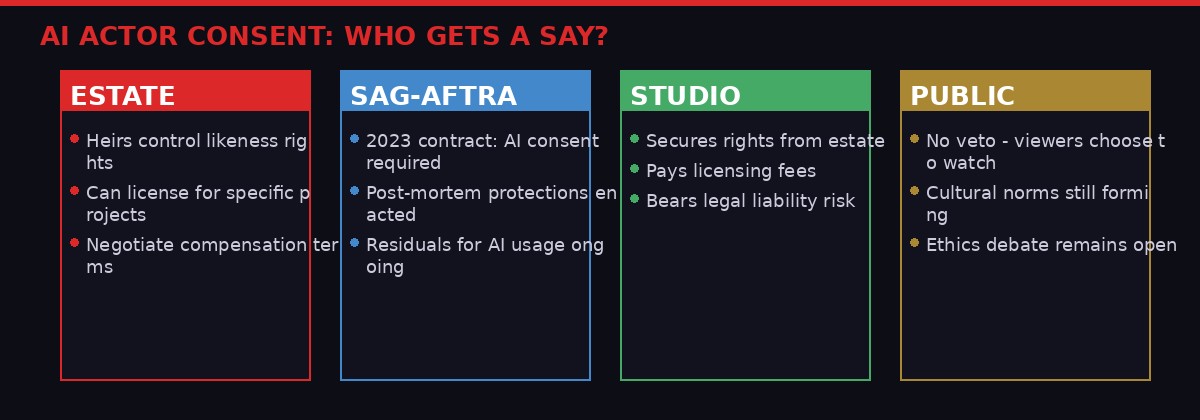
The consent story is the most legally significant part of this. Kilmer's daughter Mercedes provided a public statement supporting the film. His son Jack is also described as supportive. The production followed SAG-AFTRA guidelines and compensated the estate for Kilmer's appearance.
"He always looked at emerging technologies with optimism as a tool to expand the possibilities of storytelling. This spirit is something that we are all honoring within this specific film, of which he was an integral part."
- Mercedes Kilmer, statement via Variety
This is a very different legal and moral situation from unauthorized AI deepfakes that repurpose an actor's likeness without permission. The Kilmer family actively contributed archival materials, reviewed the production's approach, and provided a formal statement of support. Their cooperation is not incidental - it's the structural basis that makes the project legally defensible.
Under California law, a deceased person's publicity rights persist for 70 years after death. New York, Illinois, and many other states have enacted or expanded similar protections. The estate is the legal rightholder. When the estate consents, the project has legal standing. When it doesn't - and we've seen numerous cases of AI-generated celebrity content created without consent - the legal exposure is substantial.
The SAG-AFTRA contracts negotiated in 2023, after the historic strike that partly centered on AI protections, require explicit consent before a studio can use AI to replicate a living actor's likeness, voice, or performance. Post-mortem protections require estate consent. Residuals for AI usage of a performer's likeness are now a defined line item in guild contracts. The Grave production worked within this framework, which is precisely what gives it a different character than the wave of unauthorized AI actor content spreading across YouTube and social media.
This doesn't resolve every ethical question. But it does establish a template: estate consent plus guild compliance plus transparent disclosure equals a legally navigable path forward.
The Technical Machinery Behind the Resurrection
The five-stage pipeline for AI actor resurrection in modern film production / BLACKWIRE infographic
The film doesn't disclose exactly which AI vendors or software platforms it used. That's typical - productions are tight-lipped about their post-production AI workflows partly for competitive reasons and partly because the tools are still evolving rapidly. But the general pipeline is well-documented from similar productions and from tech company publications.
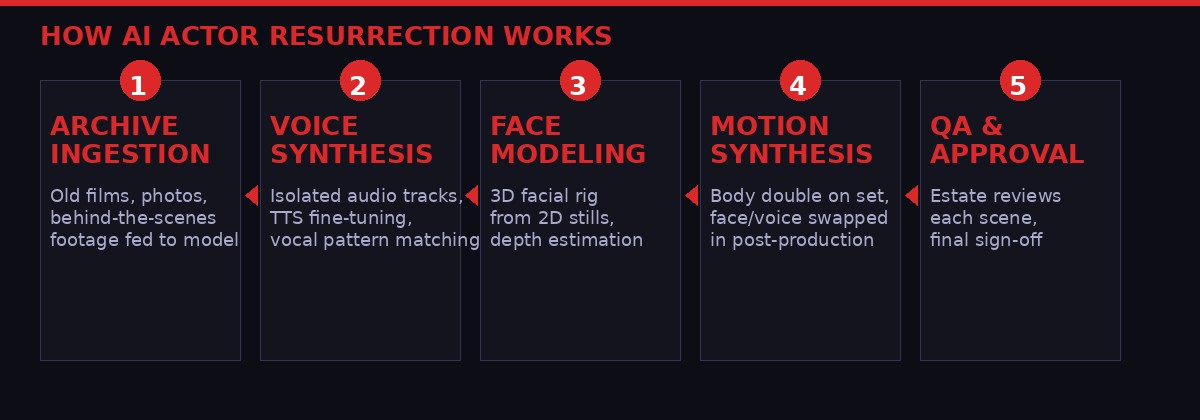
Archival ingestion: The process begins with as much raw material as possible. For Kilmer, this includes decades of film footage, behind-the-scenes recordings, promotional interviews, and in this case family-provided personal photos and video that would not otherwise be accessible. This archive feeds training or fine-tuning data for the face model.
Voice synthesis: Kilmer had already established a precedent here. For Top Gun: Maverick in 2022, he worked with a company called Sonantic to create an AI-powered speaking voice when his natural voice had been severely damaged by the tracheal procedure. Sonantic - later acquired by Spotify - used isolated vocal tracks from his earlier films combined with hours of Kilmer speaking in a variety of registers. The result was a voice that could say new words in Kilmer's vocal style. For Grave, the team uses a similar approach, drawing on his distinct vocal pattern while incorporating the hoarser, more damaged quality of his later voice to match the tubercular character.
Face modeling and motion synthesis: A body double performs on set. In post-production, the AI system maps Kilmer's face onto the double's performance, adjusting for lighting, angle, and expression. The more archival footage you have of a subject from every angle, the better the model performs. Kilmer's extensive film career provides an unusually rich training corpus.
Quality review: The estate reviews scenes. This step is not optional - it's both a legal requirement under the terms of their agreement and a moral commitment from the production. Mercedes Kilmer and her brother are described as actively engaged with the filmmaking process, not merely passive licensors.
Val Kilmer previously used AI voice synthesis to reprise his role as Iceman in Top Gun: Maverick (2022) while still alive, after his throat cancer treatment destroyed his natural voice. That prior consent and the existing trained voice model provide a baseline that the Grave production builds upon - making this arguably a continuation of something Kilmer himself explicitly authorized, not a posthumous imposition.
The Long History of Hollywood Resurrecting the Dead
The shock at AI actor resurrection is understandable - but it should be calibrated. Hollywood has been doing versions of this for years. What's changed is the cost, the fidelity, and the scale at which it's now possible.
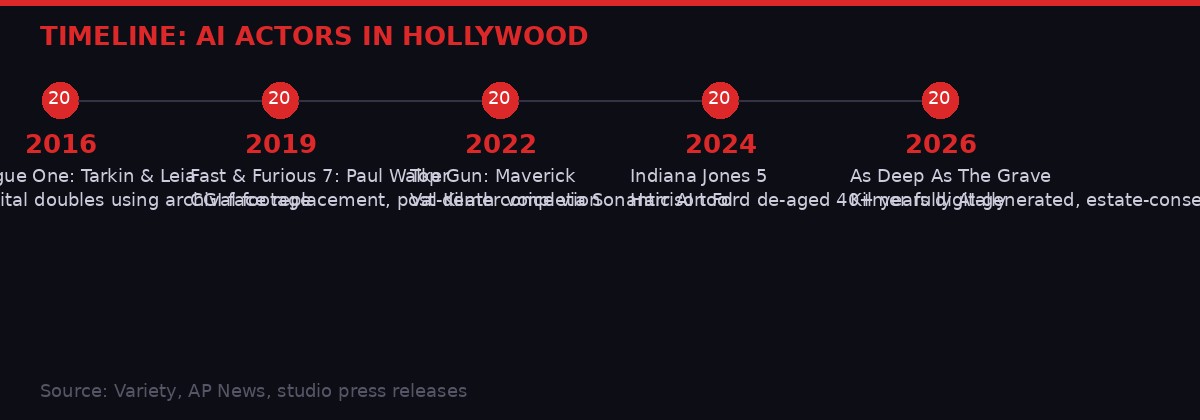
2016: Rogue One - A Star Wars Story. The film used digital doubles for Grand Moff Tarkin (played by the late Peter Cushing, who died in 1994) and a young Princess Leia (Carrie Fisher, who died during production). The Tarkin recreation was particularly uncanny and triggered significant public debate about the ethics of the practice. Cushing's estate gave consent, but critics argued consent from family doesn't resolve the deeper question of whether a deceased person would have approved being used in this way.
2019: Fast and Furious 7. Paul Walker died mid-production. The studio completed the film using his brothers as body doubles and CGI face replacement. The scene where his character drives into the sunset was explicitly designed as an in-universe farewell. Public response was emotional and largely positive, which set a cultural template: death-in-production resurrections feel different from premeditated casting of deceased actors.
2023: Indiana Jones and the Dial of Destiny. Harrison Ford was digitally de-aged 40 years for a lengthy opening sequence set during World War II. No one died. No estate was involved. This was living-actor de-aging, which has different ethical dimensions but uses much of the same technology. Ford was paid for his performance, gave consent, and was on set for the original capture.
The Kilmer case sits in a new category: premeditated casting of an actor known to be dying, followed by posthumous AI performance generation with estate consent. It's not a death-in-production fix. It's not unauthorized CGI de-aging. It's a deliberate production decision, made with the knowledge that AI would be needed to complete the role after the actor's death.
That deliberateness is what makes it legally and ethically complex in new ways. The production had the foresight - and arguably the calculation - to lock in consent while Kilmer was still alive and cogent enough to understand what he was authorizing. That preemptive consent is the strongest form of protection the production has.
SAG-AFTRA, Digital Rights, and the Labor Question
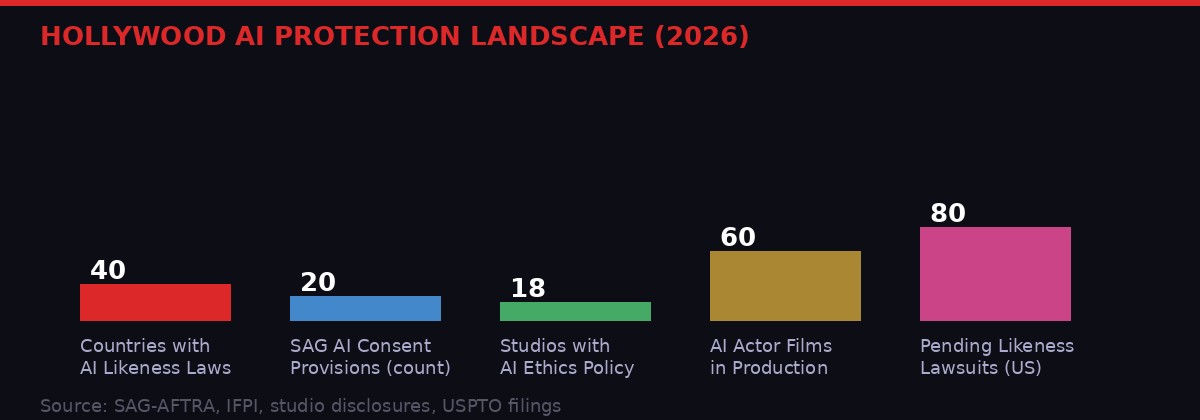
Hollywood's AI protection landscape in numbers: laws, contracts, and pending litigation / BLACKWIRE infographic
The 2023 SAG-AFTRA strike was partly fought over exactly these questions. Actors demanded - and won - contractual provisions that require studios to obtain explicit consent before using AI to replicate a performer's likeness, voice, or performance. They also won provisions covering what happens after an actor's death: studios must negotiate with estates, pay compensation, and cannot use an actor's AI likeness in roles or contexts they would have objected to in life.
The provisions are imperfect. They apply to SAG members and signatory studios. They don't cover non-union productions. They don't govern the enormous volume of unauthorized AI content created by non-studio actors online. And the post-mortem provisions rely heavily on what an estate thinks the deceased would have wanted, which is necessarily speculative.
But they represent a serious first attempt at creating legal infrastructure for a world in which digital likenesses can be generated at will. The Kilmer case is a test of whether that infrastructure actually works in practice - not just on paper.
The production's compliance with SAG guidelines is notable because As Deep As The Grave is an indie film. It doesn't have the resources of a Disney or Warner Bros. It had to navigate shutdowns, budget cuts, and six years of production challenges. The fact that it still chose to operate within the consent framework rather than cutting corners is meaningful. It suggests the framework has real teeth - or at least that some productions take it seriously.
"His family kept saying how important they thought the movie was and that Val really wanted to be a part of this. He really thought it was important story that he wanted his name on. It was that support that gave me the confidence to say, okay let's do this."
- Coerte Voorhees, director, via Variety
The compensation question is less transparent. The Variety report confirms the estate was compensated under SAG guidelines, but doesn't disclose figures. For a low-budget indie production, the amounts may be modest. For a major studio production using a bankable star's likeness, the numbers would be very different. This will become a pressure point as the practice scales - estates will want royalty-style arrangements, not one-time buyouts, as AI likenesses become perpetually useful assets.
The Second-Order Effects: What This Normalizes
The Kilmer case is being reported as a heartwarming story of a director fulfilling a dying actor's final wish. And on one level, it is. But it also normalizes something with serious second-order consequences that deserve examination.
It establishes that family consent is sufficient authorization. But families don't always agree. Estates have conflicts. Children disagree with each other. What happens when a deceased actor's spouse gives consent and their children object? The legal framework around this is not resolved.
It proves the technology is production-ready at indie budget levels. If a low-budget film with cash constraints can produce a convincing AI performance from a deceased actor, the barrier to doing this has collapsed. Studios with larger budgets and larger libraries of archival footage will be able to do this with better results. The cost curve is one-directional.
It creates asset value in celebrity archives. If an actor's decades of film, audio recordings, and promotional materials can be processed into a reusable AI model, that archive becomes a financial asset that outlasts the person. Estates will increasingly manage performers as ongoing intellectual property portfolios, not just one-time residual streams. This changes the relationship between agents, studios, and estates in ways that aren't yet fully understood.
It puts pressure on living actors in specific ways. If studios can generate a deceased actor's performance for a fraction of the cost of hiring a living actor, what happens to aging performers who play niche roles? The argument that an AI version of Kilmer can play Father Fintan because nobody else could is at least somewhat true - the role was built around him. But that specificity won't always be the justification. The more general version of this logic - "we have archive, we can use AI, it's cheaper" - will emerge when financial pressures push in that direction.
It raises questions about creative accountability. If something goes wrong - if the AI generates a scene that the estate later objects to, if the performance feels wrong to audiences, if the character is used in a way that feels exploitative - who is responsible? The director? The AI vendor? The estate? The legal lines are not drawn yet.
None of these are reasons to condemn the Kilmer production specifically. The filmmakers appear to have acted in good faith, with genuine relationships to the Kilmer family and a project that Kilmer himself wanted to be part of. But good faith in the first case doesn't prevent bad faith in subsequent cases. The precedent is being set now, and it will be cited far beyond this particular film.
The Kilmer Legacy and What Comes Next
Val Kilmer's relationship with AI and technology was ahead of the industry. He partnered with Sonantic in 2021 - while still alive - specifically because he understood that technology could restore something that disease had taken. He said at the time: "As human beings, the ability to communicate is the core of our existence and the side effects from throat cancer have made it difficult for others to understand me. The chance to narrate my story, in a voice that feels authentic and familiar, is an incredibly special gift."
That framing - AI as gift, as restoration, as a tool to expand possibility rather than replace human creativity - runs through Mercedes Kilmer's statement about the new film. It may be how the family genuinely thinks about this. It may also be the most legally and emotionally useful framing for a project that needs public acceptance to succeed. Both can be true at once.
What's certain is that As Deep As The Grave is about to become a reference point in every debate about AI in film for the next five years. Legal scholars will cite it. SAG will reference it in the next round of contract negotiations. Other estates will get calls asking whether they want to "do a Kilmer." Other directors will look at actors who died mid-production and ask whether the technology can complete the job.
The answers won't always be as clean as they are here. Kilmer himself worked with AI voice synthesis while alive. His family is unified in support. The director built the role around the real person's identity. Those conditions won't always align.
Hollywood has always been in the business of manufacturing immortality - keeping stars alive on celluloid, letting generations discover them again. Generative AI is just the newest tool for that old enterprise. But the permanence is now literal in ways it wasn't before. A well-trained model of Val Kilmer's face and voice could, theoretically, generate new performances indefinitely. The question of how long an actor's estate should be able to control - and profit from - that capability has no settled answer.
The Canyon de Chelly has been inhabited continuously for more than 5,000 years. The Kilmer film is about the permanence of human presence and memory in a landscape. There's a strange symmetry in a story about preserving identity across time being told partly through a technology that can preserve a performer's identity past the boundary of death.
Whether that symmetry feels like poetry or like a warning depends on who's watching - and who's profiting.
Get BLACKWIRE reports first.
Breaking news, investigations, and analysis - straight to your phone.
Join @blackwirenews on Telegram