The Hostile Takeover: Wall Street Is Buying Crypto's Bear Market at Wholesale Prices
$5 billion in Q1 venture funding. Schwab opening spot trading. Circle debuting wrapped Bitcoin. Coinbase getting a bank charter. All while Bitcoin sits 40% below its high and retail investors run for the exits. This is not coincidence. This is acquisition.

The screens that used to flash only equities now track Bitcoin alongside the S&P 500. Photo: Pexels
Somewhere between Bitcoin's slide from $109,000 to $67,000 and the $1.2 billion that fled crypto ETFs in Q1 2026, something strange happened. The biggest names in traditional finance stopped watching from the sidelines and started writing checks.
Not small checks. Not exploratory pilot programs. Not "innovation lab" press releases designed to die in committee. Real money. Infrastructure money. The kind of capital that builds rails, hires compliance teams, files for bank charters, and launches products meant to last decades.
Charles Schwab - $11.9 trillion in client assets - announced spot Bitcoin and Ethereum trading, with a waitlist already open. Circle filed to IPO and simultaneously unveiled cirBTC, a wrapped Bitcoin product targeting the very institutions that spent 2024 calling crypto a fad. Coinbase received conditional approval for an OCC trust charter. The Ethereum Foundation completed a $143 million staking deployment. And according to DefiLlama data, crypto startups pulled in nearly $5 billion from venture investors in Q1 alone, with Sequoia Capital, Founders Fund, Bain Capital, and Alibaba Group all participating.
The total crypto market cap dropped 20% in the same period. (DefiLlama, CoinShares Q1 2026 reports)
This is not a paradox. This is a pattern. And if you've watched how private equity operates in any other distressed market - real estate in 2009, oil in 2015, media in 2020 - you already know what's happening. The smart money doesn't buy at the top. It buys when the obituaries start running.
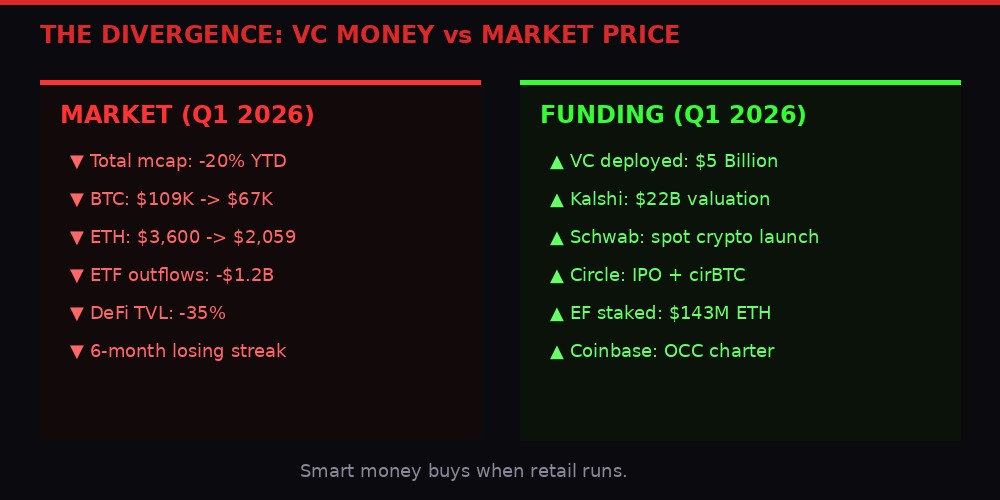
The divergence between market price and institutional capital deployment hasn't been this wide since the 2022 bottom.
The $5 Billion Bet Nobody Noticed

Behind every Q1 headline about Bitcoin's price collapse, a different number was climbing. Photo: Pexels
Crypto startups raised nearly $5 billion from venture investors in Q1 2026, according to DefiLlama's fundraising tracker. That's down 16% from Q1 2025's roughly $6 billion, which was inflated by post-inauguration euphoria. But $5 billion is still massive. It's more than the entire crypto VC market deployed in 2019. It's more than most tech verticals outside of AI raised in the same period.
The composition tells you more than the total. Prediction markets dominated, pulling in over $1.7 billion. Payments took $735 million. Trading infrastructure got $423 million. Custody and security brought in $363 million. DeFi protocols raised $306 million. This isn't speculative token-launch capital. This is infrastructure capital. Plumbing money. The kind of investment that only makes sense if you believe crypto has a future measured in decades, not cycles.
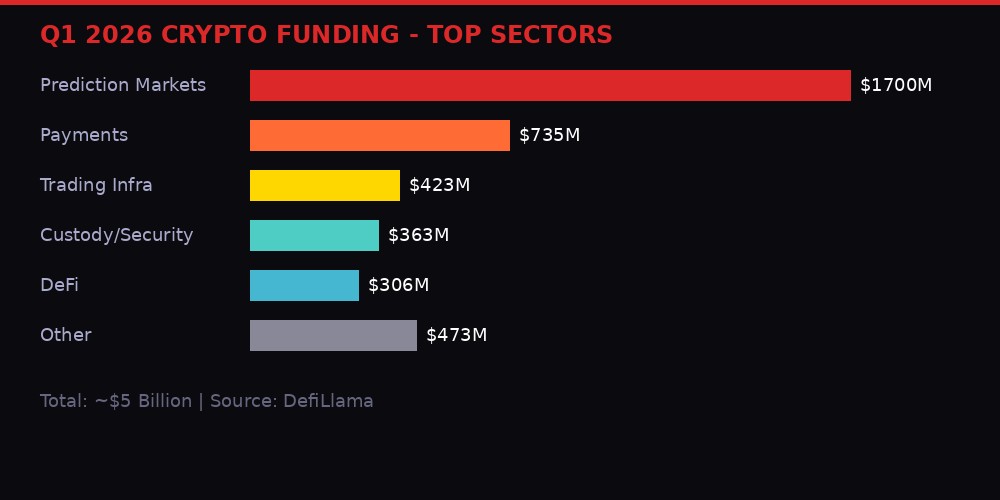
Prediction markets, payments, and trading infrastructure consumed over half of Q1's venture capital. Speculative token projects barely registered.
The individual rounds are even more revealing. Kalshi, the CFTC-regulated prediction exchange, raised $1 billion at a $22 billion valuation. Coatue Management led the round, the same firm that has backed Instacart, DoorDash, and Snap. This isn't crypto money recycling through crypto funds. This is mainstream growth capital validating prediction markets as a permanent financial product category.
Polymarket secured $600 million from Intercontinental Exchange, the company that owns the New York Stock Exchange. ICE didn't just invest - it indicated it might acquire up to $40 million in Polymarket securities from existing holders. When the owner of the NYSE starts buying equity in a decentralized betting platform, the line between TradFi and DeFi isn't blurring. It's gone.
Rain pulled in $250 million at a $2 billion valuation for stablecoin payments infrastructure. Iconiq Capital led the round with backing from Sapphire Ventures, Dragonfly Capital, Bessemer Venture Partners, and Galaxy Digital. The thesis: stablecoin payment rails will replace SWIFT for a meaningful chunk of cross-border commerce within five years.
BitGo raised over $213 million through an IPO on the New York Stock Exchange, pricing shares at $18 with strong institutional demand. A crypto custody company listing on the NYSE would have been science fiction three years ago. Now it's a standard capital markets event.
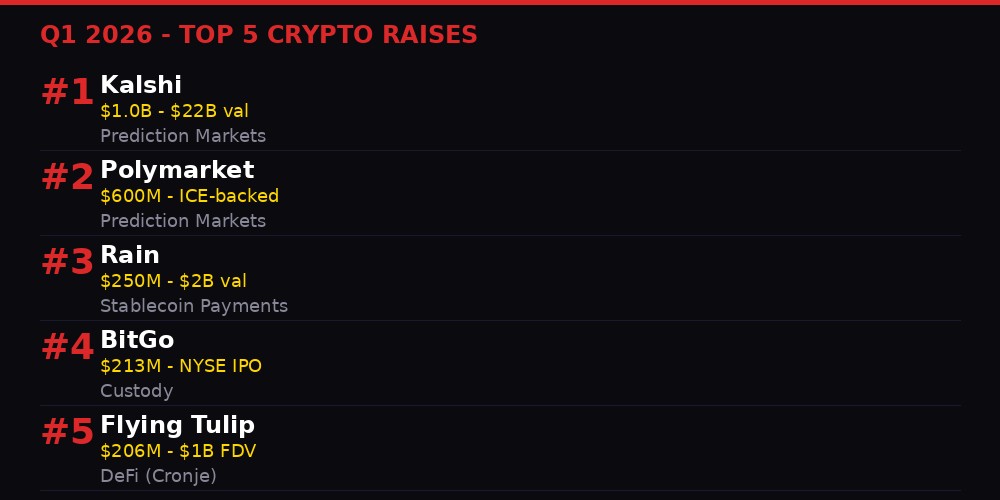
The top five raises alone account for over $2.3 billion. Traditional finance led every single one. Source: DefiLlama, Bloomberg, DL News
Other notable rounds included Flying Tulip's $206 million token sale at a $1 billion FDV, led by DeFi architect Andre Cronje. Tether poured $200 million into Whop, a digital marketplace for creators, at a $1.6 billion valuation. LMAX Group raised $150 million from Ripple specifically to integrate RLUSD as collateral across institutional trading venues. Alpaca pulled in $150 million in a Series D led by Drive Capital, with Citadel Securities participating.
Citadel Securities. The market maker that handles roughly 25% of all U.S. equity volume. Investing in crypto infrastructure. That alone tells you where the puck is heading.
Schwab Enters the Arena: $11.9 Trillion Meets Bitcoin

Schwab's crypto announcement wasn't a pivot. It was the last domino falling. Photo: Pexels
On April 3, a Schwab spokesperson confirmed to CoinDesk what CEO Rick Wurster has been telegraphing since July 2025: "We remain on track to launch our spot crypto offer in the first half of 2026, starting with bitcoin and ether." A waitlist is already live. The product will run through Charles Schwab Premier Bank, SSB.
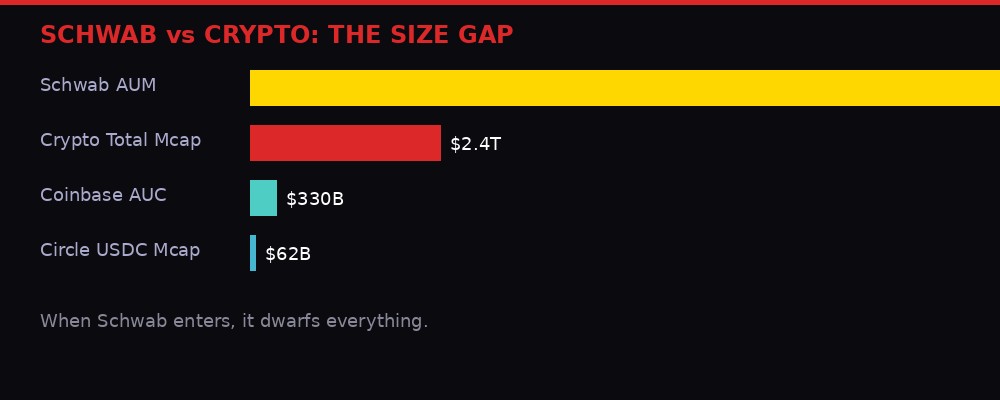
Schwab's client assets represent roughly five times the entire cryptocurrency market capitalization. When it turns on spot trading, the liquidity implications are staggering.
The scale disparity is almost comical. Schwab manages $11.9 trillion in client assets. The entire cryptocurrency market is worth $2.4 trillion. Coinbase, the largest crypto-native exchange, custodies about $330 billion. Schwab entering spot crypto is like Walmart opening a corner store. The existing players don't compete on the same dimension.
But this isn't about Schwab taking volume from Coinbase or Kraken. It's about the pool of capital that has never touched crypto because the friction was too high. There are tens of millions of Schwab clients who own stocks, bonds, ETFs, and mutual funds through a single interface. They've never downloaded MetaMask. They've never used a DEX. They may have bought a Bitcoin ETF through Schwab's existing platform, but they've never held spot crypto in a brokerage account alongside their retirement portfolio.
That's the unlock. Not converting crypto-native traders, who already have their preferred platforms. Converting the mass affluent - the millions of households with $500,000 to $5 million in investable assets who allocate 60/40 to stocks and bonds and have been reading about Bitcoin for a decade without buying any.
Schwab already offers Bitcoin futures, crypto-linked ETFs, and the Schwab Crypto Thematic Index (STCE) ETF. Spot trading is the final step. And Schwab's competitive advantage isn't technology or fees. It's trust. When a 53-year-old financial advisor tells a 60-year-old client that they can now buy Bitcoin through their Schwab account, the conversation is completely different from "download this app called Coinbase."
Wurster framed this explicitly as a push toward a "unified investment platform" where digital assets sit in the same account view as stocks and bonds. The message to Schwab's client base is clear: crypto is no longer an alternative asset. It's an asset. Period. (CoinDesk, April 3, 2026)
Circle's Double Play: IPO and the War for Wrapped Bitcoin

$1.7 trillion in Bitcoin sits dormant, unable to participate in DeFi. Circle wants to change that. Photo: Pexels
Circle announced cirBTC this week, a wrapped Bitcoin product backed 1:1 by actual Bitcoin, designed specifically for institutions. It will launch on Ethereum and Arc first, with a multichain expansion planned. The announcement came the same week Circle is navigating a very different crisis - the $285 million Drift Protocol hack, where an attacker used Circle's own CCTP bridge to move $232 million in stolen USDC from Solana to Ethereum.
The juxtaposition is brutal. On one hand, Circle is positioning itself as the trusted institutional bridge between Bitcoin and DeFi. On the other, blockchain investigator ZachXBT is publicly asking why Circle didn't freeze the stolen funds faster. Circle's response - that it only freezes assets "when legally required, consistent with the rule of law" - is legally correct and operationally damning. It highlights the impossible position centralized stablecoin issuers occupy: they have the power to freeze, but exercising that power without a court order creates liability.
cirBTC enters a crowded market. BitGo's wBTC has existed for years. Coinbase launched cbBTC after delisting wBTC over concerns about Justin Sun's involvement through BiT Global. Now Circle is making its play, betting that its brand, regulatory posture, and existing USDC infrastructure give it a distribution advantage.
"Bitcoin is sitting on the sidelines of DeFi. Not because people don't want yield or liquidity - it's because they don't trust the wrapper. cirBTC is Circle's answer: 1:1 backed, on-chain-verifiable, and built on infrastructure the market already trusts." - Rachel Mayer, VP of Product at Circle (via X, April 2, 2026)
The math supports the thesis. Roughly $1.7 trillion in Bitcoin exists. The total value locked in DeFi across all chains is around $85 billion. If even 5% of dormant Bitcoin enters DeFi through institutional-grade wrappers like cirBTC, that's $85 billion in new liquidity - enough to double the entire DeFi ecosystem overnight.
But critics see another centralization risk. Richard Green, managing director at Rootstock Labs, told DL News that "this launch just trades one centralized middleman for another. Institutions seeking to take their bitcoin from passive storage to productive capital consistently tell us they want decentralization."
The institutional market may disagree. For a pension fund or family office, "decentralized" often translates to "no one to call when something goes wrong." Circle's regulatory moat - pending IPO, USDC compliance framework, relationships with major banks - is precisely what makes cirBTC attractive to the kind of capital that won't touch wBTC.
Maple Finance's Sid Powell captured the dynamic: "Circle already has strong infrastructure, broad distribution, and credibility across crypto and payments. If cirBTC integrates smoothly across DeFi, wallets and exchanges, it could become a meaningful player very quickly. There is still strong demand for Bitcoin liquidity in DeFi." (DL News, April 3, 2026)
The Ethereum Foundation's Quiet Power Move

70,000 ETH staked in a single program. The Ethereum Foundation is no longer just a grant-maker. Photo: Pexels
While the market's attention was fixed on Drift's implosion and Schwab's announcement, the Ethereum Foundation quietly completed one of the most significant treasury operations in crypto history. On April 3, the foundation staked roughly 45,034 ETH in a single session - about $93 million at current prices - spread across uniform chunks of 2,047 ETH each.
The move brings the foundation's total staked position to approximately 69,500 ETH, nearly hitting the 70,000 ETH target announced in February 2026. At roughly $2,059 per ETH, that's approximately $143 million in staked assets generating between $3.9 million and $5.4 million annually at the current 2.7% to 3.8% APY range for institutional stakers. With MEV-boost, returns could run higher. (CoinDesk, Arkham data, April 3, 2026)
The annual yield is modest relative to the foundation's estimated $100 million operating budget. But the strategic significance is enormous. For years, the Ethereum Foundation funded operations by selling ETH, creating persistent sell pressure and drawing criticism from the community. Every quarterly dump landed like a headline: "Ethereum Foundation Sells Again, Price Drops." It was a governance nightmare wrapped in a treasury management problem.
Staking solves both. The foundation earns yield without selling. Its treasury becomes productive rather than depleting. And the community gets a signal that the foundation is long-term aligned with the network it created. This is the crypto equivalent of a company buying back stock instead of issuing new shares. It changes the narrative from extraction to investment.
The foundation's Arkham-tracked portfolio shows approximately $270.9 million in total assets across 14 addresses. ETH dominates at about 102,400 ETH ($210.9 million), with smaller positions in USDC, BNB, and a fraction of a bitcoin. Over 100,000 ETH remains unstaked. Whether the foundation expands beyond the initial 70,000 ETH commitment hasn't been announced, but the infrastructure is now in place to do so.
The timing matters. ETH is down roughly 43% from its October 2025 cycle peak. ETF outflows for Ethereum products have been persistent. Bloomberg Intelligence analyst James Seyffart described the recent ETH ETF performance as "not pretty." The foundation staking at these levels is a statement: we're not worried about the price. We're building for the next decade.
Coinbase, Blanche, and the Regulatory Clearing
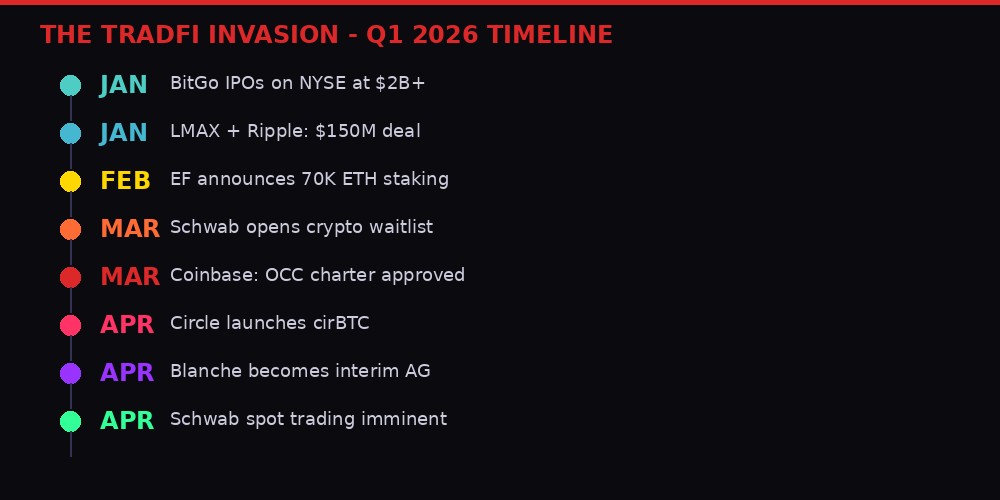
From January's BitGo IPO to April's Schwab launch, every month of 2026 has brought another institutional milestone.
The regulatory landscape shifted more in 72 hours than it had in the previous six months. On April 2, President Trump removed Attorney General Pam Bondi and named Todd Blanche - his former personal attorney and deputy AG - as interim head of the Department of Justice.
For crypto, Blanche is not an unknown quantity. As deputy AG, he dismantled the DOJ's National Cryptocurrency Enforcement Team, the unit formed in 2022 under Biden to pursue crypto-related fraud and sanctions evasion. He signed a four-page memo ordering prosecutors to stop pursuing regulatory violation cases in the crypto industry. That memo was cited in the Southern District of New York's case against Tornado Cash developer Roman Storm, contributing to the government dropping one of the charges against Storm. (CoinDesk, April 3, 2026)
There's a catch, and it's a significant one. According to ProPublica reporting, Blanche held between $159,000 and $485,000 in various cryptocurrencies - including Bitcoin, Solana, Cardano, and Ethereum - when he signed the enforcement memo. His ethics disclosure showed he'd pledged to divest before working on crypto-related matters. He apparently didn't. This creates a conflict-of-interest problem that hasn't gone away now that he's running the entire department.
The same week, the CFTC and DOJ filed a joint lawsuit against Illinois, Arizona, and Connecticut over those states' efforts to shut down prediction market providers. The CFTC's argument is simple: prediction markets are swaps, swaps are federal jurisdiction, and states don't get to issue cease-and-desist letters against federally regulated entities. Illinois Governor Pritzker responded that the Trump administration is "carrying water for companies driving well-documented and lucrative insider trading schemes."
Separately, Coinbase received conditional OCC approval for a trust charter, moving it closer to operating as a federally regulated crypto custodian. This is the kind of regulatory milestone that doesn't generate Twitter engagement but fundamentally changes what's possible. A Coinbase with a federal trust charter can custody assets for banks, pension funds, and sovereign wealth funds that currently can't work with state-chartered entities. It's the regulatory equivalent of getting a AAA credit rating.
Put these pieces together and you get a picture of a regulatory environment being systematically cleared for institutional entry. The DOJ isn't prosecuting crypto companies. The CFTC is actively suing states that try to regulate prediction markets. The OCC is granting bank-adjacent charters to crypto-native firms. And the man now running the DOJ holds crypto himself. You can debate whether this is good policy. You cannot debate that it removes friction for Wall Street capital entering crypto. That appears to be the entire point.
The Bear Market That Institutional Money Loves

Bitcoin's price chart shows a bear market. The capital flows tell a completely different story. Photo: Pexels
Bitcoin is trading around $67,000, down from $109,000 at the October 2025 peak. The total crypto market cap has shed 20% year-to-date. ETF investors pulled $1.2 billion in the first three months of 2026, marking the second consecutive quarter of outflows. The bear market that started six months ago shows no sign of relenting.
The macro headwinds are real. The ISM prices-paid index jumped to 78.3 in March, the highest since June 2022, undermining expectations for near-term rate cuts. The Iran-U.S. conflict continues to elevate oil prices, with Brent crude at $109 per barrel. The Fed is stuck. Inflation is sticky. The geopolitical risk premium hasn't been this elevated since 2022.
On-chain metrics are worse. CryptoQuant data shows 30-day apparent demand at approximately -63,000 BTC. That's net negative. Even though ETF purchases rose to about 50,000 BTC over the past 30 days (the highest since October 2025) and Strategy accumulated roughly 44,000 BTC in the same period, selling from other market participants overwhelmed those inflows. (CryptoQuant, CoinDesk, April 3, 2026)
Wallets holding 1,000 to 10,000 BTC have flipped to net distribution, with their one-year balance change dropping to approximately negative 188,000 BTC, down from positive 200,000 BTC at the cycle peak. Mid-sized holders have slowed accumulation sharply. The Coinbase Premium Index remains negative, signaling weak U.S. spot demand.
Derivatives tell the same story. Bitcoin's 30-day implied volatility dropped to 51.28%, the lowest since February. Puts are pricing above calls on Deribit, indicating persistent demand for downside protection. Glassnode identified a negative gamma zone from $68,000 all the way down to the high $50,000s. If Bitcoin sustains a break below $68,000, dealers hedging their short put exposure would be forced to sell, potentially creating a feedback loop that accelerates the decline toward $60,000 or lower.
The Easter weekend makes it worse. With CME futures closed and ETF creation/redemption paused over Good Friday, the institutional bid that has increasingly anchored Bitcoin's price is largely absent. Trading is left to spot markets where selling pressure has been most persistent. It's the kind of setup that produces either a boring flat weekend or a violent gap-down when liquidity returns Monday.
And yet: $5 billion in venture capital. Schwab spot trading. Circle cirBTC. Coinbase OCC charter. Ethereum Foundation staking $143 million. The surface says pain. The infrastructure says preparation.
This is what accumulation looks like when it's done by institutions instead of individuals. Retail buys at $100K and sells at $67K. Institutional capital builds the rails at $67K so it can process volume at $200K. The bear market isn't a problem for Wall Street. It's the sale they've been waiting for.
What Q2 Looks Like From Here

The infrastructure being built in Q1 2026 will define the market structure for the next cycle. Photo: Pexels
The immediate price picture remains fragile. U.S. inflation data on April 9 represents the next major catalyst. If March core PCE exceeds February's 3.1%, rate-cut expectations could fade further, strengthening the bearish case. CryptoQuant pegged resistance between $71,500 and $81,200, levels that have capped every relief rally in the current structure. Without a macro trigger - a ceasefire, a rate cut, a dramatic policy shift - Bitcoin likely stays range-bound between $60,000 and $72,000 through mid-April.
But the institutional calendar looks very different from the price calendar. Schwab's spot trading could launch as early as May. Circle's IPO is moving through the pipeline. The CFTC's lawsuit against states over prediction markets will head to appeals court later this month. Coinbase's OCC charter requires additional compliance milestones but could reach final approval by summer. The Ethereum Foundation has infrastructure in place to stake beyond its initial 70,000 ETH target.
Every one of these events widens the on-ramp for traditional capital. And every on-ramp eventually gets traffic.
The historical pattern is remarkably consistent. After the 2018 crash, institutional infrastructure built during the bear - Fidelity Digital Assets, Bakkt, the first Bitcoin futures ETF applications - laid the groundwork for the 2020-2021 bull run. After the 2022 collapse, infrastructure built during that bear - BlackRock's ETF filing, the Coinbase-SEC resolution path, the stablecoin regulatory framework - created the conditions for the 2024-2025 rally.
The same dynamic is playing out now, but at a vastly larger scale. In 2018, the biggest institutional crypto event was Fidelity launching a custody pilot. In 2026, it's Schwab offering spot trading to $11.9 trillion in client assets. The magnitude has changed by orders of magnitude. The pattern hasn't changed at all.
James Butterfill, head of research at CoinShares, noted a critical evolution in the investor base. It's no longer just hedge funds and family offices with outsized risk appetites. Pension funds and university superannuation funds are allocating to crypto. These are institutions with 30-year time horizons and fiduciary obligations. They don't panic sell. They don't capitulate. They accumulate on a schedule and hold through cycles. Their entry into the market creates a structural floor that didn't exist in previous bear markets. (DL News, April 3, 2026)
The prediction market sector's dominance in Q1 fundraising signals another structural shift. Over $1.7 billion flowed into Kalshi, Polymarket, and adjacent platforms. Prediction markets are the intersection of crypto rails, financial derivatives, and mass consumer adoption. When the CFTC is suing states to protect these platforms' right to operate, the political backing is explicit. Prediction markets may be the first crypto-native product category to achieve genuine mainstream scale, which would pull the rest of the ecosystem forward.
Norman Wooding, CEO of SCRYPT, captured the conditional optimism: "If tensions ease, short-term safe-haven flows will rotate back into traditional risk." Translation: the money is waiting on the sideline for a signal. When it moves, it will move fast, and it will move into the infrastructure that's being built right now.
The retail narrative says crypto is dying. The institutional capital flows say crypto is being acquired. These two things can both be true at the same time. The bear market kills the weak hands and the overleveraged traders. It also creates the discount that institutional buyers need to justify their compliance costs, their multi-year build-outs, and their board-level approval processes.
Wall Street doesn't buy at the top. It never has. It buys when the bleeding creates bargains that justify the risk-adjusted return models that investment committees require. And right now, with Bitcoin at $67,000, Ethereum at $2,059, and the entire crypto market cap at $2.4 trillion, the models are clearly saying yes.
The hostile takeover isn't coming. It's already underway. The only question is how much of crypto's future will be owned by the same institutions that spent the last decade calling it worthless.
Get BLACKWIRE reports first.
Breaking news, investigations, and analysis - straight to your phone.
Join @blackwirenews on Telegram