The War on Healing: How the US and Israel Are Systematically Destroying Healthcare Across the Middle East
Hospitals bombed. A 106-year-old vaccine institute struck. Cancer drug factories flattened. Ambulances targeted with documented double-tap strikes. Thirty-six days into the war on Iran, the machinery of healing is being dismantled with the same precision applied to military targets.
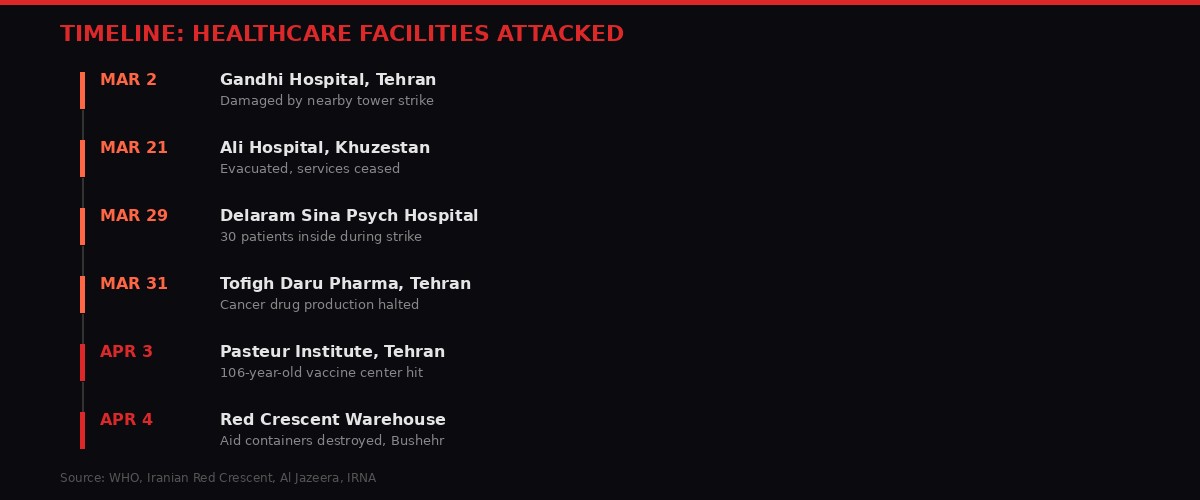
A documented timeline of strikes on healthcare infrastructure in Iran. Sources: WHO, IRNA, Iranian Red Crescent.
On Friday morning, April 4, a drone struck a Red Crescent relief warehouse in Iran's Bushehr province. The impact destroyed two relief containers, two buses, and a fleet of emergency vehicles. No casualties were reported at the site. But the message was delivered. Humanitarian infrastructure is not a protected category in this war. It is a target set.
The day before, strikes hit the Pasteur Institute of Iran in Tehran - a 106-year-old medical research center founded in 1920 through an agreement between the Iranian government and the Institut Pasteur de Paris. The facility produces vaccines for tetanus, hepatitis B, and measles. It supports the country's entire national immunization program. Two of its departments work directly with the World Health Organization.
Iranian President Masoud Pezeshkian, a 71-year-old heart surgeon by training, posted on X: "What message does attacking hospitals, pharmaceutical companies and the Pasteur Institute as a medical research center in Iran convey?" He appealed to the WHO, the Red Cross, and Doctors Without Borders to respond. (Source: Al Jazeera, April 3, 2026)
The response, so far, has been words. The WHO's director general, Tedros Adhanom Ghebreyesus, confirmed the attack and noted that two Pasteur departments had been collaborating with WHO programs. He wrote that "the conflict in Iran, and the region, is impacting the delivery of health services and the safety of health workers, patients, and civilians." He did not call it a war crime. He did not threaten consequences. He used the passive voice.
Here is what the passive voice is covering: Since March 1, the WHO has verified over 20 attacks on healthcare in Iran, resulting in at least nine deaths - including an infectious diseases health worker and a member of the Iranian Red Crescent Society. The Iranian Red Crescent has reported that 236 health facilities have been struck since the war began on February 28. More than 600 schools and education centers have been damaged. (Source: WHO, Iranian Ministry of Foreign Affairs)
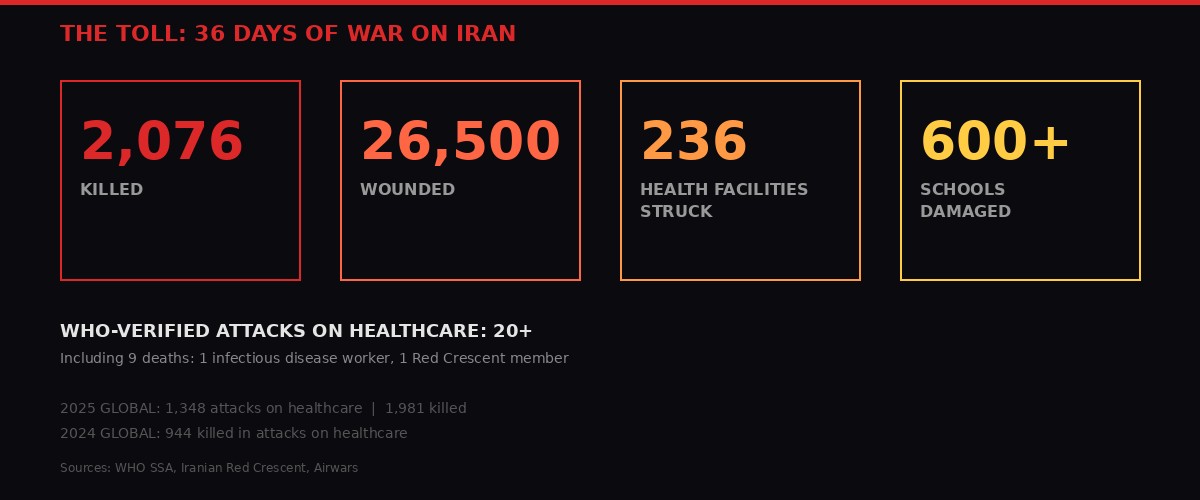
The numbers as of Day 36. Sources: WHO, Iranian Red Crescent, Airwars.
The Pasteur Institute: Destroying a Century of Science
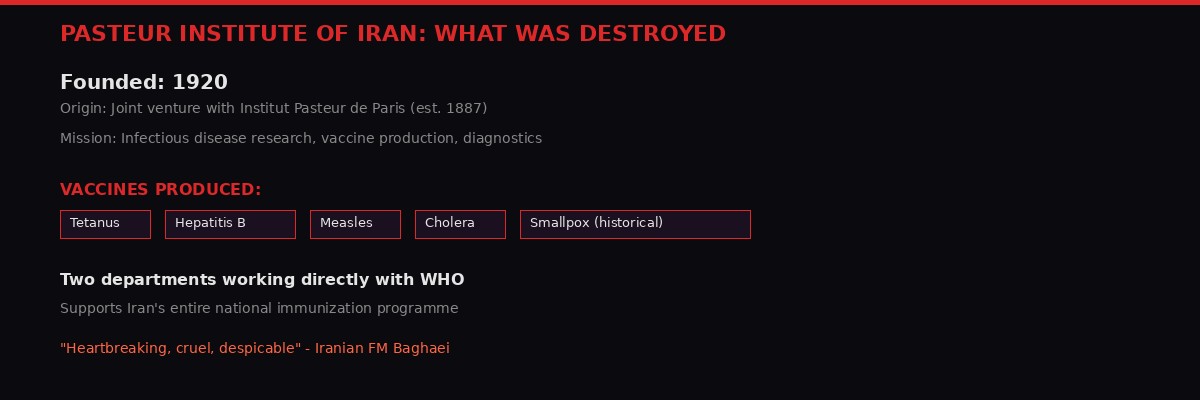
What the Pasteur Institute does - and what was struck on April 3.
The Pasteur Institute of Iran is not a military installation. It is not dual-use infrastructure. It is not a command center disguised as a laboratory. It is, by every legal and functional definition, a civilian medical research facility that has been operating continuously for 106 years.
Founded in 1920 as a joint venture between the Iranian government and the Institut Pasteur de Paris - itself established in 1887 by Louis Pasteur - the Tehran facility has spent a century fighting diseases that kill without regard for geopolitics. Smallpox. Cholera. Tetanus. Hepatitis B. Measles. The institute's researchers developed and produced the biological products that form the backbone of Iran's national vaccination campaigns.
Iranian Foreign Ministry spokesman Esmaeil Baghaei described the strike as "heartbreaking, cruel, despicable, and utterly outrageous." He noted that the Pasteur Institute is "the oldest and most prestigious research and public health centre in Iran and the entire Middle East." He did not provide casualty figures from the attack. (Source: Al Jazeera, April 3, 2026)
The destruction of vaccine production capacity has implications that will outlast the war by years, potentially decades. Iran's immunization infrastructure depends on domestic production. International sanctions have already constrained pharmaceutical imports. Destroying the facility that produces the vaccines means Iranian children will face preventable diseases long after the last bomb falls. Measles does not care about ceasefire agreements.
This is not collateral damage. A vaccine laboratory does not generate military advantage for either side. Its destruction does not degrade Iran's ability to fight. It degrades Iran's ability to keep its children alive. The distinction matters - or it used to.
A Pharmaceutical Industry Under Fire
The Pasteur Institute was not the first medical target. On March 31, US-Israeli strikes hit Tofigh Daru Research and Engineering Company in Tehran - one of Iran's largest pharmaceutical manufacturers. The company, owned by the state-run Social Security Investment Company, develops and produces active pharmaceutical ingredients for anticancer, cardiovascular, immunomodulatory, and narcotic medications. (Source: Al Jazeera, LinkedIn company profile, March 31, 2026)
Put plainly: a factory that makes cancer drugs was bombed during a war that has no connection to cancer drugs. The facility's LinkedIn page, still active at the time of this writing, describes its mission in the dry language of pharmaceutical manufacturing. It does not mention weapons. It does not mention military applications. It makes medicine for people who are dying of diseases that have nothing to do with geopolitics.
No confirmed casualty numbers were reported from the Tofigh Daru strike. The Iranian government identified it as a civilian target. The US and Israeli militaries have not provided a military justification for the attack. The cancer patients who depended on the facility's output have not been consulted about their treatment options going forward.
The pattern extends beyond pharmaceutical production. On March 29, the Delaram Sina Psychiatric Hospital in Tehran - a newly constructed facility - sustained significant damage during strikes on the capital. According to the state-run Islamic Republic News Agency (IRNA), approximately 30 patients were inside the hospital when it was hit. A psychiatric hospital. Thirty patients. No military value. No strategic significance. Just people receiving treatment for mental illness, caught in a war they did not start and cannot escape. (Source: IRNA, March 29, 2026)
On March 21, Ali Hospital in Andimeshk, Khuzestan province, was damaged by an explosion. The facility was forced to evacuate staff and cease all services, according to WHO verification. An entire community lost its hospital. On March 2, the first full day of the war, Gandhi Hospital in Tehran was damaged during strikes on a nearby television communications tower. The tower was the target. The hospital was the consequence. Whether that distinction matters to the patients is an open question. (Source: WHO, Mehr News Agency, Fars News Agency)
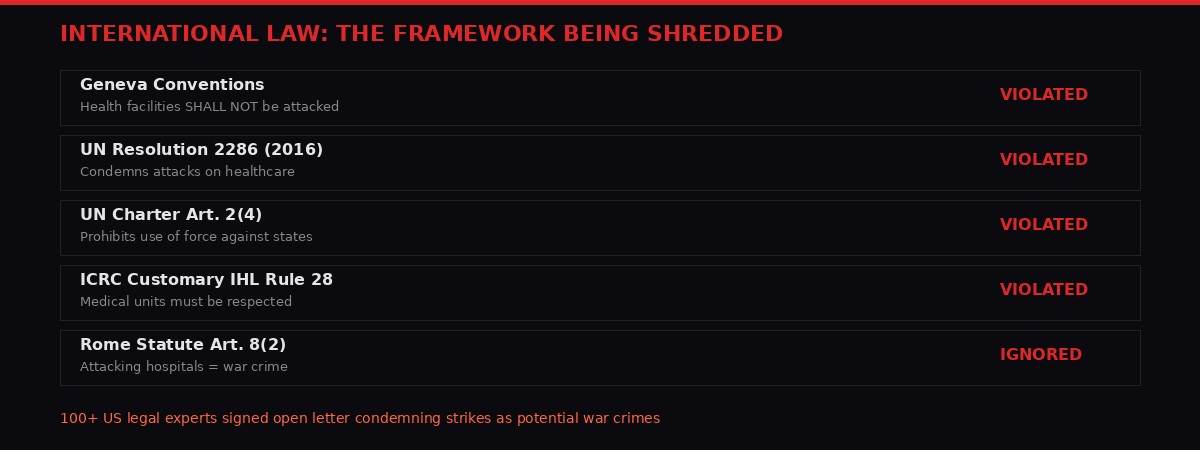
The legal framework that was built to prevent exactly this. Source: ICRC, UN, Rome Statute.
The Legal Architecture No One Is Enforcing
International humanitarian law is unambiguous on this point. Health establishments and medical units, including hospitals, shall not be attacked. The International Committee of the Red Cross has codified this across every major treaty governing armed conflict. The protections extend to the sick and wounded, to medical staff, and to transport vehicles such as ambulances. There are no asterisks. There are no exceptions for countries that claim to be fighting terrorism or preventing nuclear proliferation.
In 2016, the United Nations Security Council unanimously adopted Resolution 2286, which condemns attacks on healthcare during armed conflict and calls on all nations to respect international law. The resolution passed without a single dissenting vote. Every permanent member of the Security Council - including the United States - voted in favor. Eight years later, two of those permanent members are conducting the strikes that the resolution was designed to prevent.
On April 3, more than 100 US-based international law experts published an open letter on Just Security, a legal analysis platform hosted at the Reiss Center on Law and Security at New York University School of Law. The letter declared that the US-Israeli campaign "was a clear violation of the United Nations Charter" and that the conduct of US forces "raise serious concerns about violations of international human rights law and international humanitarian law, including potential war crimes." (Source: Just Security, April 3, 2026)
The signatories include some of the most prominent legal scholars in the United States: Oona Hathaway and Harold Koh of Yale Law School, Philip Alston of NYU, and former Human Rights Watch chief Kenneth Roth. These are not activists. They are the people who wrote the textbooks that military lawyers study. When they say the word "war crime," they mean it in the precise, statutory sense defined by the Rome Statute of the International Criminal Court.
The letter identifies four categories of concern. First, the legality of initiating the war itself - noting that Iran did not attack the United States or Israel, and the UN Security Council did not authorize the strikes. Second, the conduct of hostilities, including strikes on schools, hospitals, and civilian infrastructure. Third, threatening rhetoric from senior officials, including Trump's statement that the US might bomb Iran "just for fun" and Hegseth's declaration of "no quarter" - a phrase that in US military academies has served as a textbook example of a war crime. Fourth, the dismantling of civilian harm mitigation structures within the Pentagon under Hegseth's "gloves off" doctrine.
"Public statements by senior officials indicate an alarming disrespect for the rules of international humanitarian law accepted by states, and which protect both civilians and members of the armed forces." - Open letter by 100+ US international law scholars, Just Security, April 3, 2026
The Iranian Red Crescent has documented 67,414 civilian sites struck since February 28, of which 498 are schools and 236 are health facilities. The organization Airwars, which independently tracks civilian casualties, found that at least 1,443 Iranian civilians, including 217 children, were killed by US and Israeli forces between February 28 and March 23 - a figure that is now five weeks old and almost certainly a significant undercount. (Source: Airwars, Iranian Red Crescent, OHCHR)
Lebanon: The Second Front of Healthcare Destruction
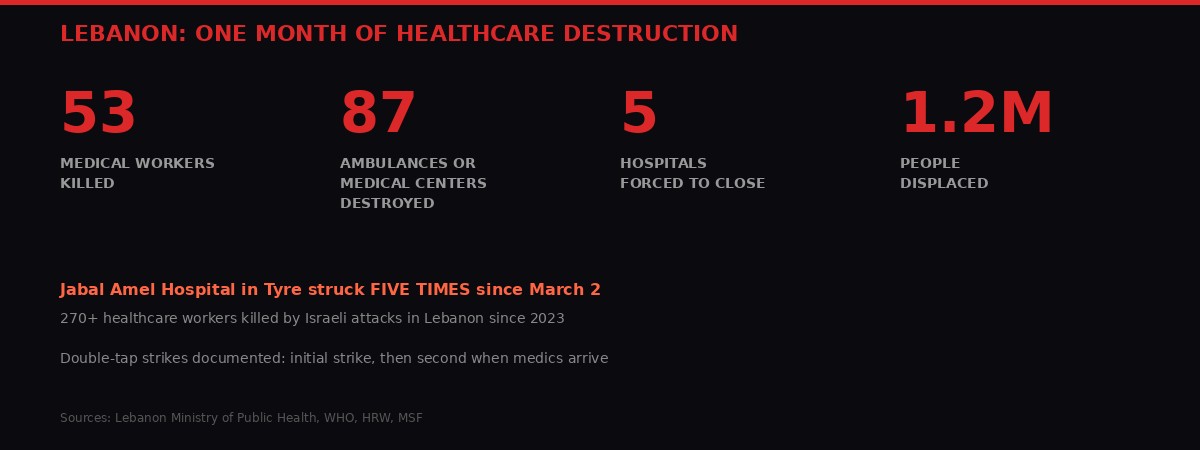
One month of Israeli attacks on Lebanon's healthcare system. Sources: Lebanon Ministry of Public Health, WHO, HRW.
Iran is not the only country where healthcare infrastructure is being systematically destroyed. In Lebanon, a parallel campaign has killed 53 medical workers, destroyed 87 ambulances or medical centers, and forced the closure of five hospitals in a single month - all since Israel intensified strikes on March 2 after Hezbollah launched retaliatory attacks following the US-Israeli assassination of Iranian Supreme Leader Ayatollah Ali Khamenei. (Source: Lebanon Ministry of Public Health)
Luna Hammad, the Lebanon medical coordinator for Doctors Without Borders (MSF), told Al Jazeera that "Israeli strikes and blanket evacuation orders are cutting people off from care and shrinking the space for health services to function." She added that MSF has documented "a pattern of attacks affecting healthcare." The language is careful. The reality is not.
Jabal Amel University Hospital in Tyre, along Lebanon's southern coast, has been struck five times since March 2. Five separate attacks on the same hospital. Each time, staff returned. Each time, they were hit again. The hospital continued operating between strikes because the alternative was to let the wounded die in the streets. That is not resilience. That is a hostage situation imposed by air power.
The destruction has a strategic purpose that healthcare workers on the ground understand clearly. A doctor treating displaced populations in Beirut, speaking on condition of anonymity, told Al Jazeera: "You can't live somewhere that doesn't have basic medical care, and of course it's now created a strain on healthcare facilities here where people are displaced because you now have over a million extra people who are going to need the health system." Destroy the hospitals, and you force the population to move. It is ethnic cleansing by infrastructure destruction.
Israeli Defence Minister Israel Katz has threatened to demolish homes across southern Lebanon and block hundreds of thousands of civilians from returning - language that Human Rights Watch described as signaling "stepped-up atrocities." Israeli forces have begun an invasion of the south, with officials declaring an intention to occupy the region and establish a so-called security zone. The destruction of healthcare infrastructure is not incidental to this objective. It is instrumental to it. (Source: HRW, March 23, 2026)
The WHO's representative in Lebanon, Dr. Abdinasir Abubakar, confirmed that "some health facilities [have been] directly attacked" and noted the displacement of healthcare workers as a compounding factor. Emergency room admissions have increased exponentially. Patients requiring chemotherapy, radiotherapy, and dialysis have been transferred further north. Dr. Hassan Wazni, general director of Nabih Berri Governmental Hospital in Nabatieh, described the situation by phone: critical patients being shuttled across the country because their local hospital can no longer function.
The attacks include documented double-tap strikes - where an initial strike occurs, and a second follows after first responders arrive. On March 28 alone, WHO director-general Ghebreyesus counted nine paramedics killed and seven wounded in five separate attacks. This is not accidental. Double-tap strikes are a deliberate tactic designed to kill the people who come to help. (Source: WHO, March 28, 2026)
Human Rights Watch's Lebanon researcher Ramzi Kaiss stated plainly: "This trend, the killing of medical workers, has not stopped despite more than 270 health workers and paramedics being killed as a result of Israeli attacks in Lebanon" since 2023. HRW has classified these attacks as "repeated, apparently deliberate" and described them as apparent war crimes. (Source: Human Rights Watch)
The Normalization of Attacking Hospitals
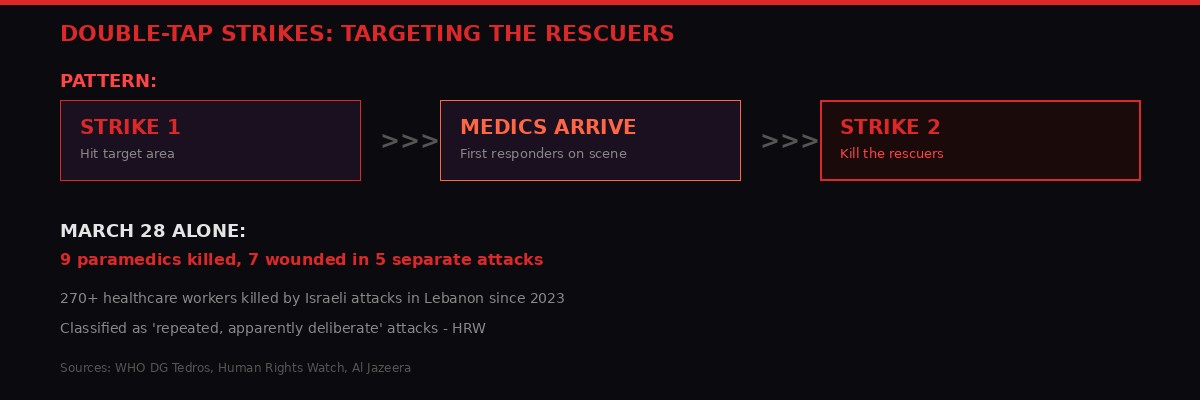
The double-tap pattern: strike, wait for medics, strike again. Sources: WHO, HRW.
The destruction of healthcare in Iran and Lebanon is not anomalous. It is the latest iteration of a pattern that has accelerated over two decades. Omar Dewachi, author of "Ungovernable Life: Mandatory Medicine and Statecraft in Iraq," told Al Jazeera that the trajectory runs from the US-led war on terror through Iraq, Syria, and Gaza to the present conflict: "When these hospitals are repeatedly hit across different conflicts with little accountability, it creates a sense that this is becoming increasingly normalised."
The numbers confirm the trend. In 2025, the WHO's Surveillance System for Attacks on Health Care (SSA) recorded 1,348 attacks on medical facilities during armed conflicts worldwide, killing 1,981 people - the majority in Sudan (1,620 killed) and Myanmar (148 killed). That was already a sharp increase from 2024, when 944 patients and medical personnel were killed. The Iran war has added hundreds more to the 2026 count in just five weeks, and the year is barely a quarter old. (Source: WHO SSA)
Forensic Architecture, the research group that investigates state violence and human rights violations, concluded that Israel conducted "systematic targeting of hospitals and healthcare workers" in Gaza throughout its military campaign there. More than 107 first responders were killed in Lebanon between late 2023 and 2024. In March 2025, Israeli forces reportedly shot dead 15 Palestinian medics working for the Palestine Red Crescent Society inside clearly identifiable PRCS ambulances during a rescue mission in Rafah. (Source: Forensic Architecture, PRCS)
The current war has added a new dimension to this pattern: the explicit targeting of pharmaceutical production and medical research capacity. Bombing a hospital kills the people inside it. Bombing a vaccine factory kills people who have not been born yet. The Pasteur Institute produced the vaccines that would have protected Iranian children from measles and hepatitis B for years to come. That production capacity does not rebuild quickly. The equipment is specialized. The expertise takes decades to develop. The cold chains that preserve biological products require infrastructure that has itself been degraded by strikes on energy facilities.
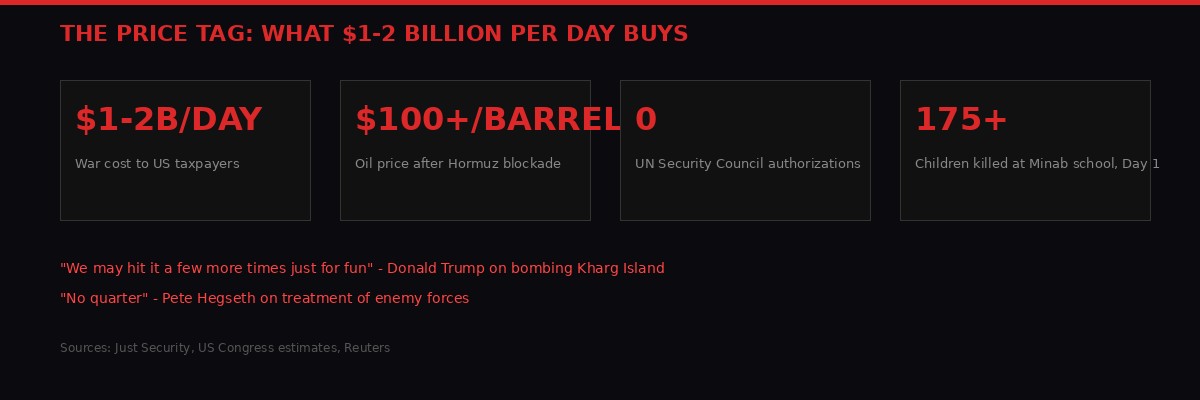
What the war costs - and who pays. Sources: Just Security, US Congress, Reuters.
The Rhetoric That Makes It Possible
The legal scholars' letter devoted significant attention to the rhetoric of senior US officials, and with good reason. Language shapes conduct. When the Secretary of Defense publicly dismisses the laws of war as "stupid rules of engagement" and declares a "gloves off" approach to warfare, he is not merely expressing an opinion. He is issuing guidance to every commanding officer, every pilot, and every targeting cell in the US military. The message is received: restraint is weakness. Compliance with international law is optional. Lethality over legality.
Defense Secretary Pete Hegseth's declaration of "no quarter" carries specific legal weight. In the laws of armed conflict, "no quarter" means troops are free to kill those attempting to surrender rather than accept their surrender and take them prisoner. It is listed as a war crime under the Rome Statute. It has been used as a textbook example of prohibited conduct in US military academies for decades. The man responsible for the entire US military used the phrase publicly, and no one in the chain of command corrected him. (Source: CNN, Just Security)
President Trump's statement that the US might bomb Iran "just for fun" - made in reference to the already-demolished Kharg Island - establishes a framework in which destruction is entertainment and civilian infrastructure is a joke. His more recent threat to bomb Iran back to the "stone ages" and his claim that the US military "hasn't even started" targeting key infrastructure suggest that bridges, power plants, and energy facilities are next. If hospitals and vaccine factories are already acceptable targets, it is difficult to identify what remains off-limits.
On the other side, Iran's Islamic Revolutionary Guard Corps declared US banks, investment firms, and commercial ships as valid targets despite their civilian status. A state television presenter warned opponents in the diaspora that their "mothers sit in mourning." Iran has imposed a nationwide internet shutdown, jailed people for sharing strike footage, and launched internationally banned cluster munitions at Israeli cities. The tit-for-tat escalation in rhetoric has created an environment where every violation by one side is used to justify the next violation by the other. The principle of nonreciprocity - which holds that one party's violations do not excuse noncompliance by the other - has been abandoned by all combatants.
The Wartime Leadership Purge
Against this backdrop of healthcare destruction and legal disintegration, Defense Secretary Hegseth on Friday abruptly fired the US Army's Chief of Staff, General Randy George, effective immediately. Reports indicated that two additional senior officers - General David Hodne and Major General William Green Jr. - were also dismissed. The timing raised immediate speculation about a wartime leadership shake-up designed to install commanders more amenable to the administration's approach. (Source: Al Jazeera, April 3, 2026)
The purge occurred on the same day that Iran confirmed the downing of a US F-15 fighter jet over central Iran. Two unnamed US officials confirmed the shoot-down to Reuters. One crew member was recovered in a search-and-rescue operation. The fate of the second was unknown as of Friday evening, with Iranian forces claiming they were searching for the pilot while US aircraft operated in the area. Iran subsequently claimed it had also struck an A-10 aircraft near the Strait of Hormuz.
The US has lost 13 service members in combat and two to noncombat causes since February 28. More than 200 soldiers have been wounded. The USS Gerald R. Ford aircraft carrier departed Croatia after five days in port for repairs following an onboard fire. Its next destination was not disclosed. These are not the indicators of a military operation proceeding according to plan.
Removing the Army's top general during an active conflict - while simultaneously destroying the legal and ethical frameworks that govern the conduct of that conflict - creates conditions where the escalation of violence against civilian targets becomes not only possible but probable. The generals who might have pushed back are gone. The lawyers who might have intervened have been sidelined. The rules that might have prevented the next hospital strike have been publicly mocked by the man who signs the orders.
The Strait, the Oil, and the Compounding Crisis
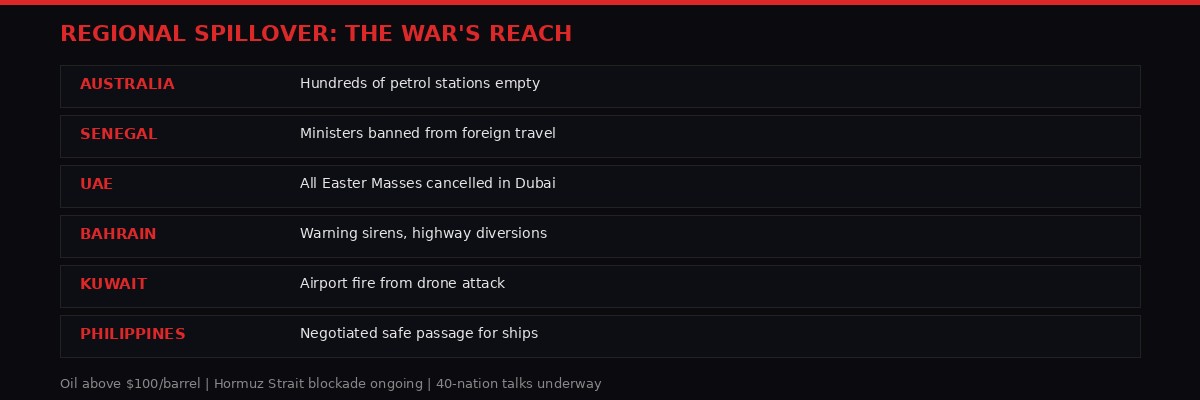
The war reaches far beyond the Middle East. Sources: BBC, Al Jazeera.
The healthcare crisis is unfolding against a broader strategic catastrophe. Iran's blockade of the Strait of Hormuz has halted most shipping through the waterway through which approximately 20 percent of the world's oil and liquefied natural gas supplies pass. Oil prices have surged above $100 per barrel. The United Kingdom is holding talks with approximately 40 countries on reopening the strait. The United States is not participating in those talks. (Source: Al Jazeera, BBC)
The Gulf Cooperation Council's secretary-general has called for the UN Security Council to authorize the use of force to protect the strait from Iranian attacks. The Philippines negotiated separate safe-passage agreements for its flagged vessels. A French-owned CMA CGM container ship became the first European-owned vessel to transit the strait since the war began - a single ship treated as headline news because the normal flow of hundreds of vessels has stopped.
In Australia, hundreds of petrol stations have run out of fuel. Senegal has banned ministers from foreign travel as oil prices bite into government budgets. In the UAE, all Easter Masses in Dubai were cancelled because of the war. A Bangladeshi farmworker in the Emirates was killed by falling shrapnel. In Bahrain, warning sirens sounded multiple times as highway traffic was diverted due to falling debris from intercepted missiles. In Kuwait, a fire at the international airport caused by a drone attack on Wednesday was finally extinguished. (Source: BBC, Al Jazeera)
The destruction of healthcare infrastructure compounds every one of these crises. Iranian strikes on Gulf countries have disrupted shipping routes for medicine and medical supplies. Lebanon's healthcare system, already degraded by the 2019 financial crisis and the 2023-2024 war, now faces the added burden of 1.2 million displaced people requiring care from a system that has fewer hospitals, fewer ambulances, and fewer healthcare workers than it did five weeks ago.
Treatable injuries become untreatable. War wounds that could heal with proper care become chronic infections requiring multiple surgeries over years. Patients needing chemotherapy, dialysis, or psychiatric care are transferred to facilities that are themselves overwhelmed. The cascade effect is not theoretical. It is happening now, documented by WHO, MSF, and the Lebanese Ministry of Public Health.
The Diplomatic Void
Former Iranian Foreign Minister Javad Zarif proposed a peace plan under which Iran would drop nuclear weapons development and the United States would lift sanctions. The US State Department said Trump is "always open to diplomacy" while simultaneously accusing Tehran of seeking a nuclear weapon and threatening to bomb its infrastructure. Russia's Vladimir Putin and Turkey's Recep Tayyip Erdogan called for an immediate ceasefire during a phone call. Pakistan said it would continue trying to mediate but acknowledged "obstacles" to peace efforts. (Source: Al Jazeera, Kremlin)
None of these diplomatic efforts have addressed the destruction of healthcare infrastructure. None have proposed enforcement mechanisms for the legal protections that already exist. None have threatened consequences for belligerents who bomb hospitals. The UN Security Council's unanimously adopted Resolution 2286 - the resolution that condemns exactly what is happening right now - sits unenforced while its two most powerful signatories conduct the attacks it was written to prevent.
The 100-plus legal scholars who signed the Just Security letter urged "US government officials to uphold the UN Charter, international humanitarian law, and human rights law at all times, and to publicly make clear US commitment to and respect for norms of international law." The letter was published on a Thursday. By Friday, the Pasteur Institute had been hit, the Red Crescent warehouse was destroyed, and the Army's chief of staff had been fired. The gap between legal expertise and political reality has never been wider.
What Happens When the Healing Stops
Dewachi's warning about compounding effects deserves more attention than it typically receives. When healthcare infrastructure is destroyed in wartime, the consequences extend decades beyond the conflict itself. Iraq's healthcare system has never fully recovered from the 2003 invasion and subsequent conflict. Syria's medical infrastructure remains devastated. Gaza's hospitals were already shells before the current regional war expanded.
Iran's situation is particularly acute because of the sanctions regime that preceded the war. International pharmaceutical imports were already constrained. Domestic production was not a luxury - it was a necessity. The Pasteur Institute, Tofigh Daru, and other pharmaceutical manufacturers represented Iran's ability to produce the medicines and vaccines that the international community would not sell it. Destroying those facilities does not merely degrade healthcare capacity during wartime. It eliminates healthcare independence for years afterward.
The children who will not receive measles vaccines because the Pasteur Institute's production lines are rubble will not show up in the casualty figures. They will appear as statistics in WHO surveillance reports years from now - outbreaks of preventable diseases in a country that once had the capacity to prevent them. The cancer patients who depended on Tofigh Daru's anticancer agents will not be listed as war dead. They will die in hospital beds, or at home, or in the streets, killed by diseases that could have been treated with drugs that no longer exist because someone decided a pharmaceutical factory was a valid military target.
The psychiatric patients at Delaram Sina, the communities around Ali Hospital in Khuzestan, the emergency patients who can no longer reach Gandhi Hospital in Tehran - these are the invisible casualties of a war that treats healthcare as infrastructure to be degraded rather than a protected category to be preserved.
Ramzi Kaiss of Human Rights Watch said it directly: "There's been continued impunity for such acts and no accountability whatsoever." The accountability mechanisms exist. The International Criminal Court has jurisdiction. The legal frameworks are in place. The evidence is being documented by WHO, MSF, HRW, Airwars, and Forensic Architecture. What is missing is the political will to enforce the rules that every combatant in this war publicly endorsed when they were not the ones breaking them.
The war will end. Wars always do. But the healthcare systems being destroyed right now will not be rebuilt by ceasefire agreements. They will be rebuilt over decades, if at all, by countries whose populations have already suffered immeasurably. The children who die of preventable diseases, the cancer patients who lose access to treatment, the psychiatric patients left without care, the paramedics killed in double-tap strikes while trying to save the wounded - they are the cost of a war that treats hospitals as targets and vaccines as collateral damage.
That cost is being imposed right now, today, documented and verified, while the world watches and issues statements in the passive voice.
GHOST Bureau reports from conflict zones. All sources cited inline. If you have information about attacks on healthcare infrastructure, contact BLACKWIRE securely.
Get BLACKWIRE reports first.
Breaking news, investigations, and analysis - straight to your phone.
Join @blackwirenews on Telegram