Fire on Eid: Settler Mobs Burn West Bank Villages While the World Watches Iran
Settler mobs burned vehicles and homes across multiple villages in the Nablus region during Eid al-Fitr celebrations. Army flares illuminated the night sky. (Illustrative graphic - BLACKWIRE)
The same weekend Iran fired missiles toward Israel's Dimona nuclear site and Trump threatened to obliterate Persian Gulf power plants, Israeli settlers were torching Palestinian cars and homes during the holiest night of the Islamic calendar. They did it in at least ten villages. The world barely noticed.
Over two nights - March 21 and 22 - settler mobs moved through Palestinian communities in the northern West Bank, setting vehicles and homes on fire, pepper-spraying residents, shooting one man in the foot, and leaving at least ten people in the care of the Palestinian Red Crescent Society. The trigger was the death of an 18-year-old Israeli settler in a road collision near Nablus. By the time the Israeli military detained five Israeli civilians, the damage was done.
This is not exceptional. This is the pattern. What is exceptional is how comprehensively it has been buried - not by censorship, but by the gravitational pull of a bigger story sixty miles to the east and a thousand miles southeast, where Iran and the United States are trading threats about power grids.
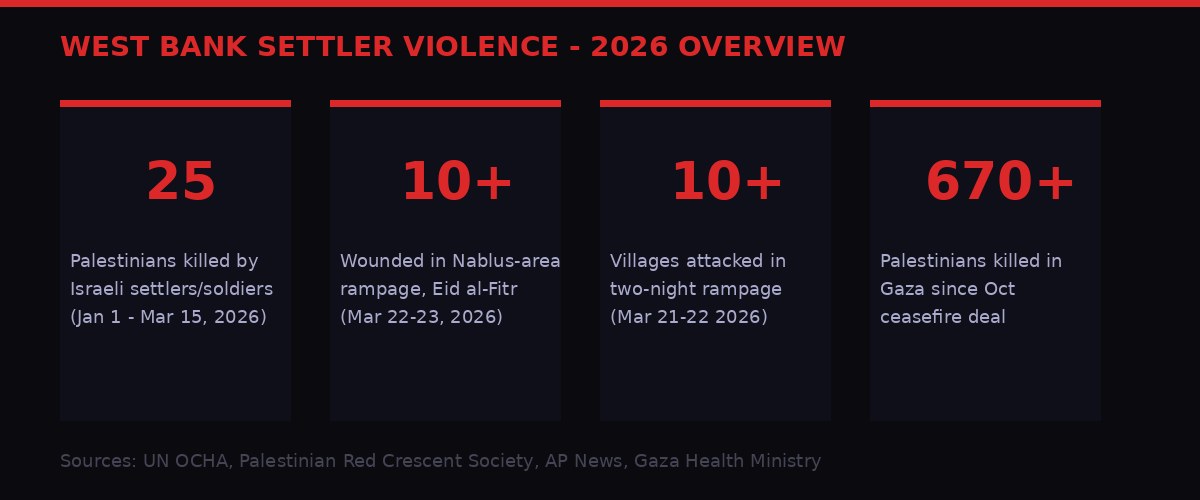
Key statistics on settler violence in the West Bank and Gaza casualties since the October ceasefire deal. Sources: UN OCHA, Palestinian Red Crescent, AP News
The Trigger: A Funeral Becomes a Torch

Israeli army flares lit the sky above villages near Nablus as settler mobs rampaged through residential areas. The military response came after the violence had already spread to four communities. (Illustrative graphic - BLACKWIRE)
On the night of Friday, March 21, Yehuda Sherman - an 18-year-old from the Elon Moreh settlement near Nablus - died in a collision with a Palestinian vehicle on a road north of several Palestinian villages. Police opened an investigation into settler claims that the crash was deliberate. No charges had been filed. No evidence of intent was presented.
That same night, hours before any investigation could produce findings, settler gangs were moving through Palestinian communities. The Palestinian news agency WAFA reported simultaneous attacks on at least six villages: Silat al Dahr and Fandaqumiya near Jenin, Jalud and Salfit south of Nablus, and in the agricultural areas of Masafer Yatta and the Jordan Valley. Homes burned. Cars burned. At least five people were wounded in those first-night attacks, which took place during Eid al-Fitr - the holiday marking the end of Ramadan, one of the most significant celebrations in the Islamic calendar.
The following night, after Sherman's funeral at Elon Moreh, the violence expanded into four more villages in the Nablus area - most significantly Deir al-Hatab, a village directly adjacent to the Elon Moreh settlement. Mourners-turned-mobs moved in after the burial.
"The wounded in Deir al-Hatab included a 45-year-old man shot in the foot and a woman suffering from smoke inhalation." - Palestinian Red Crescent Society statement, March 22-23, 2026
Videos obtained by the Associated Press showed cars and homes in flames as Israeli army flares lit the sky above the village. Smoke rose over multiple neighborhoods. The scenes were shot from a distance - civilian phones, mostly. Few journalists were on the ground to document the systematic destruction.
The Israeli military said that late Sunday, security forces detained five Israeli civilians and confiscated some weapons "as they attempted to restore order." It acknowledged that soldiers and Palestinian civilians had been injured in the chaos. The phrasing - restoring order - implies the military arrived after a state of disorder had already taken hold, which is accurate. Deir al-Hatab had already been burning for hours before any detention occurred.
Not a Rampage - A System
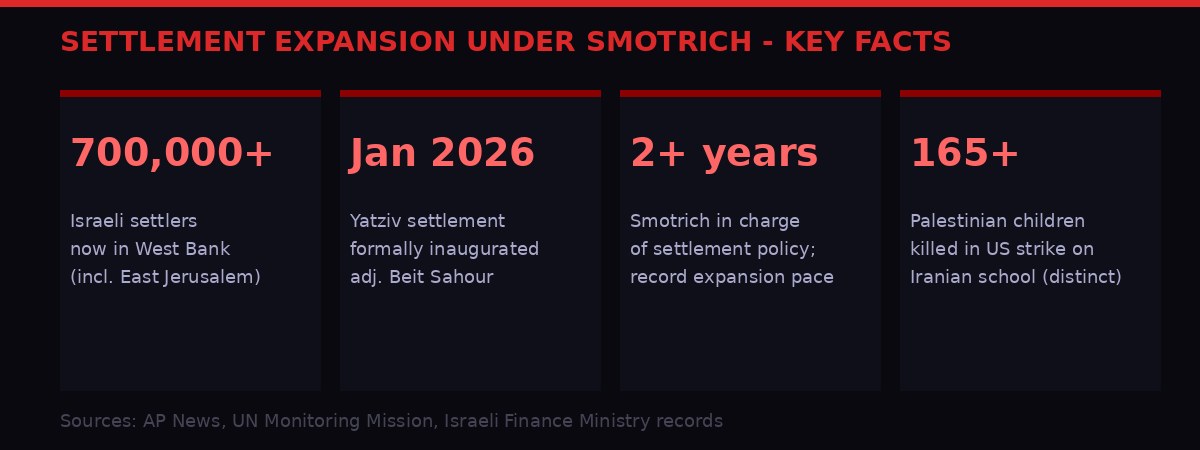
Key facts about settlement expansion under Finance Minister Bezalel Smotrich, who has overseen record-pace recognition of outposts as official settlements since taking control of settlement policy. Sources: AP News, Israeli Finance Ministry
To understand what happened over Eid, it helps to understand the political architecture that enables it. The violence did not emerge from a vacuum. It escalated from a structure of governance that has, since 2022, made settler impunity a feature rather than a bug of Israeli policy in the occupied West Bank.
Finance Minister Bezalel Smotrich holds authority over settlement construction - an unusual arrangement with no real democratic parallel, in which a minister with explicit maximalist territorial ambitions controls the machinery that regulates Palestinian land in occupied territory. Under his tenure, the pace of settlement recognition has accelerated dramatically. In January 2026, Smotrich personally attended the inauguration of Yatziv, a newly-legalized settlement adjacent to the Palestinian town of Beit Sahour, built on land where settlers had blocked a planned Palestinian children's hospital for over a decade.
"We are standing stable here in Israel. We're going to be here forever. We will never establish a Palestinian state here." - Finance Minister Bezalel Smotrich, speaking at the Yatziv settlement inauguration, January 19, 2026 (AP News)
Smotrich and his allies in government operate with a specific theory: that sufficiently dense and legally-recognized settlement presence makes a Palestinian state physically impossible, regardless of what future negotiations might produce. The settlements have to be contiguous enough, numerous enough, and legally enough entrenched that any withdrawal becomes politically unimaginable.
The Elon Moreh settlement, from which the funeral procession launched on March 22, is not a fringe outpost. It was established in 1979, expanded repeatedly, and is home to thousands of residents. The settlement sits directly adjacent to multiple Palestinian villages. Friction is not incidental - it is structural. The proximity is deliberate.
Lt. Gen. Eyal Zamir, head of the Israeli military, publicly condemned the rampage last week, calling it "especially unacceptable during wartime for the military to confront a threatening minority from within." The condemnation is notable - and also largely symbolic. Settler attacks on Palestinian villages, by the UN Office for the Coordination of Humanitarian Affairs count, have continued at elevated levels throughout the Iran war period, as security resources and international attention have shifted elsewhere. As of March 15, 25 Palestinians had been killed by Israeli settlers and soldiers in 2026.
Eid in the Cross-Hairs: Why the Timing Matters
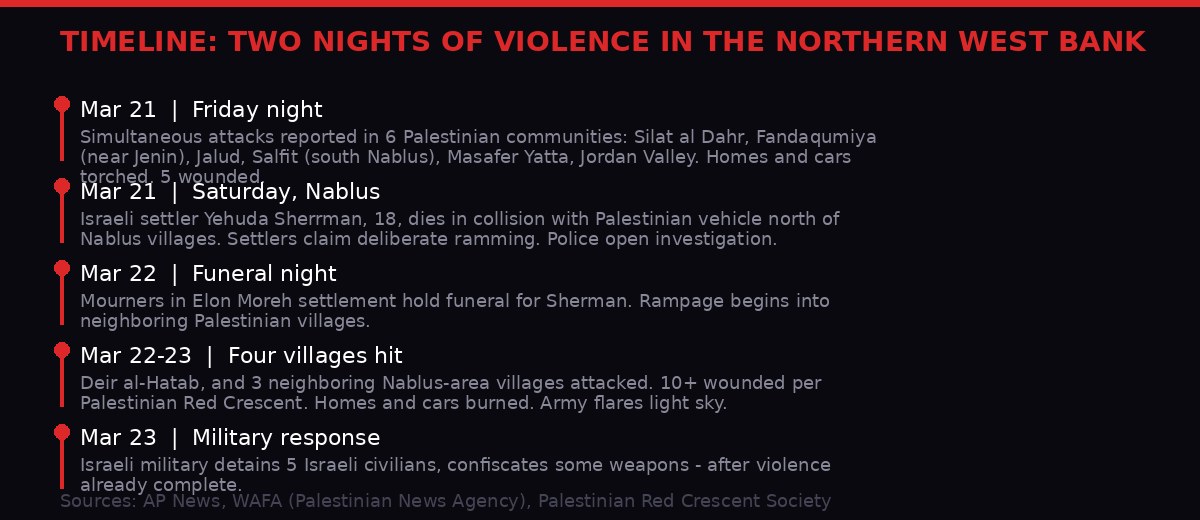
Two-night timeline of the Eid al-Fitr settler rampage across the northern West Bank, March 21-23, 2026. Sources: AP News, WAFA, Palestinian Red Crescent Society
The timing of the attacks is not incidental. Eid al-Fitr is the major communal celebration at the end of Ramadan - a period during which Muslim families gather, visit relatives, and congregate in public spaces. Palestinian communities in the northern West Bank were in the middle of that celebration when the violence hit.
Ramadan in the occupied West Bank has historically been a period of elevated tension. Movement restrictions tighten around Jerusalem. Checkpoint wait times increase. Israeli security presence surges in areas with large Muslim populations. But the holiday period is also supposed to be one where families feel they can gather without fear of armed incursion. That understanding - fragile to begin with - was shattered on both nights of Eid.
The communities targeted span a wide geography. Silat al Dahr and Fandaqumiya are near Jenin, a city already under sustained pressure from Israeli military operations that began intensifying in late 2023. Jalud and Salfit sit in the central West Bank, south of Nablus. Masafer Yatta and the Jordan Valley represent two of the most vulnerable agricultural communities in the south and east - areas where settlers have systematically targeted Palestinian farmers and herders for years. The breadth of the attacks across a single night suggests coordinated intent, not spontaneous reaction to a single road collision.
The Palestinian Authority, for its part, has limited recourse. Its security forces operate under strict geographic and operational constraints defined by the Oslo Accords, which divide the West Bank into Areas A, B, and C - with Area C, comprising roughly 60% of West Bank territory, under full Israeli military and civil control. Many of the villages attacked fall in or adjacent to Area C. Palestinian security forces cannot enter Israeli settlements, cannot detain settlers, and cannot protect Palestinian civilians from settler violence without risking a confrontation with the Israeli military.
"Attacks by settlers - including arsons, shootings and beatings - have intensified as attention shifts to the Iran war." - AP News, March 23, 2026
The Gaza Ceasefire That Keeps Fraying
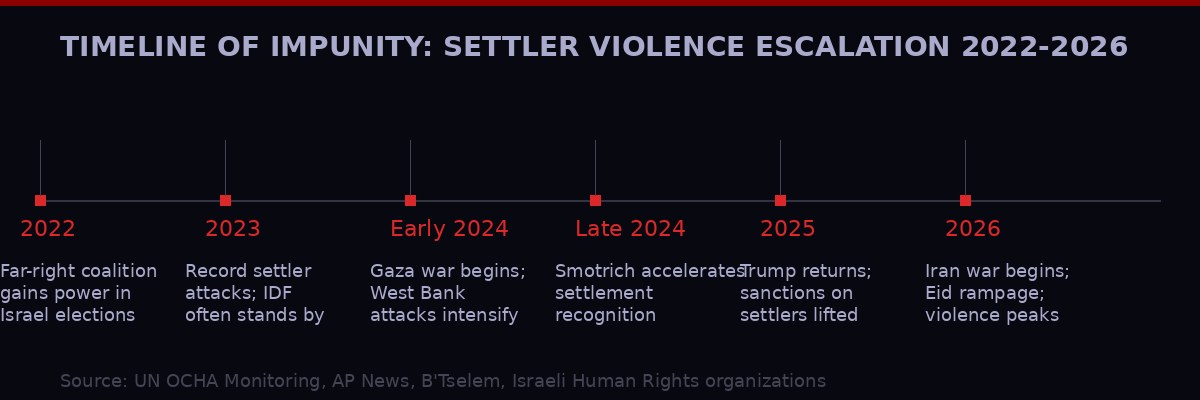
The escalation of settler violence in the West Bank tracked against key political milestones from 2022 to 2026. Sources: B'Tselem, UN OCHA, AP News
While the West Bank saw its Eid rampage, Gaza experienced its own Sunday violence. Four Palestinians were killed in Israeli strikes - three police officers in a vehicle hit in the central Nuseirat refugee camp, and one more person in Gaza City. The Awda and Shifa hospitals received the casualties. Ten others were wounded in the Nuseirat strike alone.
An October 2024 ceasefire deal was meant to halt what had been a more than two-year war between Israel and Hamas. In theory, it did. In practice, Israeli forces have carried out repeated airstrikes and regularly fired on Palestinians near military-held buffer zones since the ceasefire took effect. More than 670 Palestinians have been killed in Gaza since the deal was signed, according to Gaza health officials.
The ceasefire has held as a political label even as it has failed as a physical reality. Israel maintains that it responds only to ceasefire violations and threats to its soldiers. Hamas and Palestinian officials have characterized the ongoing strikes as deliberate harassment designed to make normal life impossible and to preserve Israeli military presence in areas that should have been handed back under the deal's terms.
The practical result is a Gaza population that cannot rebuild, cannot move freely, and buries new casualties every week - while the international community's attention has swiveled almost entirely to the Iran war that erupted February 28, when the United States and Israel began bombing Iranian territory.
The Iran war has cost over 2,000 lives by current AP tallies - including 1,500+ Iranians, 15 Israelis, at least 13 US military personnel, and civilians in Lebanon, where Hezbollah and Israeli forces have been exchanging fire throughout the conflict. Israel has bombed Beirut apartment buildings and Litani River bridges in southern Lebanon. Lebanese President Joseph Aoun called the bridge strikes "a prelude to a ground invasion." Egypt condemned the strikes as collective punishment. Over 1,000 people have been killed in Lebanon and more than one million displaced by Israeli strikes since the broader conflict began.
Against this backdrop, the West Bank and Gaza function as a secondary conflict - familiar enough to produce numbness, distant enough from the Iran war's immediate drama to lose page-one positioning. The bodies still count. The houses still burn. The accounting simply runs later.
Accountability Gap: Who Answers for Settler Violence
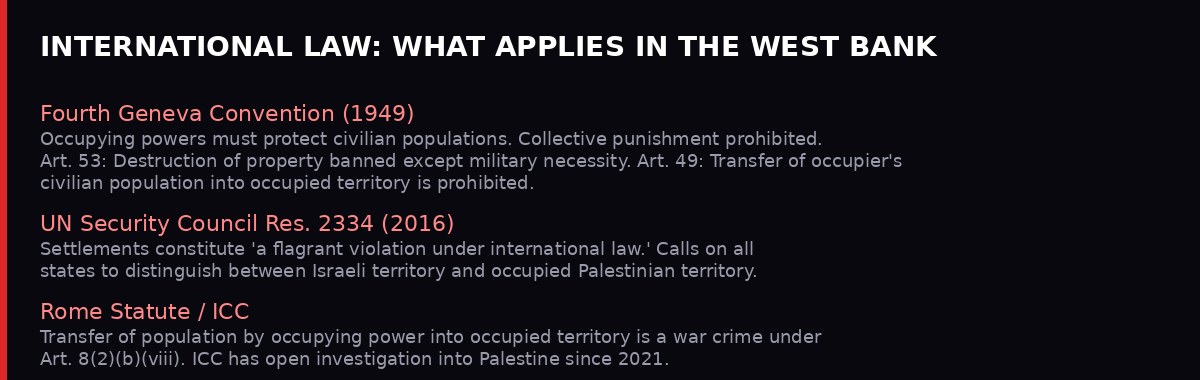
Key provisions of international law governing the West Bank occupation and settler violence. Sources: Fourth Geneva Convention, UN Security Council Resolution 2334, Rome Statute
The five Israeli civilians detained after the Elon Moreh funeral rampage represent a small fraction of the settler violence that has occurred across the West Bank in 2026. Prosecution rates for settler attacks on Palestinian civilians have historically been extremely low. A 2023 review by Israeli human rights organization Yesh Din found that police files were closed without indictment in 93% of cases involving settler attacks on Palestinian civilians. That statistic predates the Iran war period, during which settler violence has intensified while security and judicial resources are strained in other directions.
The international legal framework is clear in principle, if largely unenforced in practice. The Fourth Geneva Convention, to which Israel is a signatory, prohibits collective punishment and requires an occupying power to protect civilian populations under its control. United Nations Security Council Resolution 2334, passed in 2016, stated explicitly that Israeli settlements in Palestinian territory constitute "a flagrant violation under international law" and called on all states to distinguish between Israeli sovereign territory and occupied Palestinian territory.
The International Criminal Court has had an open investigation into the situation in Palestine since 2021, covering both Israeli and Palestinian actions. In 2024, ICC judges issued arrest warrants for Israeli Prime Minister Benjamin Netanyahu and former Defense Minister Yoav Gallant for alleged crimes against humanity in Gaza. Neither has been arrested. The warrants have produced diplomatic friction with ICC member states but no enforcement action.
The Trump administration - which has lifted sanctions on Iranian oil while conducting what legal scholars describe as an escalating war of questionable international legality - has been deeply supportive of the Israeli settlement enterprise. The administration's close ties with Smotrich's faction represent a continuation and intensification of the first Trump term's normalization of settlement expansion. There is no indication the United States intends to hold settler attackers to any standard beyond the Israeli domestic prosecutorial system - the same system that closes 93% of cases without charges.
"We want to leave everything in the country intact, so that the people who come after this regime are going to be able to rebuild and reconstitute." - Israeli Ambassador to Washington Yechiel Leiter, speaking about Iran, not the West Bank - CNN, March 23, 2026
The contrast is instructive. The Israeli government is publicly solicitous about preserving Iranian civilian infrastructure for a future post-regime population - while structurally enabling the destruction of Palestinian homes, vehicles, and livelihoods in territory that Palestinians also hope to govern.
The Strategic Silence: Why Attention Is Currency
There is a structural dynamic at play in how conflicts receive coverage, and the West Bank is losing badly in the current market.
The Iran war has genuine global consequences. The Strait of Hormuz blockade has pushed oil to $113 a barrel (Brent crude, as of Monday morning trading). The IEA's Fatih Birol has called it the worst energy crisis since 1973. Trump's 48-hour ultimatum - threatening to "obliterate" Iranian power plants if Hormuz is not reopened - expired Monday evening Washington time, with Iran promising in response to mine the Gulf and strike regional power infrastructure including the UAE's Barakah nuclear reactor. The stakes of that conflict are genuinely civilizational.
But the concentration of global attention on the Iran war creates a predictable shadow effect in the territories Israel occupies. When the world's cameras are pointing southeast toward the Strait of Hormuz, they are not pointed northeast toward Deir al-Hatab and Elon Moreh. The settler movement - and those in the Israeli government who support and fund it - understands this dynamic. Several analysts who track settlement activity have noted that periods of external Israeli military engagement have historically coincided with accelerated settlement construction and reduced enforcement against settler violence.
The UN OCHA count - 25 Palestinians killed by settlers and IDF soldiers in the West Bank in 2026 through March 15 - does not capture the systematic nature of harassment, arson, and destruction that precedes and surrounds each lethal incident. The 10+ wounded in the Eid rampage were the visible tip. The hours of terror, the burned possessions, the disruption to family celebrations, the demonstration to every Palestinian in those villages that they could be attacked on the most important night of their religious calendar without meaningful consequence - that accumulates into something that does not fit cleanly into a casualty count.
That accumulation is, by design, invisible. Not censored - invisible. It is buried by the same gravity that makes $113 oil a front-page story and a man shot in the foot in Deir al-Hatab a wire brief, if it makes the wire at all.
What Comes Next: Occupation Without Horizon
The West Bank trajectory, absent some dramatic shift in Israeli politics or US policy, points in one direction. The settlement enterprise has been advancing for over five decades. In 2026, it has the wind at its back: a supportive US administration, a far-right Israeli government, international attention consumed by the Iran war, and a Palestinian Authority that is politically weakened, geographically fragmented, and militarily constrained.
The Palestinian population in the West Bank - roughly 3 million people - continues to live under military occupation, with limited movement, no vote in the government that controls their territory, and a legal system that treats settler violence as a low-priority enforcement problem. The Eid rampage is the latest iteration of a dynamic that has been running continuously since 1967, accelerating particularly since 2022.
Gaza, meanwhile, is in a condition that multiple UN agencies have described as approaching unlivability. The October ceasefire was supposed to create conditions for reconstruction and humanitarian access. Instead, over 670 people have been killed since the deal was signed. The 2+ million people of Gaza lack adequate food, water, medical care, and shelter. Reconstruction cannot proceed under active military pressure.
The Lebanon front adds a third theater. Over one million people displaced, over 1,000 killed, bridges cut - with the Lebanese president warning of ground invasion and Egypt condemning the destruction as collective punishment of civilians. If Israel does launch a ground operation in southern Lebanon while simultaneously conducting the Iran war, it would be managing three simultaneous military campaigns, each with its own casualty dynamics, each requiring international attention it cannot fully receive while the Iran story dominates.
The civilians in all three theaters share one characteristic: they have the least control over the forces that determine whether they live or die, and the least access to the international political processes that might constrain those forces. The people of Deir al-Hatab celebrated Eid with army flares over their rooftops and fires in their streets. The people of Gaza buried four more dead on Sunday. The people of southern Lebanon sleep under the sound of jets.
None of it stops when the cameras stay on Iran.
Key Figures - West Bank Violence, March 2026
- 10+ - Palestinians wounded in Nablus-area Eid rampage, March 22-23 (Palestinian Red Crescent Society)
- 6 - Villages attacked in overnight assaults on Friday, March 21 (WAFA, Palestinian News Agency)
- 4 - Villages targeted in second-night rampage, March 22-23 (AP News)
- 25 - Palestinians killed by Israeli settlers and soldiers in the West Bank from January 1 to March 15, 2026 (UN OCHA)
- 670+ - Palestinians killed in Gaza since October ceasefire deal (Gaza Health Ministry)
- 5 - Israeli civilians detained after the rampage (Israeli military statement)
- 93% - Rate at which Israeli police closed settler attack files without indictment (Yesh Din, 2023)
- 1,000+ - Killed in Lebanon by Israeli strikes since conflict began (Lebanese health officials)
Get BLACKWIRE reports first.
Breaking news, investigations, and analysis - straight to your phone.
Join @blackwirenews on Telegram