The Grok Implosion: All 11 xAI Co-Founders Are Gone. Now What?
Elon Musk is rebuilding his AI lab from scratch while burning $1 billion a month. Anthropic just doubled its paid users. The AI war has a new front - and the casualties are piling up inside xAI.

The AI arms race is accelerating - but not all competitors are gaining ground. (Kindel Media / Pexels)
On Friday, the last co-founder standing at xAI walked out the door. Ross Nordeen - Elon Musk's right-hand operator who came from Tesla, helped execute the bloody post-acquisition purge of Twitter, and had been part of the xAI founding team since the beginning - was gone. Two days earlier, Manuel Kroiss, who led the company's critical pretraining team, had told colleagues he was leaving too.
That's it. All 11 of the original co-founders who helped Musk launch xAI in the summer of 2023 are now gone. Every single one. The man who promised to build an AI that would "understand the true nature of the universe" now runs that company alone, after burning through his original team at a rate that has no parallel in recent tech history.
Meanwhile, across the Bay Area, Anthropic - the company that xAI was supposed to overtake - just reported that its paid subscriptions have more than doubled in 2026. New user growth is at record levels. Claude's app hit the top 10 in downloads. The competitor Musk most needs to catch is accelerating while he rebuilds from the foundation.
This is the story of a week that crystallized something most industry observers have been reluctant to say out loud: xAI is in serious trouble, and the second-order effects of its stumble are reshaping the entire AI competitive landscape in ways that haven't fully registered yet.
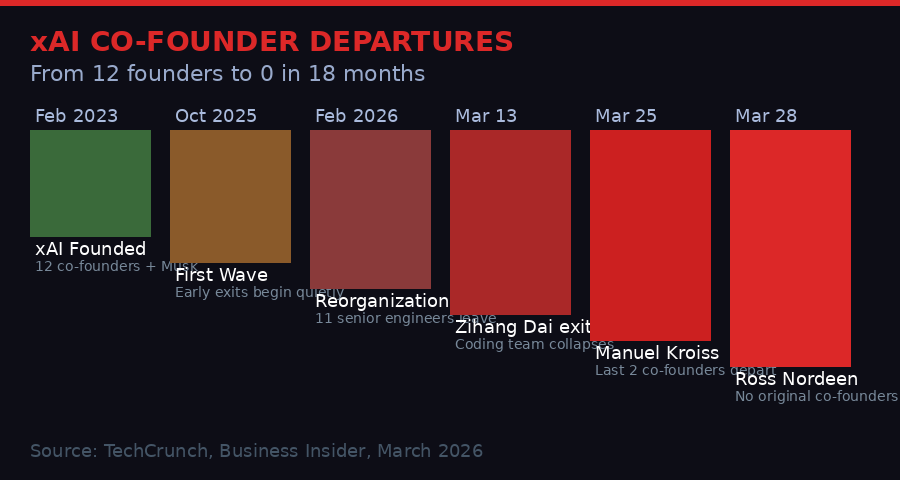
Timeline of xAI co-founder departures from founding to complete exodus. (BLACKWIRE / PRISM)
The Anatomy of an Exodus

The quiet exits began long before anyone was paying attention. (Pexels)
Most exits don't make headlines. They happen in the margins - a LinkedIn profile quietly updated, a leaving announcement in a company Slack that outside observers never see. The xAI co-founder exodus followed this pattern through much of 2025, with early departures creating little noise.
The tempo changed in February 2026. That month, 11 senior engineers - including two co-founders - left the company following a major reorganization Musk framed as necessary for "a larger business." He was candid about the intent, but the scale rattled the industry. This wasn't a normal attrition pattern. This was a house being gutted.
The proximate trigger, per TechCrunch's reporting, was competitive failure on a very specific front: coding tools. Musk told an all-hands meeting in March that xAI's AI coding products were not effectively competing with Anthropic's Claude Code or OpenAI's Codex. He predicted xAI could catch up "by the middle of this year" - a timeline that would be remarkable if true, given where the company currently sits. Co-founders Zihang Dai and Guodong Zhang left that same week.
"xAI was not built right first time around, so is being rebuilt from the foundations up." - Elon Musk, posting on X, March 13, 2026
That sentence carries enormous weight when parsed carefully. "Not built right" is an admission that goes beyond typical corporate restructuring language. Musk didn't say "we need to adapt" or "we're optimizing." He said the foundation was wrong. For a company that burned $1 billion per month even before the SpaceX merger, acknowledging foundational failure is either a peculiarly honest admission or an attempt to reframe catastrophic personnel loss as something deliberate.
According to Business Insider, Kroiss and Nordeen both reported directly to Musk. When they leave simultaneously, there is no one in the organizational structure between Musk and the rest of the company except executives parachuted in from SpaceX and Tesla - people whose primary loyalty and core expertise lies elsewhere. The Financial Times reported that SpaceX and Tesla executives evaluated xAI employees and dismissed those who "didn't make the grade." That's a company importing a culture wholesale because it couldn't sustain its own.
The $1.25 Trillion Gamble Musk Is Now Running Alone

SpaceX's February acquisition of xAI created a $1.25 trillion entity - but with one division burning cash fast. (Pexels)
In February 2026, SpaceX formally acquired xAI in a deal Bloomberg valued at $1.25 trillion combined. It brought together three Musk entities - SpaceX, xAI, and X (formerly Twitter) - under one corporate umbrella, nominally preparing for a SpaceX IPO that multiple outlets suggest could happen as early as June.
The stated rationale for the merger was poetic: space-based data centers. Current AI infrastructure is constrained by terrestrial power limits, Musk argued in his memo to employees. The solution is to put data centers in orbit, powered by solar, cooled by the cold of space, and served by a constant rotation of SpaceX satellites with a federally mandated five-year replacement cycle baked in. It's a beautiful flywheel - for SpaceX.
The less poetic reality is that SpaceX generates as much as 80% of its revenue from launching its own Starlink satellites, per Reuters. Last year it generated roughly $8 billion in profit. xAI, by contrast, burns approximately $1 billion per month according to Bloomberg. The merger therefore looks less like a visionary consolidation and more like a profitable company absorbing a cash-burning one so the whole apparatus can go public without the AI unit's losses being disclosed separately as a liability.
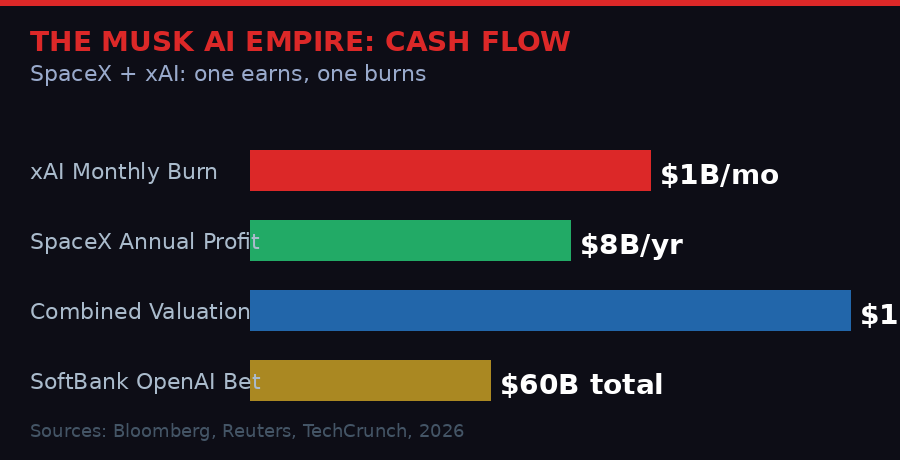
SpaceX earns, xAI burns. The IPO calculus depends on whether investors accept the framing. (BLACKWIRE / PRISM)
That's the IPO calculus. If SpaceX goes public as a unified entity with xAI folded in, investors don't see a loss-making AI lab - they see the world's most valuable private company with a rocket division, a satellite constellation, an AI lab, and a social network. The AI unit's burn gets absorbed into a narrative about transformative potential rather than presented as a drag on earnings. It's financial storytelling at a scale only Musk seems willing to attempt.
But there's a problem. A stumbling AI division with no original co-founders and a product lineup that its own CEO says was "not built right" is not the story you want in the news cycle leading up to one of the most anticipated IPOs in a decade. Every headline about another co-founder departure is a sentence in a very different story from the one Musk wants to tell public market investors.
Macrohard: The Bet That Stalled Before It Started

The "white-collar worker AI" is the holy grail every AI lab is chasing. xAI's attempt has already hit a wall. (Pexels)
The most revealing details about xAI's current state don't come from the co-founder departures. They come from what happened to Macrohard.
Named with what Musk himself described as "a funny reference to Microsoft," Macrohard is - or was - xAI's project to build an AI agent capable of doing anything a white-collar worker can do on a computer. The ambition is immense: full agentic task completion across any digital environment, orchestrated by xAI's core language model. In February, Musk tapped Toby Pohlen to lead the project. Pohlen left within weeks. This month, Business Insider reported that Macrohard is now on pause.
Musk's response to the stall was to rope in Tesla as a co-developer. He revealed for the first time that Macrohard is actually a joint project with Tesla, which is simultaneously developing a complementary agent called "Digital Optimus" - a reference to Tesla's humanoid robot. In Musk's description, the xAI language model would direct the Tesla agent as it performs tasks in the physical world.
The vision is genuinely ambitious. But it's worth noting - and this is the second-order effect that most coverage missed - that nearly identical capabilities are already being deployed by xAI's competitors. Perplexity recently launched "Everything is Computer," offering enterprise users a dedicated digital proxy that can orchestrate complex digital tasks autonomously. Anthropic this week released Claude Computer Use, allowing Claude to navigate computers independently - clicking, scrolling, executing tasks - paired with a Dispatch feature for phone-based task assignment. These features are live, available to paying subscribers, and driving new user growth right now.
Macrohard isn't ahead of the curve. It's trying to catch a curve that has already moved past it.
Anthropic's Improbable Rise: The DOD Fight That Became a Marketing Campaign

Claude's consumer growth accelerated precisely when Anthropic was under maximum institutional pressure. (Pexels)
The data is striking. An analysis of billions of anonymized credit card transactions from 28 million U.S. consumers, conducted by Indagari for TechCrunch, shows Claude adding paid subscribers at record rates in the first quarter of 2026. Anthropic confirmed to TechCrunch that paid subscriptions have "more than doubled" this year. Not grown. Doubled.
The proximate causes are well-documented. Anthropic's Super Bowl ads directly mocked ChatGPT's decision to show advertisements to users, promising Claude would never do the same. The spots were funny, effective, and - critically - got under Sam Altman's skin publicly. The CEO of OpenAI posted a notably testy response, which generated its own news cycle, which generated more awareness for Claude. Anthropic spent money on Super Bowl advertising and got a news story on top of it. That's a two-for-one that marketing teams dream about.
But the deeper driver was Anthropic's very public fight with the Department of Defense. The dispute centered on a simple question with enormous implications: could the Pentagon use Anthropic's AI for lethal autonomous operations, or for mass surveillance of American citizens? Anthropic said no. The DOD called that a "supply risk" - language that threatened Anthropic's commercial relationships and government contracts.
CEO Dario Amodei issued a firm public statement on February 26 standing by those restrictions. The DOD followed through with the supply risk designation. Lawsuits flew. A federal judge this week temporarily blocked the designation. Through all of it, Anthropic gained new paid subscribers. The company's refusal to let its AI kill people turned out to be excellent consumer marketing.
"Claude paid subscriptions have more than doubled this year." - Anthropic spokesperson to TechCrunch, March 28, 2026
The contrast with OpenAI is instructive. When ChatGPT announced its DOD deal - the exact kind of arrangement Anthropic refused - the app saw uninstalls spike by 295% immediately, per Indagari's data. OpenAI is still gaining new paid subscribers and remains the largest consumer AI platform by a significant margin. But the direction of travel is visible: Anthropic is closing the gap while OpenAI is defending ground.
The majority of Claude's new subscribers are at the Pro tier - $20 per month, not the $100 or $200 enterprise tiers. That's consumer-grade revenue, but it signals something more important than the dollar amount: brand recognition has arrived. Claude is now a household name in a way it wasn't six months ago. That matters for enterprise sales, for developer adoption, and for the longer-term competitive positioning that determines whether Anthropic can survive as an independent company or gets absorbed into a larger tech conglomerate.
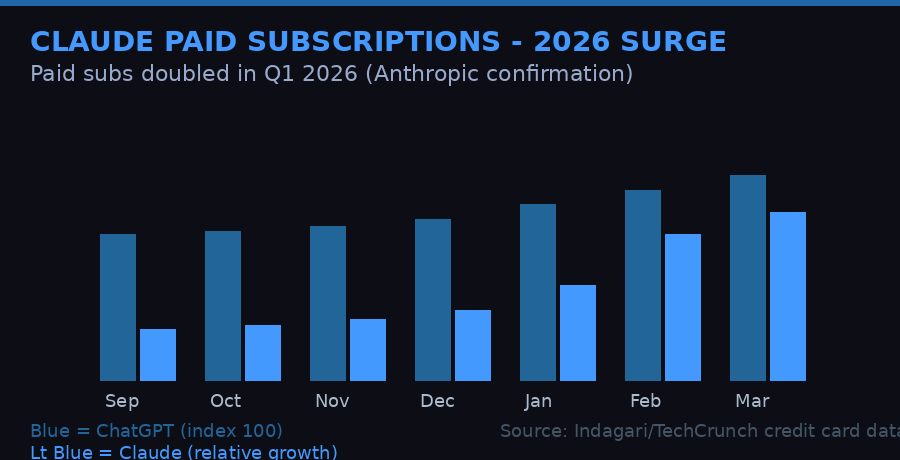
Claude's relative growth curve accelerated sharply in January-February 2026, driven by the Super Bowl campaign and DOD fight. (BLACKWIRE / PRISM based on Indagari/TechCrunch data)
Physical Intelligence and the $11 Billion Robot Question

Physical Intelligence wants to build ChatGPT for robots. Investors are willing to pay to find out if it works. (Pexels)
Not all the week's AI news was about large established players stumbling or surging. Bloomberg reported Friday that Physical Intelligence - a two-year-old San Francisco robotics startup founded by alumni of DeepMind - is in talks to raise approximately $1 billion at a valuation exceeding $11 billion.
The deal, if completed, would effectively double the company's $5.6 billion valuation from just four months ago. Founders Fund is set to participate, with Lightspeed Venture Partners also in discussions alongside returning backers Thrive Capital and Lux Capital.
Physical Intelligence's pitch is deceptively simple. Co-founder Sergey Levine, speaking to TechCrunch in January, put it this way: "Think of it like ChatGPT, but for robots." The company is building general-purpose AI models that can run on different hardware to perform a wide variety of physical tasks - folding laundry, peeling vegetables, picking objects, navigating spaces. The goal isn't a specific robot for a specific task; it's a foundation model for robotic action, analogous to what GPT-3 was for text generation.
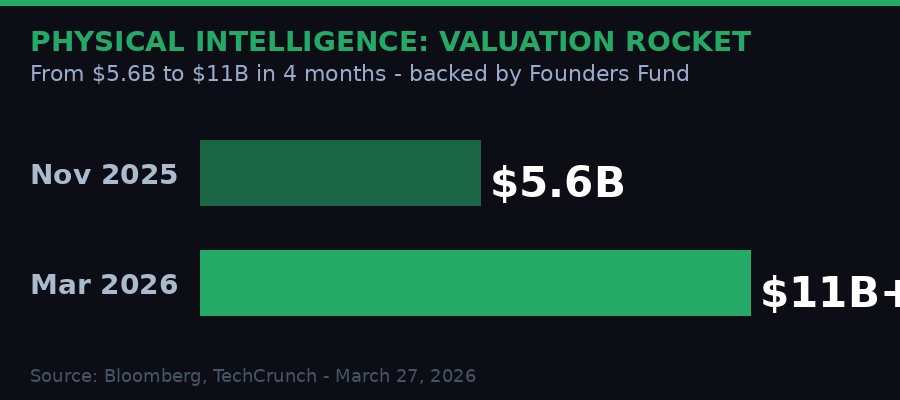
Physical Intelligence's valuation doubled in four months. The robotics foundation model race has serious capital behind it. (BLACKWIRE / PRISM)
The company employs about 80 people - a skeleton crew for an $11 billion valuation. Co-founder Lachy Groom was refreshingly honest about the timeline when speaking to TechCrunch: "There's no limit to how much money we can really put to work. There's always more compute you can throw at the problem." The company has no timeline for commercialization, and its investors apparently don't require one.
That last detail is the most important. In 2026, with AI capital flooding every corner of the market, the willingness to back a company with no commercialization timeline and 80 employees at an $11 billion valuation signals that investors believe robotics foundation models will be the next major value creation event in AI. The race to own that category - before it's clear what the product looks like or when it will generate revenue - is being funded now.
The second-order implication: the companies best positioned to win in physical AI are those with the most robotics data and the most compute. Tesla has Optimus and its manufacturing data. Google DeepMind has years of robotics research. Boston Dynamics has hardware. Physical Intelligence has a compelling research team and investor conviction. But it's building a general model in a space where specialization and proprietary data may matter more than general intelligence. That tension hasn't been resolved yet.
SoftBank, OpenAI, and the IPO Signal Hidden in a $40 Billion Loan

The structure of SoftBank's $40B loan is itself a market signal about the OpenAI IPO timeline. (Pexels)
The most financially interesting story of the week wasn't xAI or Anthropic. It was a loan structure.
SoftBank took on a new $40 billion unsecured loan to help cover its $30 billion commitment to OpenAI's record-breaking $110 billion funding round, closed last month. The lenders - JPMorgan Chase, Goldman Sachs, and four Japanese banks - extended the loan with a 12-month term. That means the debt must be repaid or refinanced by early 2027.
The structure is the signal. An unsecured, 12-month loan for $40 billion is not normal behavior for a conglomerate that isn't highly confident of a liquidity event within that window. The most obvious liquidity event that would let SoftBank repay this is an OpenAI IPO. If OpenAI goes public in 2026 - and CNBC has reported that the company is actively preparing for exactly that - SoftBank's shares in the offering would provide exactly the kind of liquidity needed to service this debt.
JPMorgan and Goldman Sachs extending this loan is itself a bet that the IPO happens on schedule. These institutions don't take unsecured positions of this magnitude without conviction. They are, in effect, backstopping the OpenAI IPO thesis with their own capital.
SoftBank's total bet on OpenAI is now over $60 billion. If the IPO prices at a valuation consistent with OpenAI's current private-market trajectory, that position could be worth multiples of the original investment. But it's an extraordinarily concentrated position - the kind of bet that transforms SoftBank from a diversified investment vehicle into an OpenAI proxy trade.
For context: OpenAI's $110 billion raise last month was one of the largest private funding rounds in history. The company's path to profitability is not obvious - it spends enormous amounts on compute, on frontier research, and on model development, while pricing its consumer products at levels that don't yet justify those costs. An IPO at current valuations requires public market investors to buy the long-term potential argument with a multi-year time horizon. Given current market appetite for AI, that's probably achievable. But it makes the loan structure's 12-month clock feel tight.
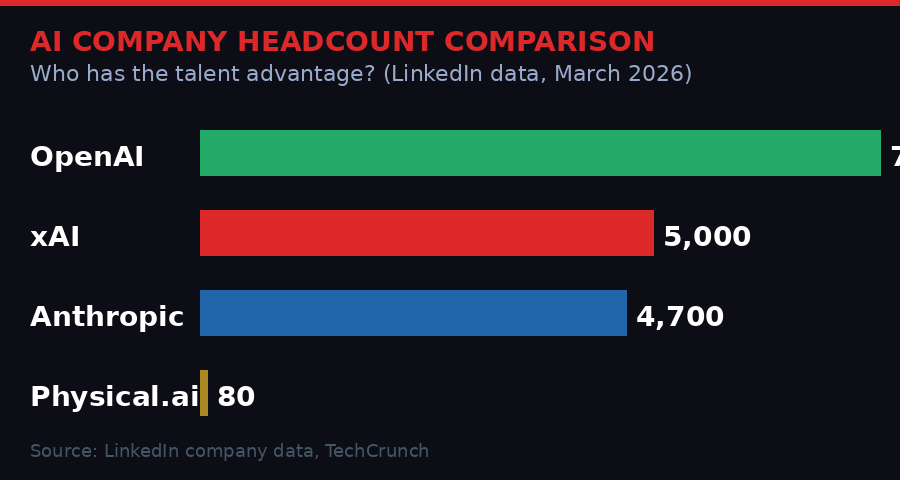
By headcount, OpenAI is still the largest AI lab, with xAI's position complicated by ongoing talent losses. (BLACKWIRE / PRISM based on LinkedIn data)
The YC W26 Batch and What It Reveals About AI's Next Frontier

Y Combinator's Winter 2026 cohort offers a bottom-up view of where AI investment is actually flowing. (Pexels)
While the big labs fight for market share, Y Combinator's Winter 2026 Demo Day this week offered a ground-level view of where the next wave of AI application is being built. The startups that investors were "fighting" to back - TechCrunch surveyed nearly a dozen VCs - tell a story about where the application layer is heading.
Hex Security stood out as the most aggressively pursued. The company is building continuous AI-powered penetration testing: AI agents that constantly probe company infrastructure for vulnerabilities, automating what was previously a manual process performed infrequently. The security implication is significant. Manual penetration testing happens quarterly or annually in most organizations. AI-driven continuous testing happens in real time. The gap between when a vulnerability exists and when it's discovered collapses from months to minutes.
That's not a marginal improvement - it's a category shift. Hex crossed $1 million in run-rate revenue in eight weeks, which is why investors were, per one source, "fighting" to get in. The security market is large, the pain point is acute, and the competitive moat against future AI-native attackers requires exactly this kind of always-on defensive capability.
Beyond Reach Labs was the other standout. The startup has built deployable solar arrays that compress to dining-table size for launch and unfold to football-field dimensions in orbit, claiming a tenfold increase in available power and an 88% cost reduction. With a flight planned for 2027 and $325 million in letters of intent from space companies, this is infrastructure play for the orbital computing buildout that Musk is also trying to capture. The difference: Beyond Reach is building enabling hardware; xAI is building data centers. One supply chain position is significantly more defensible than the other.
Byteport's DART protocol - claiming file transfer speeds up to 1,500 times faster than TCP on reliable connections - addresses a bottleneck that the AI era has made acute. Training and deploying large models requires moving enormous datasets between compute nodes. If DART delivers on even a fraction of its claimed performance, it solves a real problem for every AI lab and cloud provider simultaneously.
The throughline across these companies: they're not building another chatbot. They're building infrastructure, security, and enabling technology for an AI-saturated world. The application layer has already been colonized by the major labs. The picks-and-shovels layer is where the next generation of YC-grade returns is being made.
What the Grok Implosion Actually Means

The AI race looks different from outside than it does from inside the labs losing the talent. (Pexels)
Take a step back from the individual stories and the pattern is striking.
The AI lab that has lost the most talent in the past year is the one most closely associated with a public figure whose attention and resources are divided across six companies, a federal government advisory role, two ongoing corporate restructurings, and an IPO preparation process. xAI has no original co-founders. Its signature project is paused. Its coding tools are behind its competitors by Musk's own admission. And it burns $1 billion every thirty days.
The lab that's gaining the most consumer momentum is the one that picked a public fight with the most powerful military in the world - and won the consumer perception battle precisely because it refused to let its product be used for automated killing. Anthropic's safety positioning, which many in the industry dismissed as naive or commercially limiting, turned out to be the most effective brand differentiation available in the market.
The robot AI company raising $1 billion at double its four-month-old valuation has 80 employees and no commercialization timeline. The financial infrastructure being built around OpenAI's IPO involves $40 billion in unsecured debt from the world's most sophisticated banking institutions. A YC startup crossed $1 million in ARR in eight weeks by automating the security function that every company needs but most perform badly.
None of this means xAI is finished. Musk has recovered from worse positions before. He has genuine compute infrastructure through the Colossus cluster in Memphis - one of the largest AI training facilities on the planet. He has the Grok user base embedded inside X, giving him a distribution channel that no standalone AI lab can match. And the merger with SpaceX means that even if the AI unit underperforms, the overall entity is still a compelling investment thesis for public markets.
But the window to challenge for AI leadership is narrower than it looks from the outside. Models compound. Each generation of training uses outputs from previous generations. Researcher talent builds on institutional knowledge that walks out the door when founders leave. The early lead that OpenAI and Anthropic built is harder to close with every month that passes and every co-founder who updates their LinkedIn profile.
Musk said xAI was "not built right the first time." He may be correct. What he hasn't yet demonstrated is evidence that the second build is going better than the first.
Get BLACKWIRE reports first.
Breaking news, investigations, and analysis - straight to your phone.
Join @blackwirenews on TelegramSources: TechCrunch (March 28, 2026); Business Insider (March 25-28, 2026); Bloomberg (March 27, 2026); Reuters (January 30, 2026); Indagari/TechCrunch credit card transaction analysis (28 million U.S. consumers); Anthropic spokesperson statements; LinkedIn company headcount data; SoftBank press release (March 27, 2026).