Yemen's Second Chokepoint: The Houthis Are Running Out of Patience
Day 28 of the US-Israel war on Iran. The Strait of Hormuz is effectively closed. Nearly 2,000 ships sit stranded. But there is a second chokepoint - Bab al-Mandeb - and the Houthis, who control it, haven't moved yet. That silence is about to end.

A maritime chokepoint under strategic pressure. Photo: Pexels
Twenty-eight days into the US-Israel war on Iran, and the map of the conflict keeps expanding. Iran bombed Israel again on Thursday. Hezbollah is fighting Israeli ground troops inside Lebanon. Gulf air defences have shot down dozens of Iranian drones over Saudi Arabia, Bahrain, and the UAE. The Strait of Hormuz - the jugular of the global energy system - is controlled by the IRGC, with a "toll booth" now operating to let pre-approved ships through at $2 million a passage.
But Abdel-Malik al-Houthi, the supreme leader of the Houthi movement that governs northwestern Yemen, has so far kept one card face-down on the table. His faction controls the Bab al-Mandeb Strait - the gateway between the Red Sea and the Gulf of Aden, through which roughly 15 percent of global seaborne trade passes. It is the second chokepoint. And analysts who have spent years watching the Houthis say the calculation of whether to play that card is happening right now.
"As the people of Yemen, we repay loyalty with loyalty," al-Houthi said on Thursday, March 27. "Any development in the battle that requires a military response, we will promptly undertake it - just as we did in previous rounds." [Al Jazeera]
That is not a statement of restraint. That is a countdown.
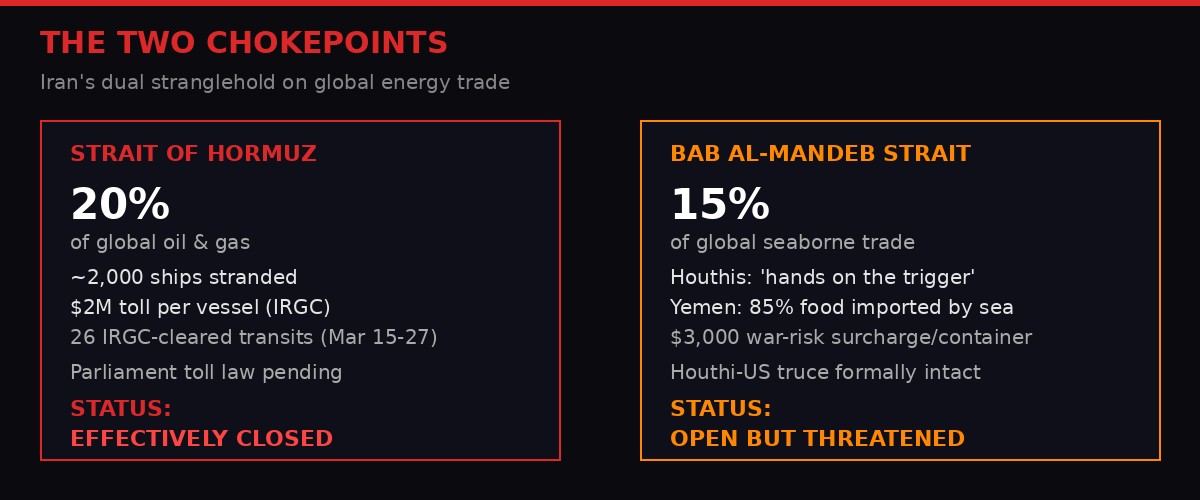
The two chokepoints - Hormuz is already under IRGC control; Bab al-Mandeb remains the Houthis' unplayed card. Source: BLACKWIRE analysis, Al Jazeera, Lloyd's List.
The Strategic Patience Running Thin

Night operations. Photo: Pexels
From the day the US-Israel war on Iran began - February 28, 2026, the date US and Israeli forces struck Iran following the assassination of Supreme Leader Ali Khamenei - the Houthis have been watching. They did not immediately join the "Axis of Resistance" in firing on American assets or Israeli cities. They held.
That restraint had a clear rationale. Last August, Israeli airstrikes obliterated the top tier of Houthi leadership in Sanaa. Prime Minister Ahmed al-Rahawi was killed. Chief of staff Mohammed al-Ghumari was killed. Twelve senior figures in a single campaign. The Houthis absorbed that decapitation strike, but they did not forget it. Their leaders became acutely aware that Israeli and American intelligence could find them. [Al Jazeera, March 7]
"The group seems to fear Israeli intelligence and the possibility of leadership decapitation," said Luca Nevola, senior analyst for Yemen and the Gulf at the ACLED conflict monitor, speaking to Al Jazeera. "Houthi intervention remains a possibility, and it could take the form of a phased escalation. At the current stage, the main Houthi priority remains avoiding direct US and Israeli retaliation."
But patience has a ceiling. The conditions that might push the Houthis past that ceiling are tightening. An Iranian military official told Tasnim News Agency on March 21 that any US aggression against Iran's oil facilities on Kharg Island would pave the way for Tehran to destabilise both the Red Sea and the Bab al-Mandeb Strait. That is the signal the Houthis have been waiting for - not a direct order, but permission.
Sadam al-Huraibi, a Yemeni political commentator, is blunt about where this leads. "I believe that the Houthis' entry into the war is only a matter of time," he told Al Jazeera. "If the Israeli-American attacks on Iran do not stop, the Yemeni group will not stand idly by endlessly. The Houthis are preparing for war in Sanaa and the provinces they control."
What Bab al-Mandeb Actually Means

Cargo ships represent the arteries of global trade. Photo: Pexels
Bab al-Mandeb - Arabic for "Gate of Grief" - sits at the southern end of the Red Sea, between Yemen on the north and Djibouti and Eritrea on the south. It is 29 kilometers wide at its narrowest. Through it passes approximately $1 trillion in goods annually. Oil from the Gulf, consumer goods from Asia, grain from Europe and South America - all of it bottlenecked through a gap barely wider than a small city.
The Houthis demonstrated from late 2023 through 2025 that they could make the strait dangerous. During their Red Sea campaign in support of Gaza, they sank four ships, killed at least nine mariners, and forced major shipping lines to reroute around Africa - adding two to three weeks and up to $1 million per voyage to journey costs. Global insurance premiums spiked. Container rates tripled on key routes.
That was with a limited targeting mandate. The Houthis were hitting vessels they classified as connected to Israel or the US, with a stated political objective. A full wartime commitment - coordinated with Iranian targeting data and timed to coincide with a degraded Israeli and American air defence posture - would be a different operation.
"Houthi long-range drone and missile attacks against Gulf states and Israel could prove more effective at a later stage of the conflict, when air defence systems may face resupply constraints," Nevola told Al Jazeera. "The opening of an additional southern front could place further strain on Israel's air defence."
The Houthis possess ballistic missiles with range sufficient to strike the UAE, Saudi Arabia, and Israel itself. They have cruise missiles and armed drones. Their naval attack capabilities include waterborne IEDs, fast-attack craft, and anti-ship missiles. During their previous Red Sea campaign, they fired on Saudi Aramco facilities and Emirati airports. What they haven't done is execute a full simultaneous campaign against shipping, Gulf energy infrastructure, and Israeli population centers at the same moment.
That combination - if deployed while the Strait of Hormuz remains closed under IRGC control - would constitute the most severe constriction of global energy trade since the 1973 oil embargo. Possibly worse.
Yemen's Civilian Catastrophe: The Population in the Crossfire

Yemen remains one of the world's worst humanitarian crises. Photo: Pexels
Here is the horrifying arithmetic of a Houthi entry into the wider war: the people who would suffer most immediately are Yemeni civilians. Not the ones in Gulf capitals, not shipping company shareholders in London, not fuel traders in Singapore. The 30-plus million Yemenis who import 85 percent of their food by sea.
Mustafa Nasr, head of the Studies and Economic Media Center, told Al Jazeera that the consequences would be a "tremendous blow" to Yemen's already devastated economy. "Yemen depends on imports for petrol, diesel and food commodities. The chaos in the waterway off the country will disrupt the shipping operations, which can result in immediate price hikes. With no substitutes, Yemeni civilians will bear the brunt."
Already, just the threat of Houthi involvement - without a single shot fired at Bab al-Mandeb - is reshaping Yemen's economic reality. International shipping companies have imposed a $3,000 "war risk" surcharge on every container bound for Yemen. That fee exists even now, when the strait is technically open. [Al Jazeera, March 14]
"Take an example: a four-member family can live off three dollars a day. But if transportation fees increase and prices of goods jump because of shipping risks, the three dollars cannot help protect this family against hunger." - Laila, 26-year-old volunteer, Sanaa
Laila, speaking to Al Jazeera from Sanaa, is not a politician or an analyst. She is one of the millions of people who would pay the price of a strategic decision made by men with guns, in capitals they have never visited. She volunteers with local humanitarian initiatives. She knows what $3 a day actually buys in a city already stretched to its limits.
Yemen entered this conflict already broken. Seven years of civil war. A humanitarian crisis that the United Nations has repeatedly called the world's worst. Infrastructure in ruins. The healthcare system running on borrowed time and international aid. Adding a naval chokepoint confrontation to that context doesn't create a crisis - it transforms an existing one into something that international aid organizations may not be equipped to address.
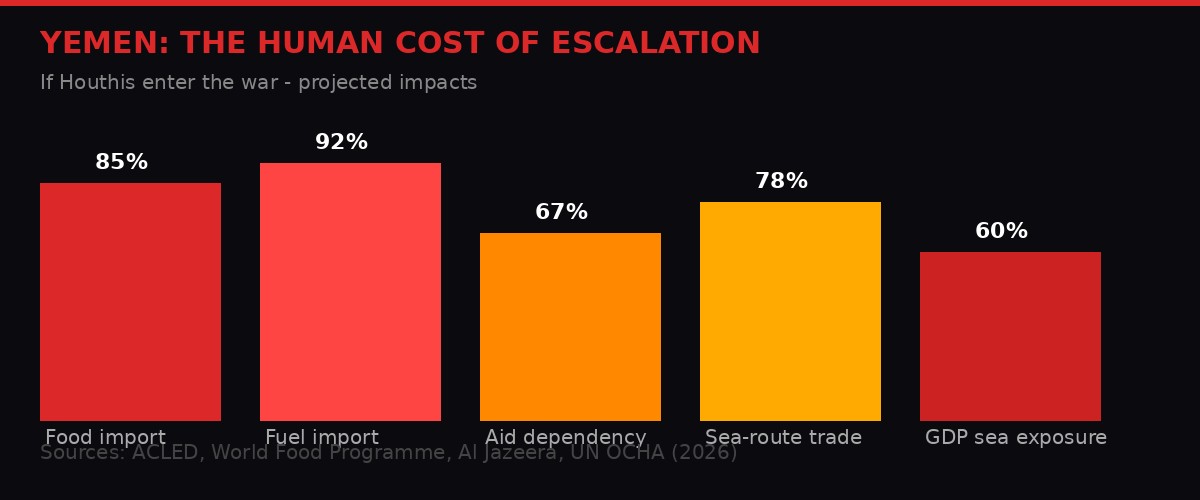
Yemen's economic vulnerabilities if Bab al-Mandeb closes. Sources: ACLED, WFP, UN OCHA, Al Jazeera.
The Truce That May Already Be Dead

Diplomacy under fire. Photo: Pexels
In May 2025, the Houthis and the United States reached a truce. The terms: the Houthis would stop attacking US shipping in the Red Sea. The US would suspend its airstrikes on Houthi-controlled territory. The Houthis later extended the arrangement to include a halt on attacks against Israel and Israeli-linked shipping after the October 2025 Gaza ceasefire deal.
That truce is now theoretical. Abdulsalam Mohammed, head of the Yemeni Abaad Studies and Research Center, told Al Jazeera directly: the Houthi-US agreement "is on the verge of collapse." [Al Jazeera, March 27]
The dynamic that sustained the truce - a frozen Gaza conflict, a contained Iran, a Houthi leadership cautious after the Sanaa assassinations - has been completely dismantled. Iran is at war. Lebanon is being invaded by Israeli ground forces. The IRGC is running a toll booth in the Strait of Hormuz. Every pillar of the regional order that made Houthi restraint strategically sensible has been knocked down.
There is one argument for continued Houthi restraint: weaponsflow. The Houthis receive arms from Iran - ballistic missiles, drones, anti-ship weapons - via smuggling routes through the Arabian Sea. With Iran under sustained US-Israeli bombardment, with Iranian military production facilities damaged (the US claims two-thirds of Iran's missile and drone production capacity has been hit), the flow of new weapons to Yemen could slow or stop. Entering the war without a reliable resupply line is a military gamble.
"The group will be militarily affected as the flow of smuggled Iranian weapons to Yemen will shrink or entirely cease. This is a formidable challenge for the group," Huraibi told Al Jazeera.
But the Houthis have stockpiles. They have been accumulating weapons for years. And the strategic logic cuts both ways: if they wait too long, Iran might lose the war. Then the Houthis lose their patron, their weapons supply, and their political backing simultaneously. Better to act while Iran can still coordinate and Iran's leverage remains real.
Lebanon, the Parallel Catastrophe

Mass displacement: the signature of this war. Photo: Pexels
While Yemen holds its breath at the Bab al-Mandeb, the war's displacement catastrophe is already fully operational in Lebanon. The numbers released by the UN Refugee Agency on Friday, March 27, are staggering in their scale and velocity.
More than 1.2 million people have been forced from their homes in Lebanon since Israel intensified its attacks in early March, according to UNHCR figures. The total number of registered displaced people - tracked by the International Organization for Migration - has reached 1,049,328, with 132,742 people living in collective shelters. Nearly one in five Lebanese citizens - 18 percent of the entire population - has been displaced in under three weeks. [Al Jazeera, March 26]
"The situation remains extremely worrying and the risk of a humanitarian catastrophe - the risk is real," UNHCR's Lebanon representative Karolina Lindholm Billing told reporters in Geneva on Friday. "The families are living in constant fear, and the psychological toll, particularly on children, will last far beyond this current escalation."
Israel's military campaign in Lebanon has included systematic destruction of bridges over the Litani River - six bridges confirmed destroyed, isolating an estimated 150,000 people in southern Lebanon and cutting humanitarian access. Israeli Defence Minister Israel Katz explicitly ordered all crossings over the Litani destroyed. Lebanese President Joseph Aoun described it as "an attempt to sever the geographical connection between the southern Litani region and the rest of Lebanese territory."
Human Rights Watch, in a statement Thursday, used the words "war crimes" and "forced displacement" together. "Israel's tactics of mass expulsion in Lebanon raise serious risks of forced displacement. Forced displacement and collective punishment are war crimes," the organization said. [HRW via X]
Meanwhile, Israel's ground forces have crossed the Lebanese border and are engaging Hezbollah fighters in direct combat. Hezbollah Secretary-General Naim Qassem stated Thursday that the group "is now in a war against both the US and Israel" and would fight to defend Lebanese territory.
The Lebanon front and the potential Yemen front are not separate crises. They are the same war, extending its geography in real time. Every new front opens additional strain on missile defence systems, air assets, and military logistics that are already running at wartime tempo.
The Wider Regional Architecture Crumbling

Regional alliances under pressure. Photo: Pexels
It is worth stepping back to account for the scale of what is happening simultaneously.
The US and Israel launched strikes on Iran on February 28 following the assassination of Ayatollah Ali Khamenei. Iran retaliated against Israel and Gulf states. The Strait of Hormuz closed. Oil prices surged above $100 per barrel - a 40 percent increase from pre-war levels. Nearly 2,000 ships are stranded, waiting. The IRGC is running a physical toll booth, charging $2 million per approved transit. An Iranian parliamentary committee is drafting legislation to formally legalize those tolls. [Al Jazeera, March 26]
In the Gulf, Saudi Arabia's air defences intercepted dozens of Iranian drones targeting oil facilities in the Eastern Province. Bahrain reported an attack on a facility in Muharraq Governorate. The UAE's defence ministry confirmed active interception of Iranian missiles. Kuwait arrested six Hezbollah-linked individuals allegedly planning assassinations. Iraq is under pressure from Gulf states to stop pro-Iran militia strikes from its territory.
The EU, meanwhile, accused Russia of providing intelligence to Iran to help target American forces - "to kill Americans," in the direct words of EU foreign policy chief Kaja Kallas. Russia's role remains unconfirmed by US officials but the accusation from Brussels signals how far the diplomatic damage of this conflict is spreading.
US President Donald Trump, for his part, has continued a dual-track approach: threatening "hell" if Iran doesn't accept a deal, while simultaneously claiming Iran "wants to make a deal so badly" but is afraid to say so. Iran's Foreign Minister Abbas Araghchi has rejected any talks, stating Tehran will continue its "resistance." Iran reportedly responded to a 15-point US peace proposal - conveyed through Pakistan - and is awaiting Washington's response. The contents of neither the US plan nor the Iranian response have been made public. [Al Jazeera, Day 27 tracker]
Trump told reporters the military campaign is "extremely ahead of schedule" against an original timeline of four to six weeks. Day 28. The four-week mark arrives this Saturday. Whether that timeline means a military conclusion, a deal, or a redefinition of objectives is unclear. What is clear is that the window for the Houthis to enter as a meaningful disruptive force - before any potential ceasefire or US drawdown - is narrowing.
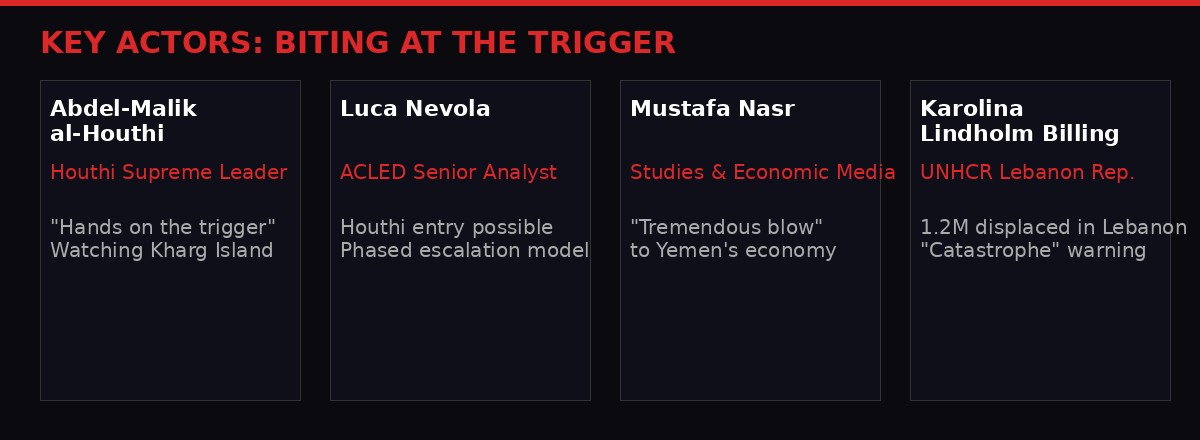
Key actors and their positions. Sources: Al Jazeera, ACLED, Studies and Economic Media Center.
Timeline: How Yemen Arrived at This Moment
CHRONOLOGY: YEMEN AND THE AXIS OF RESISTANCE
The Domestic War That Could Restart

A country already shattered. Photo: Pexels
There is a further dimension to this calculus that analysts emphasize: Houthi entry into the wider war would not just trigger a maritime conflict. It would likely reignite Yemen's internal war.
The UN-backed truce between the Houthis and Yemen's internationally-recognised government has held since April 2022 - a fragile ceasefire that has prevented a return to full-scale ground combat. But that truce's logic has always been that neither side sees an advantage in fighting. If the Houthis commit forces to attacking the Gulf and Israeli targets, Yemen's anti-Houthi forces - now emboldened after retaking Aden and southern provinces in January 2026 - may see an opening.
"The clashes on the front lines are poised to reignite, potentially ushering in a new chapter of war between the Houthis and pro-government Yemeni forces," Mohammed from the Abaad Studies Center told Al Jazeera.
The Yemeni government, backed by Saudi Arabia and the UAE, believes its military position has improved. It consolidated the south. It resolved the separatist conflict that had diverted resources for years. It now presents a more unified front. US and Saudi Arabia would likely provide both air support and material backing for an anti-Houthi ground offensive if the Houthis attacked American or Gulf assets.
That scenario - Houthis attacking the Red Sea and Bab al-Mandeb while simultaneously fighting a renewed ground war against Yemeni government forces, potentially with direct US strikes resuming - is not a conflict. It is a collapse. And it is the reality in which 30 million Yemeni civilians would have to survive, with 85 percent of their food arriving by sea.
The humanitarian infrastructure that has barely sustained Yemen through eight years of war - the World Food Programme convoys, the UNICEF vaccination programs, the NGO operations that keep children from dying at rates that international monitors describe as catastrophic even in "peacetime" - operates through those port access routes. Block the ports and you are not making a strategic military move. You are executing a food weapon.
What Comes Next: Three Scenarios

Three roads. Photo: Pexels
The intelligence and analytical community tracking the Houthis currently sees three near-term scenarios, none of them clean.
Scenario One: Continued strategic patience. The Houthis wait. They watch. They make statements about loyalty and triggers but do not act. This extends as long as Iran doesn't ask them to act, as long as US forces don't strike Yemen, and as long as anti-Houthi ground forces don't advance. The cost of this scenario is credibility - the Houthis positioned themselves as fighters, and watching Iran lose without doing anything will damage their standing within the resistance network. Al-Huraibi is explicit: "When the icon is defeated, morale cannot remain high."
Scenario Two: Phased escalation. The Houthis resume Red Sea shipping attacks - restarting their previous campaign - without yet blocking Bab al-Mandeb entirely. They fire on Israeli-linked vessels and Gulf tankers. This applies pressure, demonstrates loyalty to Iran, and draws international attention, without triggering the full catastrophic scenario. It is the most likely first move if they move at all. Nevola calls this "phased escalation" - a tested Houthi playbook.
Scenario Three: Full commitment. The Houthis open Bab al-Mandeb as a war zone simultaneously with Iranian Hormuz control, launch missile and drone strikes against Gulf infrastructure and Israeli cities, and trigger their side of the "Axis of Resistance" at full capacity. This is the nightmare scenario for global trade and regional stability. It would, as Nasr put it, form "a serious tragedy for the population" of Yemen itself - and trigger direct US strikes that could end the Houthi political project entirely.
The probability calculus shifts daily based on what happens in Iran. If the US attacks Kharg Island - Iran's main oil export terminal - the signal threshold the Houthis have described will have been crossed. If a ceasefire deal materialises in the next week, the pressure may temporarily release. But right now, on Day 28, the dial is moving toward action. Not because anyone planned it. Because the architecture of the war has left the Houthis few other options that don't compromise their identity and their position.
"Tehran does not want to use all its cards at once," Huraibi told Al Jazeera. "It aims to save the Houthi group for the coming phase."
The coming phase may be arriving.
The Gate of Grief. That is what Bab al-Mandeb means in Arabic. In eight hundred years of trade and conflict, the name has never felt more literal. The men with the guns in Sanaa know it. The shipping traders monitoring vessel positions in Lloyd's List know it. The 26-year-old volunteer in Sanaa who knows what three dollars a day actually buys knows it.
The world is watching two choke points now. One is closed. One is waiting.
Get BLACKWIRE reports first.
Breaking news, investigations, and analysis - straight to your phone.
Join @blackwirenews on TelegramSources: Al Jazeera (multiple reports, March 7-27, 2026), UNHCR briefing Geneva March 27, IOM displacement data March 26, ACLED / Luca Nevola analysis, Abaad Studies and Research Center, Studies and Economic Media Center, Human Rights Watch statement March 27, Lloyd's List Hormuz toll booth reporting March 26, Tasnim News Agency, Iran International, Iraqi officials on Gulf demands, US DoD official statements on Iranian missile production damage.