BREAKINGUkraine's Desert Gambit: Zelenskyy Signs Gulf Defense Pacts as Iran War Enters Month Two

The war that began on February 28 with US and Israeli strikes on Iran has, in 30 days, fundamentally redrawn the architecture of global security partnerships. On Saturday, as the Iran-backed Houthi rebels fired their first missiles at Israel and 2,500 additional US Marines arrived in the region, Ukrainian President Volodymyr Zelenskyy was conducting a different kind of offensive - diplomatic, not kinetic, and aimed squarely at solving Ukraine's most pressing military deficiency.
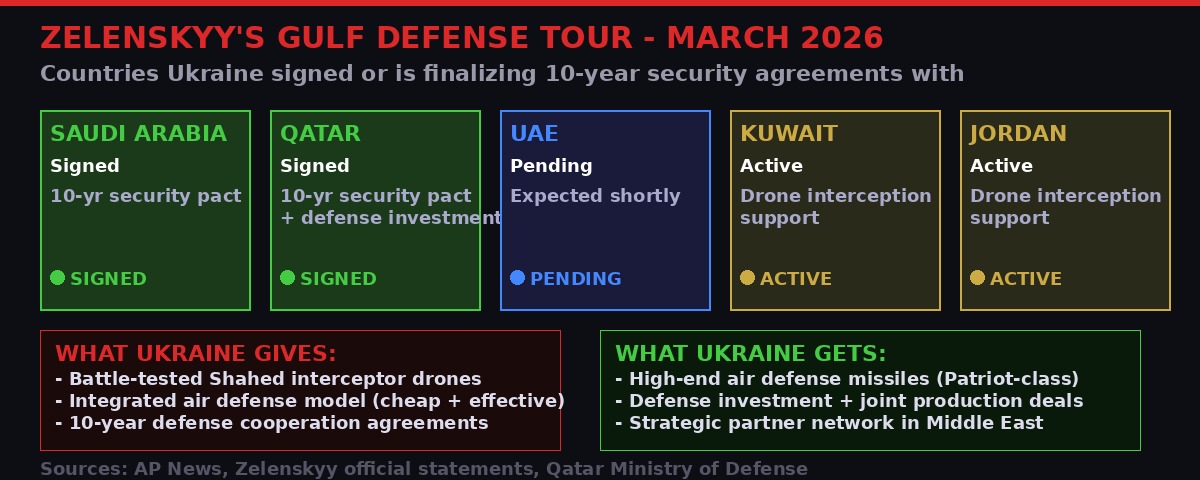
Zelenskyy made unannounced visits to the United Arab Emirates and Qatar on Saturday, according to AP News. He had already visited Saudi Arabia on Thursday. The trips confirmed what Kyiv had been hinting at for weeks: Ukraine has signed, or is close to signing, 10-year security cooperation agreements with Saudi Arabia, Qatar, and imminently the UAE - and it is actively helping five Gulf states intercept Iranian drone attacks on their territory.
The exchange at the core of these deals is stark in its pragmatism. Ukraine offers battle-hardened drone interception systems - cheap, effective, and refined through four years of daily combat against Russian Shahed drones. The Gulf states, awash in American weapons systems they cannot fully maintain without foreign expertise, offer something Ukraine desperately needs: high-end air defense missiles.
"Simple sales do not interest us," Zelenskyy told reporters at a live briefing on Saturday. The message was plain: Kyiv wants strategic partnerships, not one-time transactions. What Kyiv is building, article by article, across the Arabian Peninsula, is the kind of multi-front alliance network that Russia hoped to deny it entirely when the full-scale invasion began in February 2022.
Month One Ends: What 30 Days of War Has Cost

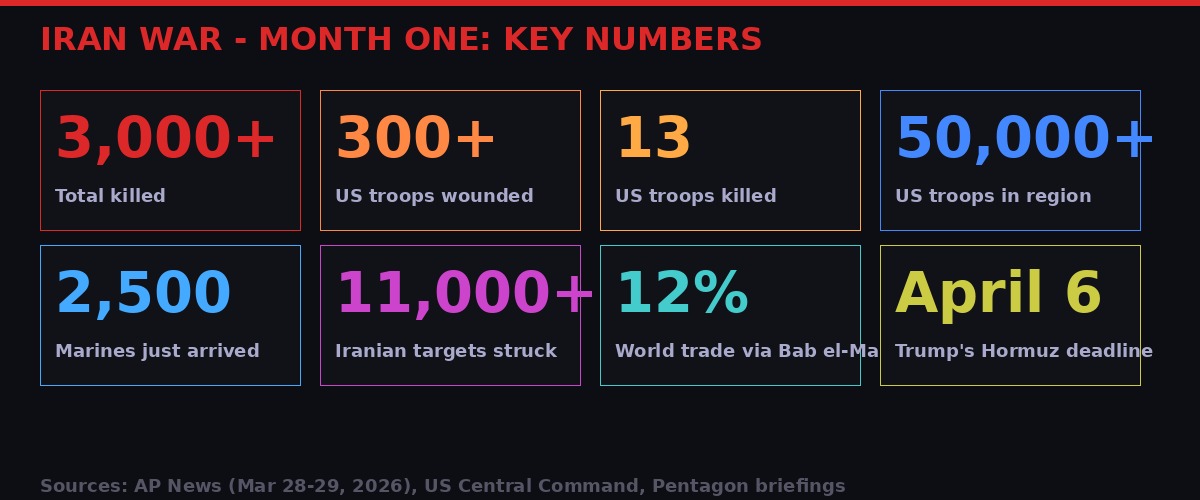
The Iran war turned 30 days old on Saturday, March 29. The toll, by the numbers available from AP News, US Central Command, and Pentagon briefings, is severe and accelerating. More than 3,000 people have been killed across the conflict zone. Over 300 American service members have been wounded. Thirteen US troops are dead - six killed when an Iranian drone struck an operations center at a civilian port in Kuwait, six more when a refueling aircraft crashed in Iraq, and Army Sergeant Benjamin N. Pennington, 26, who died after being wounded in a March 1 attack on Saudi Arabia's Prince Sultan air base.
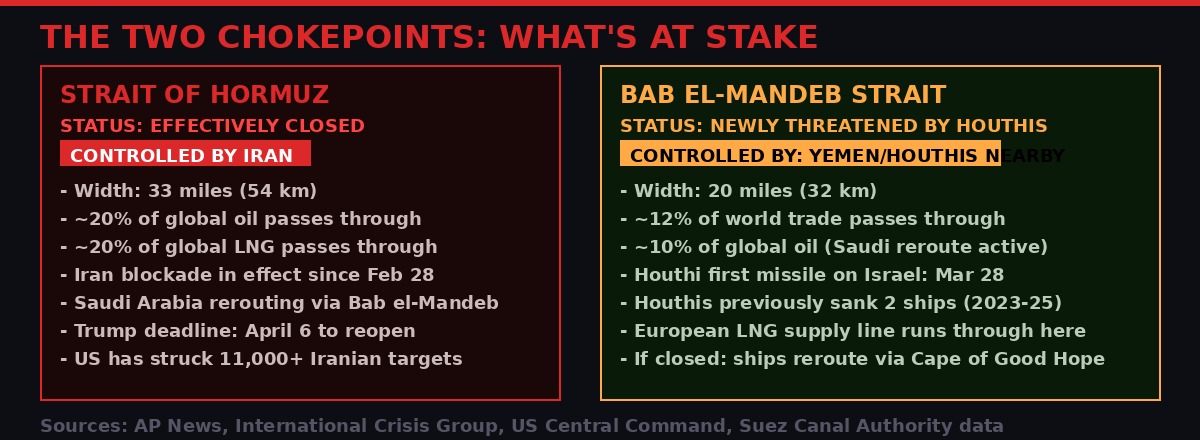
The United States has struck more than 11,000 Iranian targets over the course of the war. Iran has retaliated with strikes against Israel, Gulf Arab states, and US military facilities throughout the region. The Strait of Hormuz - the 33-mile-wide channel through which roughly 20 percent of the world's oil and liquefied natural gas passes - remains effectively closed under Iranian control.
The economic consequences have not waited for a ceasefire. Oil prices have surged. Fertilizer exports from Iran have been disrupted, creating cascading food supply shocks across multiple continents. Air travel across the region has been severely disrupted. Global container shipping firms have been rerouting vessels around the Cape of Good Hope at significant additional cost - the same response triggered when the Houthis attacked Red Sea shipping in 2023 and 2024.
The US military presence in the region has grown to what officials describe as the largest American force in the Middle East in more than 20 years. That includes two aircraft carriers, several other warships, some 50,000 troops, and now the USS Tripoli - an amphibious assault ship carrying around 2,500 Marines from Japan's 31st Marine Expeditionary Unit, plus transport and strike fighter aircraft. The USS Boxer and two additional ships carrying another Marine Expeditionary Unit have been dispatched from San Diego.
Additionally, at least 1,000 troops from the 82nd Airborne Division - the US Army's emergency response force, trained to parachute into hostile territory and secure airfields - are preparing to deploy to the Middle East in the coming days, according to people with knowledge of the plans who spoke to AP News. The unit would include a battalion of the 1st Brigade Combat Team, the division commander, and staff.
Secretary of State Marco Rubio said Friday that the US can meet its objectives "without any ground troops" - but added that Trump "has to be prepared for multiple contingencies" and that forces are available to give the president "maximum optionality." That phrasing, "maximum optionality," has been used consistently by the administration when it will not rule out an option it cannot publicly commit to.
The Houthis Open a Second Front

The biggest development of Saturday - one that reshapes the entire strategic picture - was the entry of Yemen's Houthi rebels into the monthlong war. The Iran-backed group had held back for a full 30 days while the US and Israel struck Iran. On Saturday, Houthi Brigadier General Yahya Saree announced on the group's Al-Masirah satellite television channel that they had launched missiles toward "sensitive Israeli military sites" in southern Israel. The Israeli military confirmed intercepting a missile fired from Yemen.
Israeli military spokesperson Brigadier General Effie Defrin was direct when asked about the Houthi launch: "We are preparing for a multifront war."
"Our fingers are on the trigger," Houthi military spokesman Yahya Saree said in a statement on Friday. "We won't allow the US and Israel to use the Red Sea for attacks on Iran."
The Houthi re-entry into the conflict is potentially more consequential than a single missile volley against Israel. The group's real power lies in its ability to target shipping in the Bab el-Mandeb Strait - the 20-mile-wide chokepoint at the southern tip of the Arabian Peninsula that vessels must pass through to reach the Suez Canal from the Red Sea.
This strait has become the indispensable alternative to the closed Strait of Hormuz. Since the Hormuz blockade began, Saudi Arabia has been sending millions of barrels of crude oil per day through Bab el-Mandeb because it has no other route. A quarter of global container trade transits through the strait on its way to and from Suez. European LNG tanker routes run directly through it.
If the Houthis close Bab el-Mandeb - as they effectively did between late 2023 and early 2025, attacking over 100 merchant vessels, sinking two and killing four sailors - the global economy would face a dual chokepoint crisis unprecedented in modern history. Both Hormuz and Bab el-Mandeb would be at least partially closed simultaneously, redirecting much of the world's energy trade to multi-week detours around Africa.
Ahmed Nagi, a senior Yemen analyst at the International Crisis Group, offered a stark assessment to AP News: if Houthi attacks on commercial shipping resume, it would "devastate so many countries" and would push oil prices and maritime security costs to new extremes. "The impact would not be limited to the energy market," Nagi said.
Zelenskyy's Calculation: Drones for Missiles

Against this backdrop of escalating chaos, Zelenskyy's Gulf tour stands as one of the more sophisticated pieces of wartime diplomacy in recent memory. Ukraine has, through four years of grinding combat against Russian forces, developed something the Gulf states need urgently right now: reliable, cheap, effective ways to intercept Iranian Shahed drones.
Tehran sent large quantities of Shahed drones to Russia starting in 2022, giving Russia a cost-effective mass attack weapon that overwhelmed Ukrainian air defenses and strained European supplies of interceptor missiles. Ukraine's answer was to develop its own interception systems - smaller, cheaper drones and specialized ground units that could kill incoming Shaheds at a fraction of the cost of a Patriot missile intercept. The techniques Kyiv has refined are now being applied in five Gulf states: the UAE, Saudi Arabia, Qatar, Kuwait, and Jordan.
"Real security is built on partnership - we value everyone and remain open to supporting all those who are ready to work together for this goal," Zelenskyy wrote on X alongside a video of himself arriving in Qatar.
The Ukrainian president said that Kyiv has signed 10-year security agreements with Saudi Arabia and Qatar and expects to finalize a similar arrangement with the UAE shortly. The Qatar Ministry of Defense confirmed that Zelenskyy and Qatar's defense minister signed cooperation agreements in the defense sector and defense investments. These are not temporary tactical arrangements - they are decade-long commitments that bind Ukraine and the Gulf monarchies into a sustained partnership structure.
What Ukraine needs in return is equally clear. Kyiv has been chronically short of high-end air defense missiles - Patriot interceptors and similar systems - that can counter Russia's ballistic missile and long-range glide bomb attacks. Gulf states possess these systems, acquired over decades of US arms sales. Ukraine's message to Riyadh, Doha, and Abu Dhabi has been consistent: help us defend against the same Iranian weapons you're now suffering from, and we will help you defend against them too.
Zelenskyy told reporters Saturday that Ukraine is exploring whether it can play a role in restoring security in the Strait of Hormuz itself. He last week said Kyiv was "looking into" the possibility. An agreement to directly assist in Hormuz operations would mark a significant further escalation of Ukraine's involvement in the Middle East conflict - and would give Kyiv new strategic leverage with Washington, which has grown increasingly reliant on its knowledge of Iranian drone systems.
Trump's Contradictions and the April 6 Deadline

The Iran war entered its second month with Trump's public communications presenting a picture of strategic confusion that has unsettled both allies and members of his own party. On separate occasions this month, Trump has said the US is winning the war, then criticized European allies for not helping, then said the US does not need their help. He has twice delayed the deadline he set for Iran to reopen the Strait of Hormuz.
The current deadline is April 6. Trump has threatened to "obliterate" Iran's energy plants if the strait remains closed - but has also stated, separately, that the US is "not affected" by the closure. He publicly claimed that a predecessor president privately told him he wished he had taken similar action against Iran. Every living former president's office quickly denied this.
"It's not the first administration that has not told the truth about war. But the president has made it kind of a very standard approach to almost any question to in one way or another kind of lie about what's really happening and basically describe everything as fine and that we're winning the war." - Leon Panetta, former Defense Secretary and CIA Director
Leon Panetta, who served as defense secretary, CIA director and White House chief of staff under Democratic presidents, offered the bluntest assessment to AP News of any senior former official: the administration is following a familiar wartime pattern of distortion, but doing so with less restraint than predecessors.
Michael Rubin, a historian at the American Enterprise Institute who worked as a Pentagon adviser on Iran and Iraq in 2002-2004, placed Trump's approach in a broader frame: "He's the first president of any party in recent history that hasn't self-constrained to live within rhetorical boundaries. So of course it creates a great deal of confusion."
Republican lawmakers, heading into a two-week congressional recess, were careful in their criticism but notable in their unease. Senator John Kennedy of Louisiana said his constituents "support what the president has done" - but added that "most of my people are also equally or even more so concerned about cost of living." The war's economic impact, from oil price shocks to fertilizer shortages, is landing on American households.
Representative Chip Roy of Texas, a member of the conservative House Freedom Caucus, backed "blowing some crap up" but said the administration had not provided sufficient detail in classified congressional briefings. "We've got to have a serious conversation about how long this is going to go, boots on the ground," Roy said.
Representative Gregory Meeks of New York, the top Democrat on the House Foreign Affairs Committee, was more pointed: "The administration is winging it. So how can you trust what the president says?"
Pakistan Brokers: The Back-Channel Nobody Expected

With traditional Middle East mediators Oman and Qatar directly caught in the crossfire of Iranian attacks, an unexpected country has stepped into the diplomatic vacuum: Pakistan. According to AP News reporting, Pakistan has been quietly relaying a 15-point US proposal to Iran and conveying Iranian counter-proposals back to Washington, with Pakistani Foreign Minister Ishaq Dar publicly acknowledging the role this week.
Pakistan's mediation effort is rooted in geography and relationships that most Western observers had not fully mapped. Islamabad shares a long border with Iran. It has close strategic ties with Saudi Arabia, including a defense cooperation agreement signed last year. Its relationship with the United States has improved significantly over the past year, with increased diplomatic engagement and economic ties. Pakistan also joined Trump's "Board of Peace" initiative aimed at ensuring peace in Gaza, despite domestic opposition from Islamist groups.
Pakistan's government said Sunday that Saudi Arabia, Turkey, and Egypt will send top diplomats to Islamabad for a two-day summit aimed at ending the war. Pakistani Prime Minister Shehbaz Sharif said he and Iranian President Masoud Pezeshkian had held "extensive discussions" on regional hostilities.
Iran's response to these mediation efforts has been contradictory in a way that mirrors Trump's own ambivalence. Iranian Foreign Minister Abbas Araghchi has been in contact with multiple counterparts about the war. But Iran has publicly denied that direct talks with the US are occurring. Mohammad Bagher Qalibaf, speaker of Iran's parliament, rejected Trump's claim of direct negotiations. An Iranian military spokesman vowed to fight "until complete victory."
This gap - between Iran's back-channel signals and its public posture - is familiar from every prior US-Iran negotiation. Iran cannot publicly appear to negotiate under military pressure; to do so would be seen domestically as capitulation. But Iranian officials have shown consistent interest in a diplomatic exit from a war that is destroying the country's economy and infrastructure. The indirect channel through Pakistan, Turkey, Egypt, and Saudi Arabia gives both sides a structure that allows progress without public humiliation for Tehran.
"Pakistani's mediation efforts may be contributing to relative restraint in the conflict." - Abdullah Khan, Pakistan Institute for Conflict and Security Studies
Abdullah Khan, managing director of the Pakistan Institute for Conflict and Security Studies, told AP News that the Pakistani mediation effort may help explain why Trump has twice delayed his threats of large-scale attacks on Iranian energy infrastructure. Iranian responses toward US interests in the Gulf have been "measured," in what Khan characterized as "an effort to preserve space for diplomacy." Even Iran's attacks on Saudi Arabia's Prince Sultan air base - which wounded over 30 US troops this week - have targeted military facilities rather than civilian infrastructure, in what security analysts read as a signal of controlled escalation.
What Ukraine's Gulf Pacts Mean for the War in Europe

The immediate context for Zelenskyy's Gulf tour is the Iran war. But the longer arc of what Ukraine is building matters just as much for the conflict in Europe. Since Russia began its full-scale invasion in February 2022, Kyiv has been systematically cut off from the kind of multi-decade alliance relationships that give a smaller state strategic depth. NATO membership has been promised but not delivered. US weapons have flowed in quantities that help Ukraine survive but not necessarily win.
The Gulf security agreements represent something different: Ukraine converting its wartime expertise into strategic currency, building bilateral partnerships with wealthy states that have leverage over Washington. Saudi Arabia's energy production decisions directly affect the US economy. Qatar hosts the largest US military base in the Middle East, Al Udeid. The UAE is a critical node in global finance and trade. These are not small partners to have defense agreements with.
If Ukraine can secure additional Patriot missile interceptors and related air defense systems from Gulf states in exchange for drone interception technology, it would partially offset the shortage of these systems that has been one of the defining constraints on Kyiv's ability to defend its cities. Each Patriot battery diverted to Ukraine represents a tradeoff for the country providing it - but Gulf states receiving Ukrainian drone expertise may calculate that the exchange favors them under current threat conditions.
Russia has not been silent about Ukraine's Gulf outreach. Moscow, which has its own relationships with Gulf states through OPEC+ oil production agreements, will view a sustained Ukraine-Gulf security architecture as a direct threat to its influence in a region where it has worked for years to displace Western strategic relationships. The Iran war has paradoxically given Ukraine an opening Russia would have worked to prevent - a geopolitical gift from a conflict that neither Kyiv nor Moscow predicted.
There is also a direct military dimension. Ukraine has been helping Gulf states with interception of Iranian Shahed drones. Iran supplies Russia with Shaheds. Ukraine knows these weapons systems in extraordinary detail - from production characteristics to flight profiles to electronic signatures. Any intelligence Ukraine gains from operating against live Iranian drones in Gulf airspace is potentially valuable in the European theater where the same weapons are being used against Ukrainian cities.
The April 6 Clock and What Comes Next

The Iran war's most immediate flashpoint remains the Strait of Hormuz and Trump's April 6 deadline for Iran to reopen it. The deadline, already pushed back twice, has become both a pressure mechanism and a credibility test. Each extension signals to Tehran that Washington's ultimatums have flexibility built in. Iran has not reopened the strait. Iran has not publicly acknowledged negotiations. Iran has continued striking US forces in Saudi Arabia.
On Friday, in what may be the first hint of flexibility, Iran agreed to allow humanitarian aid and agricultural shipments through the Strait of Hormuz following a United Nations request. This is a narrow carve-out - commercial oil and gas traffic remains blocked - but it is the first instance of Iran accepting any limitation on its control of the strait since the war began. Analysts are cautious about reading too much into a humanitarian concession, but in the pattern of these conflicts, humanitarian corridors often precede broader diplomatic movement.
The Islamabad summit beginning Sunday - bringing together Saudi Arabia, Turkey, and Egypt in talks brokered by Pakistan - will test whether a regional diplomatic architecture can generate enough momentum to reach Trump before the April 6 deadline. Iranian Foreign Minister Araghchi's contacts with multiple counterparts this week suggest Tehran is at minimum monitoring these channels. Whether it is prepared to offer anything substantive before April 6 is unknown.
The Houthis' re-entry adds a new variable that neither Pakistan nor any other mediator can easily control. The Houthis are not fully managed by Tehran - they have their own political dynamics, their own military leadership, and their own history of acting on principle even when it conflicted with Iran's strategic preferences. A Houthi decision to resume large-scale attacks on Red Sea shipping would not require Iranian authorization. It could happen independently of any diplomatic progress in Islamabad.
For Ukraine, watching from a remove, the timing of Zelenskyy's Gulf tour - the day the war hit its one-month mark, the day the Houthis fired their first missiles at Israel - was not accidental. Kyiv signed its Gulf defense pacts at the moment when the Middle East's security architecture was most visibly fragmenting and when the Gulf states most urgently needed exactly what Ukraine had learned to offer. That is not sentimentality. It is the logic of wartime opportunity, executed with precision.
The Iran war is one month old. The Houthis have now entered it. Thirty-one thousand additional US troops and Marines are in motion toward the region. Pakistan is hosting diplomats from three regional powers on Sunday. The April 6 deadline is eight days away. And Zelenskyy is building alliances in the desert that will outlast this particular crisis by a decade.
Get BLACKWIRE reports first.
Breaking news, investigations, and analysis - straight to your phone.
Join @blackwirenews on TelegramSources: AP News (March 28-29, 2026) - Samy Magdy, Isabel DeBre, Josh Boak, Mary Clare Jalonick, Lorne Cook; Zelenskyy official statements via X; Qatar Ministry of Defense official release; US Central Command announcement; Pentagon briefings via people familiar with plans speaking on condition of anonymity; International Crisis Group Yemen analyst Ahmed Nagi; Abdullah Khan / Pakistan Institute for Conflict and Security Studies; Leon Panetta statement to AP; Michael Rubin / American Enterprise Institute; Congressional statements from Rep. Gregory Meeks, Sen. John Kennedy, Rep. Chip Roy.