The Kingdom That Mined $1.88 Billion - And Is Selling Every Last Coin
Bhutan dumped $152 million in Bitcoin in 2026 alone. Transfers are accelerating - from $15M monthly clips to $72M in a single week. Holdings are down 66% from peak. And the Gelephu Mindfulness City pledge is now mathematically dead.
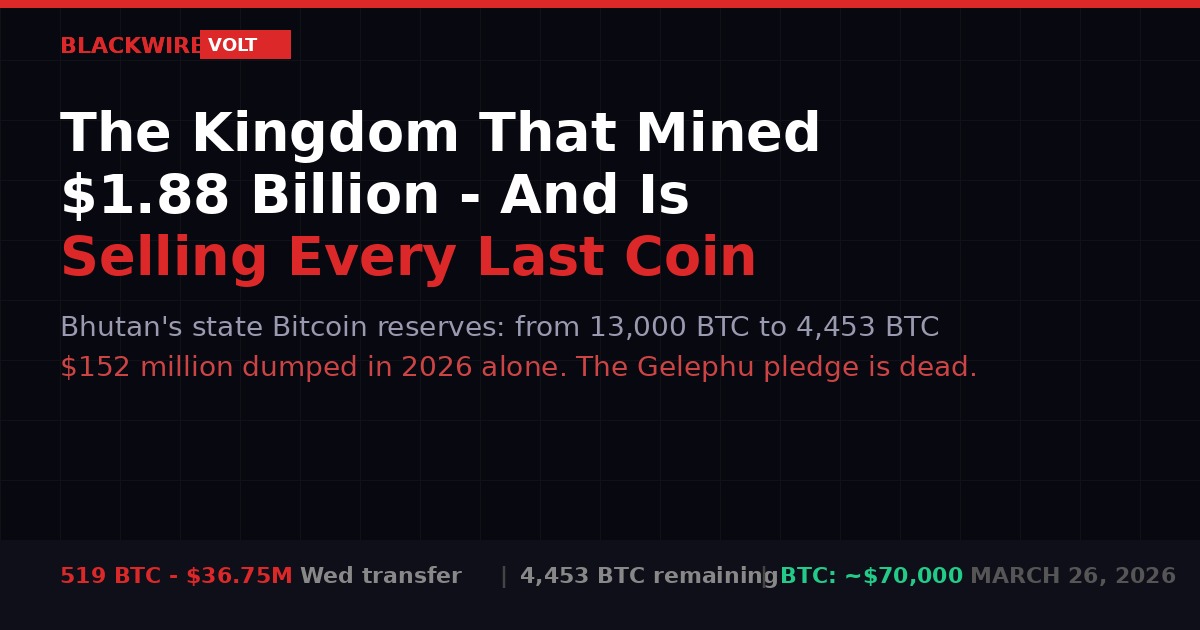
Bhutan's state Bitcoin reserves have collapsed 66% from their late-2024 peak of 13,000 BTC. March 2026 has seen the fastest liquidation phase yet. (BLACKWIRE / VOLT)
On Wednesday morning, the Royal Government of Bhutan transferred 519.707 BTC - worth approximately $36.75 million at current prices - to an external address. It was not exceptional. It was Tuesday's continuation of a sell campaign that now defines one of the most aggressive state-level Bitcoin liquidations in crypto history.
According to Arkham Intelligence data, Bhutan's holdings have fallen from a peak of roughly 13,000 BTC in late 2024 to 4,453 BTC as of this morning. The kingdom - population 800,000, GDP roughly $3 billion - is not in financial distress. It mines Bitcoin with zero-cost hydroelectric power from rivers fed by the Himalayas. Every coin sold is 100% profit. And they are liquidating fast.
The pace is what traders are watching. January and February 2026 saw $5-15 million clips, consistent OTC-style selling through counterparties like QCP Capital. March changed the calculus entirely: $72 million in a single week, the largest concentrated dump in Bhutan's Bitcoin history, followed immediately by Wednesday's $36.75 million transfer. The acceleration is not subtle.
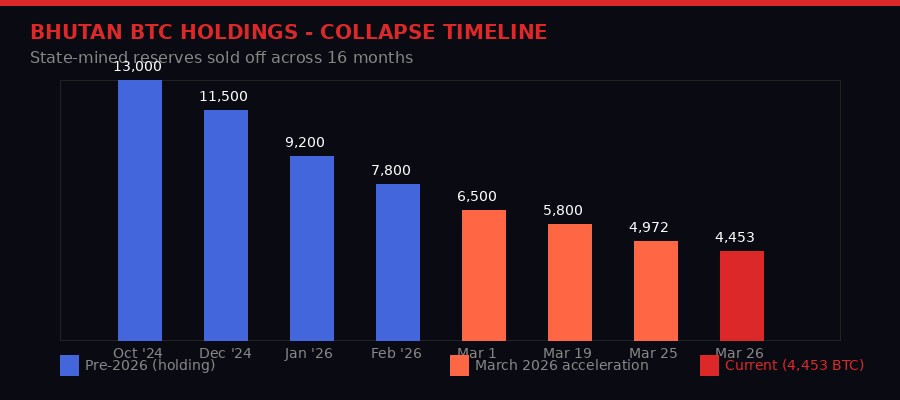
Bhutan's state Bitcoin holdings timeline from peak (Oct 2024) to current 4,453 BTC. The March 2026 acceleration is visible. (BLACKWIRE / VOLT)
From Miner to Liquidator: How Bhutan Built Its Stack
Bhutan's entry into Bitcoin mining was quiet and strategic. Starting around 2019, the government's commercial arm, Druk Holding & Investments (DHI), began converting excess hydroelectric generation capacity into Bitcoin mining operations. The model was simple and nearly perfect: Bhutan sits on some of the world's cheapest electricity, generated by rivers flowing off the Himalayas, and most of it was already being sold to India at regulated rates. Bitcoin mining was a premium product for surplus capacity.
By 2024, Bhutan had accumulated a stack that peaked at approximately 13,000 BTC - worth, at the November 2024 BTC highs near $119,000, approximately $1.547 billion. At the portfolio's peak valuation, Bhutan held Bitcoin worth roughly half of its annual GDP. For a sovereign nation with fewer than one million people, this was remarkable. No central bank endorsement, no public announcement, no IMF consultation. Just a government commercial entity quietly minting one of the largest sovereign Bitcoin reserves on earth.
The secrecy was intentional. Bhutan did not announce the program. It was surfaced in 2023 by blockchain analytics firms analyzing unusual on-chain flows and tracing them to Druk Holding addresses. When confronted, Bhutanese officials confirmed the mining operation but declined to detail its scope. By that point, the portfolio was already in the billions.
The strategy made sense on paper. Bhutan earns foreign exchange primarily from hydroelectric exports to India and tourism. Bitcoin gave it a second dollar revenue stream with no extraction cost. The king's office blessed the program. The revenues were earmarked for national development. Everything tracked. Until Bitcoin started falling and the sell orders started flowing.
BHUTAN BTC POSITION - MARCH 26, 2026
The Acceleration: January Clips to March Blitz
Read the Arkham transfer log chronologically and the acceleration is stark. January 2026 opened with controlled, institutional-style selling: 184 BTC on January 6 ($14.09 million), 100.818 BTC ($8.31 million) routed to QCP Capital Singapore, and a $1.5 million USDT transfer to a Binance hot wallet. Quiet, OTC-style. A government selling like it had done this before, at a pace designed not to move markets.
February held the same register. Another 100 BTC ($6.77 million) sent to QCP Capital. Then silence for two weeks. Then March.
The shift started subtly. On March 12, 175 BTC ($11.85 million) moved out. Normal by earlier standards. Then, in a single week beginning March 19, approximately $72 million worth of Bitcoin was transferred in rapid succession: a 595.848 BTC transfer ($44.44 million) - the single largest transfer of 2026 by a wide margin - followed by 205.53 BTC ($15.14 million), then 150.047 BTC ($11.14 million), then 20.506 BTC ($1.52 million) to QCP Capital's merchant deposit address. Four transfers. One week. $72 million.
Wednesday's 519.707 BTC move landed on top of that. Total 2026 outflows now sit at approximately $152 million - more than the previous eighteen months of selling combined, compressed into eleven weeks.
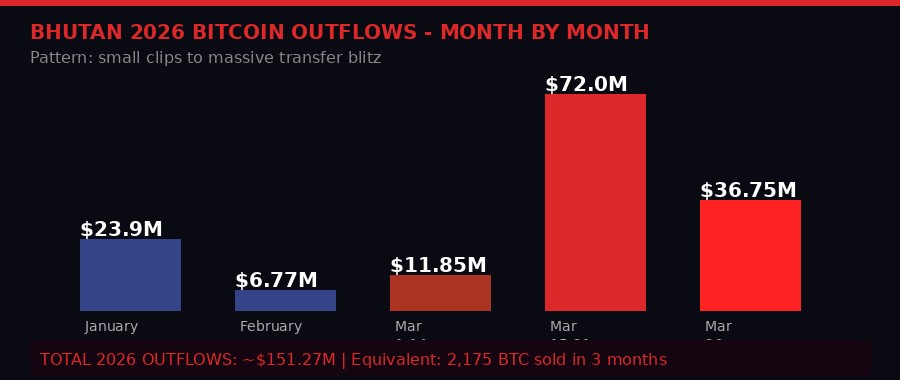
Monthly Bitcoin outflows from Bhutan's state reserves, 2026. The March acceleration is the sharpest in the program's history. (BLACKWIRE / VOLT)
QCP Capital's role throughout is notable. The Singapore-based trading firm has been the most consistent counterparty across the selling program, receiving at least three confirmed transfers totaling roughly $16.6 million in 2026 alone. QCP operates primarily in over-the-counter derivatives and structured trading - their repeated appearance as a destination strongly implies an ongoing OTC relationship, not spot exchange liquidation. Bhutan is not dumping on retail. It is selling through a structured OTC desk, likely with some degree of price protection built into the relationship.
CoinDesk reported Wednesday that it has reached out to Druk Holding & Investments for comment on the acceleration and whether the Gelephu Mindfulness City Bitcoin pledge remains active. No response had been received at time of publication.
The Gelephu Pledge: $860 Million Commitment on 4,453 BTC
In December 2024, at what turned out to be near-peak holdings, Bhutan announced the Gelephu Mindfulness City project - a sweeping, futuristic urban development initiative in the country's south, envisioned as a smart city integrating technology, sustainability, and Bhutanese Buddhist philosophy. The ambition was staggering: international airport, technology corridors, healthcare hubs, spiritual centers - a new city built from scratch to attract foreign investment and diversify Bhutan's economy beyond hydropower and tourism.
To fund it, the government announced a commitment of "up to 10,000 BTC" from its Bitcoin reserves. At December 2024 prices around $86,000 per Bitcoin, that pledge was worth approximately $860 million. More than enough to seed a major urban development program.
Twelve months later, the math does not work. The pledge required 10,000 BTC. Current holdings stand at 4,453 BTC. To fulfill the original commitment, Bhutan would need to have retained - or now purchase - an additional 5,547 BTC. At today's price of $70,000, buying that back would cost approximately $388 million. There is no indication that is the plan. The on-chain evidence runs the other direction.
The government has never formally withdrawn or modified the pledge. It has simply not been discussed publicly as the selling has intensified. The December 2024 announcement generated international headlines about Bhutan's visionary approach to sovereign Bitcoin reserves as a development financing mechanism. The 2026 liquidation has generated far less coverage outside the crypto analytics community.
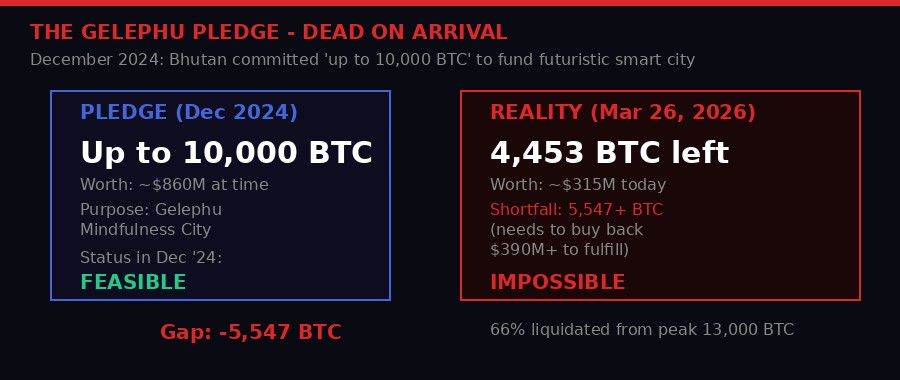
December 2024: up to 10,000 BTC pledged for Gelephu Mindfulness City. March 2026: 4,453 BTC remaining. The gap is 5,547 BTC and growing. (BLACKWIRE / VOLT)
"The pledge in its original form is mathematically impossible to fulfill without reversing the drawdown entirely." - CoinDesk analysis, March 26, 2026
What does that mean in practice? Either the Gelephu City project is being funded by alternative means - foreign direct investment, Indian grants, development bank loans - and the Bitcoin pledge was a headline generator rather than a financing commitment. Or the project's scope has been quietly reduced. Or the government is betting it can sell now and rebuy later cheaper. None of these scenarios are reassuring about the state of Bhutan's strategic Bitcoin planning.
The OTC Mechanics: How a Nation Sells $150 Million in Crypto
Sovereign Bitcoin selling at scale is a different animal from retail liquidation. You cannot route 519 BTC through a standard exchange order book without leaving enormous footprints and moving the market against yourself. The art is in execution - minimizing slippage, maintaining price, and distributing the selling pressure across multiple sessions and counterparties.
Bhutan appears to be executing this reasonably well, though the recent acceleration may be compressing the timeframe in ways that increase market impact. The QCP Capital relationship is the clearest signal of a professional OTC setup. Singapore-based QCP is one of Asia's leading crypto OTC and derivatives firms, with the infrastructure to absorb large sovereign-scale transactions, provide price certainty, and route the assets into institutional demand without direct exchange footprint.
The pattern of staggered transfers - multiple transactions across several days rather than a single massive block - is consistent with OTC desk practice. The desk agrees to a price or a price range, takes the Bitcoin in tranches as the client delivers, and manages distribution on its side. The 20.506 BTC transfer specifically to QCP's merchant deposit address on March 26 confirms this is operational plumbing, not a one-off sale.
The $1.5 million USDT transfer to Binance in January is the only confirmed exchange-level move and was likely used for operational liquidity - paying mining operational costs, staff, or converting to Indian rupees for in-country expenses - rather than a market sale. The bulk of the selling appears to be flowing off-exchange through QCP and potentially other undisclosed OTC counterparties.
This matters for price impact assessment. If Bhutan were dumping on Binance spot, the market would see it. Because it is flowing through QCP, the selling is absorbed by institutional buyers on the other side of OTC deals, reducing visible market impact. The Bitcoin still enters circulation, but through more controlled channels. That is professional execution. The question is whether the pace of March's acceleration is starting to outrun even QCP's absorption capacity.
What This Means for Bitcoin's $70,000 Floor
Bitcoin is holding near $70,000 as of Thursday morning - a level it has defended despite an active Iran-Strait of Hormuz conflict, surging oil prices, and the Federal Reserve's hardening stance against rate cuts. The resilience has been described as bullish by multiple analysts. The market is shrugging off macro headwinds that would historically send crypto to much lower levels.
But the support is not clean. Two key technical indicators are flashing caution. The Coinbase Premium - the price differential between Bitcoin on Coinbase and on offshore exchange Binance - has turned to its most negative reading in over a month, according to Coinglass data. A negative premium means U.S. institutional investors are paying less than their global counterparts, signaling softer domestic institutional demand relative to offshore. It is the opposite of what you want to see in a genuine bull run.
U.S. spot Bitcoin ETF inflows tell a similar story. The 11 listed spot ETFs pulled in $1.53 billion in net inflows during March, ending a three-month streak of outflows - on the surface, bullish. But the distribution is front-loaded: nearly $1.3 billion arrived in the first half of the month, with just $195 million trickling in since mid-March. The institutional bid has not disappeared. It has stalled.
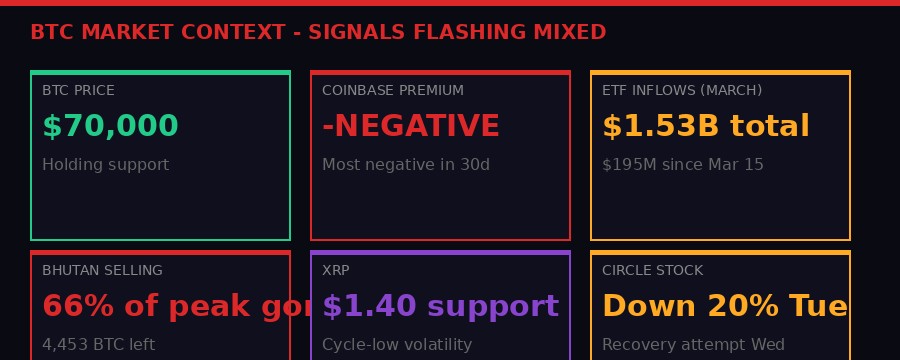
Key crypto market signals as of March 26, 2026. BTC holds $70K but underlying demand indicators are weakening. (BLACKWIRE / VOLT)
"The signal here is that institutional demand has not disappeared. However, it is selective and less linear than in the strongest accumulation phases." - Vikram Subburaj, CEO, Giottus Exchange, CoinDesk March 26, 2026
Into this environment, Bhutan is adding approximately $150 million per quarter in sell pressure. On a market where $70,000 is the contested floor and institutional inflows are decelerating, that is not trivial. The OTC routing minimizes visible impact - but pressure is pressure. Every Bitcoin QCP absorbs from Bhutan needs a buyer on the other side. Those buyers exist right now, but if macro conditions deteriorate further, the depth of that OTC bid becomes the critical variable.
The market structure reading: BTC is holding, but the ceiling is heavy. Sustained selling from a sovereign with a zero cost basis and no commercial incentive to hold is exactly the kind of persistent downward pressure that grinds through support levels over time. A $70,000 level that could survive an Iran war but fails on sovereign liquidation would be a historically ironic outcome.
Bhutan's Mining Economics: Why Every Sale Is Profit
Understanding why Bhutan can sell without hesitation requires understanding its mining economics. The kingdom generates approximately 1,600-2,300 megawatts of hydroelectric power annually - substantially more than domestic consumption requires. The surplus is sold to India under long-term bilateral agreements. Bitcoin mining was introduced as an alternative use for excess capacity, particularly during seasons when Indian demand is lower.
The effective cost of Bitcoin production through hydroelectric mining is primarily operational - staff, hardware, cooling, maintenance. The electricity itself has a marginal cost near zero relative to alternatives, since it would otherwise flow to India at regulated rates or go unused. Industry estimates put Bhutan's all-in production cost at roughly $3,000-5,000 per Bitcoin, well below any price level Bitcoin has traded at since 2020.
This means Bhutan's cost basis on its entire 13,000 BTC peak stack was probably below $65 million. At $70,000 per coin, selling 4,453 BTC is worth $312 million - roughly 5x the mining cost of the entire original stack. Every sale is pure margin. The government is not selling under distress. It is monetizing a position with returns most sovereign wealth funds would kill for.
The rational question is why accelerate now, at $70,000, rather than wait for higher prices? Several possibilities. First, Bhutan may have assessed macro and geopolitical risk - the Iran conflict, rising oil prices, Fed hawkishness - and concluded the probability of near-term higher prices does not justify the holding risk. Second, the Gelephu project may need near-term USD capital for construction phases regardless of Bitcoin's trajectory. Third, the government may be responding to internal political pressures around the concentration of national wealth in a single volatile asset. Fourth, the QCP OTC relationship may have been set up under a structured program with a preset liquidation schedule that predates the current environment.
None of these require distress. Bhutan looks like a sophisticated seller executing a planned exit from an oversized position, at reasonable prices, through professional channels. The acceleration in March suggests something changed - timeline, need, or calculation - but the execution remains professional.
The Broader Sovereign Bitcoin Picture
Bhutan's selling has broader implications for the thesis that sovereign nation-state Bitcoin accumulation is a one-way street. The 2024-2025 narrative leaned heavily on the idea that countries like Bhutan and El Salvador were demonstrating a new model of sovereign reserve management - holding Bitcoin as a hard currency alternative, a hedge against dollar dependence, a wealth preservation vehicle outside Western financial infrastructure.
El Salvador took a different route. After adopting Bitcoin as legal tender in 2021 and accumulating hundreds of millions in reserves, the country negotiated an IMF bailout in early 2025 that included Bitcoin reserve reduction requirements. El Salvador has since stepped back from aggressive Bitcoin holding as a condition of international financing. The ideological commitment met the fiscal reality of needing multilateral support.
Bhutan is different - it is not under IMF conditionality, and its selling is not externally driven. But the pattern is the same: sovereign accumulation followed by sovereign liquidation, at a price and pace determined by domestic fiscal needs rather than Bitcoin conviction. The "nations are going to hodl Bitcoin forever" thesis has not survived contact with actual sovereign treasury management.
That is not necessarily bearish for Bitcoin long-term - institutional capital, corporate treasuries, and U.S. ETF demand collectively dwarf Bhutan's remaining position. But it does complicate the narrative that sovereign accumulation creates permanent demand floors. Governments sell. Sometimes aggressively. And when they do, they have cost basis advantages that allow them to sell at any price and still profit.
The U.S. government's own seized Bitcoin holdings - over 200,000 BTC at various stages of forfeiture and legal resolution - represent a far larger overhang than Bhutan's remaining 4,453. The question of whether and how the U.S. Treasury manages those reserves will be a far bigger price catalyst than anything Bhutan does from here.
Timeline: Bhutan's Bitcoin Journey
What Happens Next
The trajectory is clear: Bhutan is not buying back. The cost basis advantage means they have no urgency to time the market precisely - they profit at $50,000 just as they profit at $100,000. The Gelephu pledge, whatever its revised status, requires capital that is being extracted from the Bitcoin position. The OTC relationship with QCP is operational and ongoing.
At the current pace of roughly $50 million per month in outflows, Bhutan's remaining 4,453 BTC ($315 million) would be fully liquidated in approximately six months - by around September 2026 - if the pace holds. That assumes QCP and other counterparties continue to absorb at current rates and that the government does not decide to retain a floor position for strategic or political reasons.
The more interesting scenario: Bhutan publicly revises or formally abandons the Gelephu pledge. That would be a significant political moment - a government acknowledging that its Bitcoin-funded development ambition was not executable in the timeframe originally stated. It would also be a cautionary data point for any other small nation considering a Bitcoin-backed development program.
For the market, the near-term impact of Bhutan's selling is measurable but not decisive. $36.75 million per transfer, absorbed through OTC, is noise in a market that moves $30-50 billion in daily volume. The significance is symbolic: a sovereign government with zero cost basis is choosing to exit rather than hold. That is a vote against price appreciation at current levels, from a counterparty with no financial pressure to sell and no emotional attachment to the asset.
When entities with no reason to sell choose to sell, markets listen. Bhutan is not panicking. It is monetizing. And it is doing so faster each week.
BROADER MARKET SNAPSHOT - MARCH 26, 2026
The Policy Dimension: Clarity Act, Circle, and the Stablecoin War
While Bhutan sells, the U.S. crypto regulatory landscape is generating its own turbulence. The Clarity Act - the long-stalled market structure bill that would establish how crypto assets are classified and regulated within the U.S. financial system - hit a new compromise proposal this week that has fractured the industry.
The proposed yield agreement, shown to stakeholders Monday and banking industry representatives Tuesday, restricts how stablecoin issuers can structure rewards programs. The language would limit rewards tied to the scale of stablecoin balances - a direct hit at Coinbase, which has built a high-margin business through its USDC distribution agreement with Circle. According to 10x Research founder Markus Thielen, Coinbase currently receives nearly $900 million per year in revenue share from Circle under the existing arrangement. Restricting yield passthrough could fundamentally alter that economics.
Circle stock dropped 20% Tuesday on the news - counterintuitive, given that restricting yield advantages Circle's issuer-level position relative to Coinbase's distribution model. But the market initially read it as regulatory risk across the stablecoin sector. By Wednesday, analysts were arguing the selloff was overdone. Bitwise CIO Matt Hougan put a potential $75 billion target valuation on Circle in a note Wednesday, roughly double its current market cap, arguing the long-term stablecoin market growth story ($1.9 trillion to $4 trillion by decade end) remains intact regardless of the yield dispute.
Coinbase CEO Brian Armstrong has not formally opposed the latest draft - but sources told CoinDesk that Coinbase "clashed with others" on an industry call this week, suggesting the exchange is not walking quietly into a deal that could cost it hundreds of millions in annual revenue. White House crypto adviser Patrick Witt tried to calm the waters Wednesday with an X post ("It's all going to work out. Bullish.") that satisfied no one.
Adding fuel: Tether announced this week that it has hired a Big Four accounting firm for a full audit of USDT reserves. That development may have contributed to Circle's Tuesday selloff - a fully audited Tether changes the competitive calculus in regulated stablecoin markets, where USDC's compliance positioning has been its core edge. If Tether achieves audit credibility, Circle's moat narrows.
The Clarity Act text is expected for circulation late this week or early next. Whatever it says will move Circle and Coinbase stock, and likely the broader crypto market's expectations for U.S. regulatory maturity. The stablecoin yield fight is not resolved. And the bill's window before the next congressional recess is finite.
Get BLACKWIRE reports first.
Breaking news, investigations, and analysis - straight to your phone.
Join @blackwirenews on Telegram