The Clock Runs Out: Trump's Ultimatum Expires, Iran Threatens Total Hormuz Shutdown and War on the Gulf's Water Supply
On Day 27 of the US-Iran war, the most dangerous 48 hours since the conflict began are reaching their end. Trump threatened to obliterate Iran's power plants. Iran responded by threatening to shut down every desalination facility keeping Gulf states alive. The world waits.
MONDAY, MARCH 23, 2026 | 00:02 CET - DISPATCHED FROM BEIRUT RELAY

The US military has conducted sustained strikes across Iran for 27 consecutive days. (Pexels)
At some point on Monday, Donald Trump's 48-hour deadline to Iran will expire. What happens next is anyone's guess - including, apparently, inside the White House.
Saturday night, Trump posted a 51-word ultimatum in capital letters on social media: open the Strait of Hormuz or the United States will destroy Iran's power plants, "STARTING WITH THE BIGGEST ONE FIRST." The post, which military law experts immediately flagged as a likely war crime if carried out, sent the region into a weekend of spiraling threats and counter-threats that has not abated by Monday morning. [AP News, Mar 22]
Iran's parliament speaker Mohammad Bagher Qalibaf responded directly on X. If Iran's power grid is targeted, he wrote, then every piece of critical infrastructure across the Gulf region - energy facilities, and crucially the desalination plants that produce the drinking water for tens of millions of people in the UAE, Saudi Arabia, Kuwait, and Qatar - would become "legitimate targets" and be "irreversibly destroyed." The threat was not rhetorical decoration. It was precise, immediate, and backed by Iran's demonstrated ability to hit those facilities with drones. [AP News, Mar 22]
This is where the war is as the 48-hour clock runs out. Not winding down - accelerating. Not toward resolution - toward a confrontation that legal scholars say could redefine what war crimes look like in the 21st century.
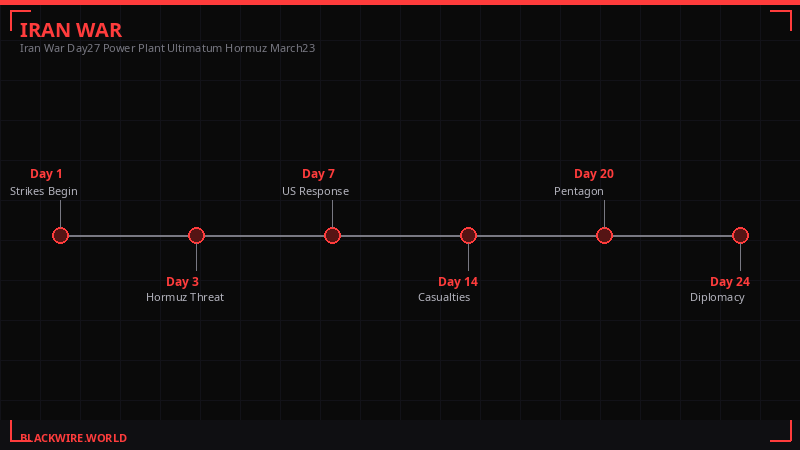
Key escalation events over 27 days of conflict.
The Ultimatum: What Trump Actually Said - and What It Means

Iran's power grid supplies hospitals, water treatment, and homes. Targeting it would constitute civilian harm under international law. (Pexels)
The ultimatum was posted late Saturday while Trump spent the weekend at his Florida property. It lacked any legal review, according to military law experts who analyzed it publicly. It was 51 words, heavy on capital letters, thin on strategy. It told Iran to open the Strait of Hormuz within 48 hours or face destruction of its power plants. [AP News, Mar 22]
"It certainly has a feeling of ready, fire, aim." - Geoffrey Corn, military law professor, Texas Tech University; retired Army lieutenant colonel and military lawyer, speaking to AP News
Corn was unsparing. The type of attack Trump described would "probably be a war crime," he said. For military commanders, it would force a choice: obey an illegal order or face court-martial for refusal. That is not a theoretical dilemma. It is a real one, playing out in quiet briefing rooms across US Central Command as the clock ticks down. [AP News, Mar 22]
Laws governing warfare do not flatly prohibit attacking power plants. But they require a proportionality analysis - military advantage weighed against civilian harm. International humanitarian law scholars say that bar is extremely high when the targets power hospitals, water treatment facilities, and homes. Iran's UN ambassador wrote to the Security Council over the weekend calling the proposed strikes "inherently indiscriminate and clearly disproportionate." [AP/IRNA, Mar 22]
US Ambassador to the UN Mike Waltz pushed back Sunday. He argued Iran's Revolutionary Guard controls much of the country's infrastructure, using it to power the war effort. Potential targets, he said on Fox News, include "gas-fired thermal power plants and other types of plants." He added that Trump "is not messing around." [AP News, Mar 22]
What Waltz did not address was the civilian population that depends on those same plants - a population that had no say in whether their government goes to war or blockades an international waterway.
Iran's Counter-Threat: The Gulf's Water Supply as a Weapon

Gulf states including UAE, Saudi Arabia, and Kuwait depend on desalination for over 80% of their drinking water. (Pexels)
The Iranian response was designed to maximize the cost to US allies rather than to the US itself. Parliament speaker Qalibaf's statement on X made explicit what military analysts had long warned: Iran's most devastating counter-option is not more missile barrages at Israeli cities. It is the destruction of the Gulf's water infrastructure. [AP News, Mar 22]
The Gulf Cooperation Council states - Saudi Arabia, UAE, Kuwait, Qatar, Bahrain, Oman - have almost no freshwater. Their populations drink desalinated seawater. Their agriculture uses it. Their industrial operations run on it. A coordinated Iranian drone campaign against desalination plants would not be a symbolic strike. It would be a humanitarian catastrophe on a scale that dwarfs anything in the current conflict. [AP News, prior reporting on desalination infrastructure]
Qalibaf went further still, adding that "entities that finance the US military budget are legitimate targets." That phrasing - deliberate, ambiguous, and legally significant - appeared designed to extend Iran's threat envelope to private infrastructure and financial institutions that supply American defense spending. [AP News, Mar 22]
Iran's threat is not entirely hypothetical posturing. Over the past 27 days, Iranian drones have struck the Ras Laffan LNG terminal in Qatar - the world's largest liquefied natural gas export facility - forcing it offline. They have hit Ras Tanura, Saudi Aramco's largest refinery. They have damaged oil storage in Fujairah, UAE. The Iranian military has demonstrated the range and targeting accuracy to hit what it threatens to hit. [AP, Reuters]
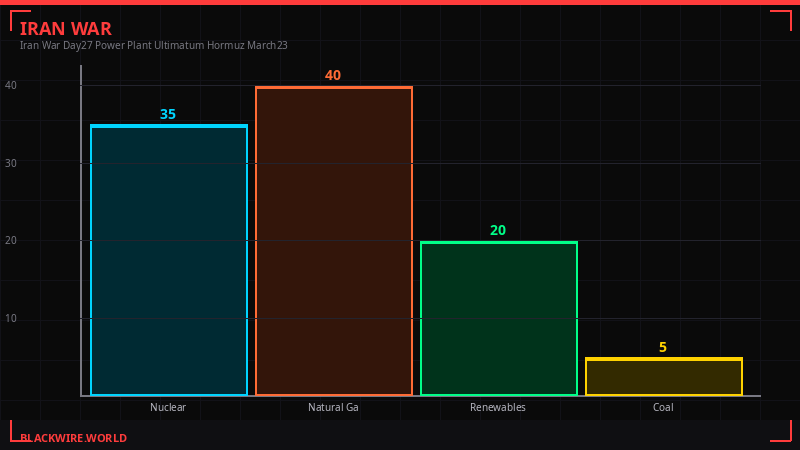
What the Strait of Hormuz controls. A full closure would be an energy shock without precedent.
Lebanon: The Second Front Accelerates

Israel destroyed the Qasmiyeh bridge near Tyre on Sunday, one of several Litani River crossings targeted to isolate Hezbollah forces. (Pexels)
While the Iran ultimatum dominated headlines, the Lebanese front entered a potentially decisive phase on Sunday.
Israeli Defense Minister Israel Katz ordered the military to accelerate the destruction of Lebanese homes near the border and to destroy bridges over the Litani River. Israeli forces struck the Qasmiyeh bridge near Tyre with an hour's warning given to civilians. Destroying the Litani crossings isolates southern Lebanon from the rest of the country, cutting Hezbollah's logistics routes - but also cutting off Lebanese civilians from hospitals, food, and escape routes. [AP News, Mar 22]
Lebanese President Joseph Aoun called the bridge strikes "a prelude to a ground invasion." That assessment was not an exaggeration for diplomatic effect. Israel has been methodically constructing the preconditions for a ground operation: clearing air defenses, destroying vehicle routes, eliminating weapons caches. The playbook is familiar from 2006, but executed at greater scale and with far more destructive weight. [AP News, Mar 22]
Israeli military spokesman Brig. Gen. Effie Defrin acknowledged the trajectory on Sunday: "More weeks of fighting against Iran and Hezbollah are expected for us." That is not the language of a military closing in on an exit. [AP News, Mar 22]
Hezbollah has continued striking Israel throughout the weekend. An Israeli civilian - 61-year-old farmer Ofer "Poshko" Moskovitz - was killed in the northern town of Misgav Am. He had told a radio station two days earlier that life near the Lebanese border felt like "Russian roulette." He was right. Israel's military initially said he died in a rocket attack; it later investigated whether its own soldiers' fire was responsible. [AP News, Mar 22]
Lebanese authorities report that Israeli strikes have killed more than 1,000 people and displaced over 1 million since Hezbollah entered the conflict following the killing of Iranian Supreme Leader Ayatollah Ali Khamenei. Hezbollah has fired hundreds of rockets into northern Israel in response. [AP News]
The Nuclear Dimension Refuses to Recede

Iranian strikes on the Negev Desert near Dimona and Arad put Israel's secretive nuclear research site in the threat corridor. (Pexels)
Late Saturday, Iranian missiles struck communities near Arad and Dimona in Israel's Negev Desert - two towns near the Negev Nuclear Research Center, which Israel neither confirms nor denies houses nuclear weapons. At least 175 people were wounded. Netanyahu visited the communities Sunday and called it a "miracle" no one died. [AP News, Mar 22]
Iran said the strikes were retaliation for the latest Israeli attack on Iran's main nuclear enrichment site at Natanz. The strike on Natanz was the most recent in a series targeting Iran's nuclear program over the 27-day war. The International Atomic Energy Agency has said most of Iran's estimated 441 kilograms of enriched uranium - the core issue driving the conflict's logic - is not at Natanz but lies buried under rubble at its Isfahan facility. [AP News, Mar 22]
The nuclear shadow over this conflict has grown darker by the week. Israel is widely believed to possess nuclear weapons. Iran has enriched uranium to 60% purity - short of weapons grade but not impossibly far. Both sides are now regularly targeting each other's nuclear infrastructure. The margin for error narrows with each strike cycle.
Israel's ambassador to Washington, Yechiel Leiter, delivered a surprising note of restraint on Sunday, cautioning against the full-scale power plant attack Trump threatened. "We want to leave everything in the country intact, so that the people who come after this regime are going to be able to rebuild and reconstitute," he told CNN. The comment suggested the US and Israel are not necessarily synchronized on the ultimatum's implementation. [AP News, Mar 22]
Human cost of 27 days of conflict. Lebanon has absorbed disproportionate civilian casualties.
Trump's Erratic Strategy and the Domestic Political Pressure

US gas prices have risen more than a dollar per gallon since the war began, erasing the projected benefit of Trump's tax refunds. (Pexels)
The war's domestic political consequences are mounting in ways that make resolution simultaneously more urgent and less likely for Trump.
The nationwide average price of regular gasoline reached $3.94 per gallon on Sunday - up more than a dollar from a month ago. Stanford Institute for Economic Policy Research director Neale Mahoney projects prices could peak at $4.36 per gallon in May, based on Goldman Sachs oil forecasts. In that scenario, the average American household would pay $740 more for gas this year - nearly equal to the $748 average increase in tax refunds from Trump's legislation. The windfall Trump promised is being consumed by the war he started. [AP News, Mar 22]
The political context matters: pivotal midterm elections are months away. Soaring gas prices hitting lower and middle-income households hardest, who receive smaller refunds but spend a larger proportion of earnings on fuel. Credit cards are maxed. The saving rate has fallen steadily. "When you start looking across the perspective from a consumer side, you're seeing people who have maxed out their credit cards," one economist told AP. [AP News, Mar 22]
Trump has cycled through multiple Hormuz strategies in the past week alone: diplomatic coalition (allies refused), US-managed-alone, "other countries will handle it," the strait would "open itself," sanctions relief on Iranian oil, and now the power plant ultimatum. Each shift undermines the last. Even allied Republicans are growing uncomfortable. "You can't all of a sudden walk away after you've kind of created the event and expect other people to pick it up," Sen. Thom Tillis (R-N.C.) told ABC. [AP News, Mar 22]
Democratic senators were harsher. Sen. Ed Markey (D-Mass.) called the power plant threat "a war crime." Sen. Chris Murphy (D-Conn.) said Trump "has lost control of the war and he is panicking." Those are not fringe assessments - military law experts outside partisan politics reached the same conclusions independently. [AP News, Mar 22]
"He overestimated his ability to control the events once he unleashed this torrent of violence." - Geoffrey Corn, military law professor and retired Army JAG officer, AP News, Mar 22, 2026
NATO Secretary-General Mark Rutte attempted to calm the situation Sunday, saying he understood Trump's frustration and that more than 20 countries were "coming together to implement his vision" of making the strait navigable. That number, if accurate, is a significant departure from the allied refusals of the past two weeks - though Rutte provided no specifics on what participation would involve. [AP News, Mar 22]
Brent crude has risen 36% since the war began Feb 28. Qatar's LNG shutdown and Hormuz disruption have hit gas markets as hard as oil.
The Three Scenarios Facing Monday

No direct US-Iran negotiations are known to be underway as the deadline expires. (Pexels)
Military analysts and regional diplomats tracking the conflict see three primary outcomes as the deadline expires, in roughly descending order of probability.
The face-saving partial reopening. Iran allows tankers from neutral nations - flagged under China, India, or other countries not party to the conflict - to transit the strait. Trump claims this as a win. Both sides avoid full escalation. Oil prices drop $15-20 per barrel. This outcome requires Iran to blink without appearing to blink, and requires Trump to accept a partial result as sufficient. It has a genuine diplomatic logic. It also requires both leaders to simultaneously exercise strategic restraint - a faculty neither has displayed reliably over the past four weeks.
US strikes on power plants. If Trump carries through, Iran's response is mechanically predictable. Iranian parliament speaker Qalibaf's statement was not a negotiating position - it was a declared policy. Full Hormuz closure. Attacks on Gulf desalination plants. Energy and water infrastructure strikes across the region. The humanitarian consequences would be severe within days - Gulf states cannot supply drinking water for their populations through alternative means for any sustained period. Oil would spike to $130-150 per barrel within 48 hours. International legal proceedings would begin. The war would enter a new, more destructive phase. [AP, experts cited therein]
The standoff extends. The most historically consistent outcome over the past 26 days. Trump issues the ultimatum. The clock expires. Nothing immediately happens. Trump announces a new "final" deadline, or frames inaction as ongoing pressure, or pivots to another talking point. Markets remain volatile but contained. The war continues at its current grinding pace. This is what has happened, in various forms, every time a decisive threshold appeared to be reached since February 28.
Analysis of three possible outcomes as the 48-hour deadline expires.
The Global Economy Absorbs the Shock - So Far

Critical oil infrastructure across the Gulf region remains under threat. Saudi Aramco's Ras Tanura, the world's largest oil export terminal, was hit earlier in the conflict. (Pexels)
International benchmark Brent crude has risen from $72.97 the day before the war began to approximately $99 on Sunday - a 36% jump in 27 days. That trajectory, if extended, produces scenarios economists describe as genuinely destabilizing for the global economy. [AP, Frankfurt dispatch]
The Ras Laffan LNG terminal in Qatar - the world's largest liquefied natural gas export facility, handling roughly 20% of global LNG - remains shut down after an Iranian drone strike. Qatar's state energy company QatarEnergy has declared force majeure, meaning it cannot supply contracted customers and bears no financial penalty. European gas prices have risen sharply as a result, compounding an energy price shock that the continent was already struggling to manage. [AP News, Frankfurt]
Saudi Aramco's Ras Tanura refinery, the East-West pipeline connecting Persian Gulf processing to Red Sea exports, and multiple Fujairah terminal facilities in the UAE have all been struck or disrupted. The Fujairah terminal partially resumed operations, providing some relief. But with Hormuz functionally closed to most tanker traffic, the entire system of workaround routes lacks the capacity to compensate fully for the lost throughput. [AP News, Mar 22]
Iran continues exporting some oil through alternative routes and directly from Kharg Island, primarily to China. Tehran has been exporting 13.7 million barrels since the war started, according to maritime intelligence firm TankerTrackers.com, with China absorbing the bulk of it. That revenue stream - paradoxically operating under the conditions of a war that supposedly targets Iran's economic capacity - funds the continued conflict. [AP News, Frankfurt]
Oxford Economics estimates that if gas prices average $3.70 per gallon for the year, US consumers will spend roughly $70 billion more on fuel than expected - exceeding the $60 billion in projected tax refunds. The rocket-and-feathers phenomenon that economists observe about gas prices suggests that even if the war ended today, prices would decline slowly, extending the economic pain well into the summer. [AP News, Mar 22]
Conflict Timeline: Week 4 Summary
What Comes Next: The 48 Hours After the 48 Hours
Whatever Trump decides to do when the clock expires, the war does not end on Monday. Neither side has stated conditions for a ceasefire. Iran's interim leadership - Mojtaba Khamenei has not made a public appearance in days - has consistently rejected negotiations framed as conditional on Hormuz reopening. The US has not put a ceasefire proposal on the table that Iran could credibly accept without losing face.
Israel's stated war aims - weakening Iran's nuclear program, its missile program, and its proxy network, and enabling the Iranian people to overthrow the theocracy - remain aspirational at best. There has been no sign of an internal Iranian uprising. The IRGC, while degraded by US and Israeli strikes, continues to function. Hezbollah is still firing rockets. The proxies have not collapsed. [AP News, Mar 22]
The war has now killed more than 2,500 people across Iran, Lebanon, Israel, and the Gulf. Over a million people are displaced in Lebanon alone. Iran's death toll has surpassed 1,500. The conflict's costs - human, economic, diplomatic - are compounding faster than any of its stated objectives are being achieved.
Netanyahu claimed on Sunday that "Israel and the U.S. were well on their way to achieving their war goals." Military spokesman Defrin promised "more weeks of fighting." Those two statements, made on the same day by the same government, capture the contradiction at the core of this conflict: success is claimed while indefinite escalation is promised.
The 48-hour clock that Trump set has always been less about military calculus and more about political theater. The question Monday is whether the theater becomes operational - and who pays the price if it does.
The most dangerous outcome is not a US strike on power plants followed by predictable Iranian retaliation. It is a miscalculation - an unauthorized strike, a radar error, a commander in the field acting on orders he interpreted differently than they were meant. The infrastructure of escalation is fully assembled. The gap between deliberate policy and catastrophic accident is narrower than at any point in the past 27 days.
Get BLACKWIRE reports first.
Breaking news, investigations, and analysis - straight to your phone.
Join @blackwirenews on Telegram