At Least 66 Dead as Colombian Military Transport Plane Crashes - Cause Unknown
A Colombian military transport aircraft carrying dozens of personnel has crashed, killing at least 66 people in one of the worst military aviation disasters in the country's recent history. The defence minister described it as a "tragic accident" but said the cause remained unclear as investigators moved to secure the crash site.

A Colombian Air Force aircraft similar to the type involved in Tuesday's fatal crash. Colombia operates a fleet of aging transport aircraft across conflict-prone terrain. [Illustrative/Pexels]
What We Know Right Now
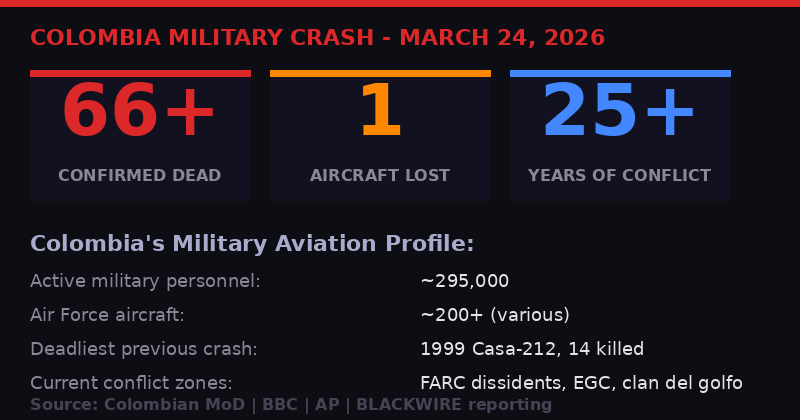
Key figures from Tuesday's Colombia military crash. At least 66 dead represents one of the worst military aviation disasters in Latin America this decade. [BLACKWIRE infographic]
Colombia's defence minister confirmed on Tuesday morning that a military aircraft had gone down, killing at least 66 people. BBC The minister classified the incident as a "tragic accident" while stressing that the precise cause had not yet been established.
Details remain sparse in the early hours following the crash. Colombian authorities have not released the type of aircraft involved, the location of the crash site, or the identities of those on board. The military has confirmed that investigators have been deployed.
The toll of 66 deaths puts this among the single deadliest military aviation accidents in Colombia's history, and one of the worst military aircraft disasters anywhere in Latin America in recent memory. By comparison, the crash of a Colombian military Casa-212 transport aircraft in 1999 killed 14 service members - a fraction of Tuesday's toll.
Colombian President Gustavo Petro has not yet issued a public statement at the time of writing. The armed forces declared the situation an active emergency and asked media to exercise restraint pending formal notification of next of kin.
"This is a tragic accident. We are mourning. Our priority is to recover our personnel and understand what happened." - Colombian Minister of National Defence, March 24, 2026 (via BBC)
Emergency response teams from the Colombian army and air force are reported to be operating at the crash site, though its exact location in the country's vast and varied terrain has not yet been officially disclosed.
Colombia's Military and the Challenges of Aviation Safety

Colombian military forces operate across some of the most demanding terrain in the world - mountainous rainforest, coastal lowlands, and remote jungle - conditions that create serious aviation challenges. [Pexels/Illustrative]
The Colombian military is one of the largest and most operationally active in South America. With roughly 295,000 active personnel and decades of counterinsurgency experience, it has also accumulated a history of military aviation incidents tied to the country's demanding geography and operational tempo.
Colombia's terrain ranges from Andean mountain ranges topping 5,000 metres to dense Amazonian jungle and humid Pacific lowlands. For transport aviation, this means constant exposure to rapidly changing weather, limited landing strips in rural areas, altitude stress on older airframes, and reduced radar coverage over remote regions.
The Colombian Air Force - Fuerza Aerea Colombiana - operates a fleet of roughly 200 or more aircraft of various types, including aging American-supplied Hercules C-130 transports, smaller DHC-6 Twin Otters for jungle operations, Casa-212 utility transports, and various helicopters including Black Hawks and Mi-17s supplied through US assistance programmes. The precise aircraft involved in Tuesday's crash has not yet been publicly confirmed.
Military aviation safety experts note that Latin American air forces, including Colombia's, have historically struggled with maintenance backlogs on aging fleets, limited spare parts availability for older Western-supplied aircraft, and the challenge of operating in environments that accelerate wear on airframes. None of these factors have been implicated in Tuesday's crash - investigation is at the earliest stage - but they form the backdrop against which incidents of this kind must be understood.
Colombia's operational military aviation mission is also exceptionally active by regional standards. The armed forces conduct anti-narcotics operations, counterinsurgency missions against FARC dissident groups and the Clan del Golfo criminal network, as well as resupply flights to remote military bases, humanitarian aid delivery, and troop transport across regions with few road connections.
Colombia's Unresolved Conflict - the Context Around This Crash
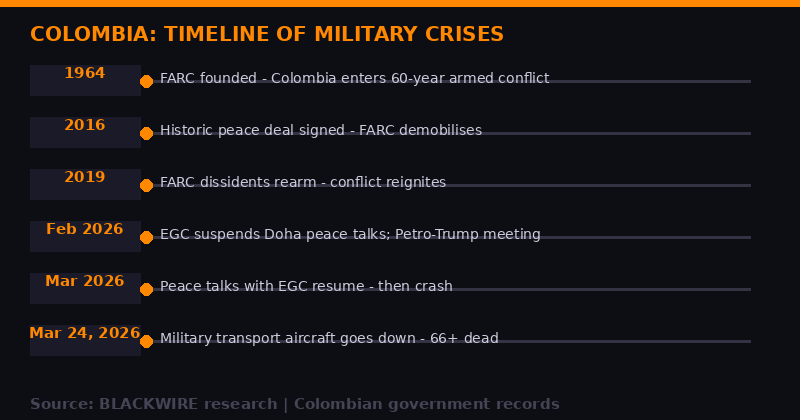
Timeline of Colombia's military and political crises leading to March 2026. The country remains one of the most complex conflict environments in the Western Hemisphere. [BLACKWIRE infographic]
Colombia has been attempting to navigate a fragile peace process even as active armed groups continue to operate across the country. President Gustavo Petro - himself a former left-wing guerrilla - entered office in 2022 on a "Total Peace" platform, seeking negotiations with multiple armed groups simultaneously.
The Estado Mayor Central, an umbrella of FARC dissident groups that rejected the 2016 peace agreement, has been engaged in intermittent government negotiations in Havana. The Ejército de Liberación Nacional (ELN) has held talks in Cuba and Venezuela. The Clan del Golfo, the country's most powerful criminal organisation, paused talks in January 2026 after the government threatened to target its leader known as "Chiquito Malo" for arrest.
In early 2026, Colombia's relationship with the United States became a flashpoint when President Trump escalated pressure over drug trafficking flows through Colombia, briefly imposing tariffs and threatening visa bans before Petro agreed to accept deportation flights. The two presidents subsequently met at the White House in February 2026 in a meeting described as "terrific" by Trump - a remarkable turnaround from weeks of diplomatic tension.
The military has been central to Petro's attempts to negotiate peace. Senior military commanders have participated directly in some dialogue processes, while simultaneously maintaining combat operations against groups that refuse talks. This creates operational complexity: the armed forces must be ready to fight the same groups they are attempting to engage diplomatically, in many cases in the same terrain.
Whether Tuesday's crash is in any way connected to active conflict operations or represents a purely technical aviation failure remains entirely unknown. The defence minister's framing as "tragic accident" suggests no hostile action is suspected at this stage - but investigations have barely begun.
A Nation No Stranger to Military Loss

Colombia's military has lost thousands of personnel across more than 60 years of armed conflict. Tuesday's crash adds to a long and painful history of military casualties. [Pexels/Illustrative]
Colombians know military grief. The country's armed conflict began formally in 1964 with the foundation of the FARC, but roots of political violence stretch back to La Violencia of the 1940s and 1950s - a decade-long civil war that killed an estimated 200,000 people.
Between 1964 and the 2016 peace agreement, the FARC conflict alone killed over 260,000 people, displaced millions more, and left deep psychological and institutional scars across Colombian society. The military lost tens of thousands of soldiers and officers during that period, including in helicopter ambushes, jungle ambushes, and - periodically - aviation accidents.
Notable military aviation incidents in Colombia's recent history include the 1999 Casa-212 crash that killed 14 soldiers, multiple helicopter losses to insurgent fire or mechanical failure over the years, and several smaller transport incidents across remote mountain and jungle terrain. None reached the scale of Tuesday's 66 dead.
For Colombian families with members in the military, the news on Tuesday morning will hit with a particular force. Many service members come from working-class backgrounds and rural communities - precisely the areas where the armed forces recruit heavily and where military service represents a significant economic opportunity alongside a genuine sense of national duty.
The military itself has undergone deep reform since the FARC peace deal, attempting to transition from a purely counterinsurgency force to an institution capable of multiple roles including disaster response, border security, and development support in rural areas. That institutional evolution has included efforts to modernise equipment and improve safety protocols, but reform is a long process and the fleet includes aircraft that have been in service for decades.
Latin America's Recurring Military Air Tragedies
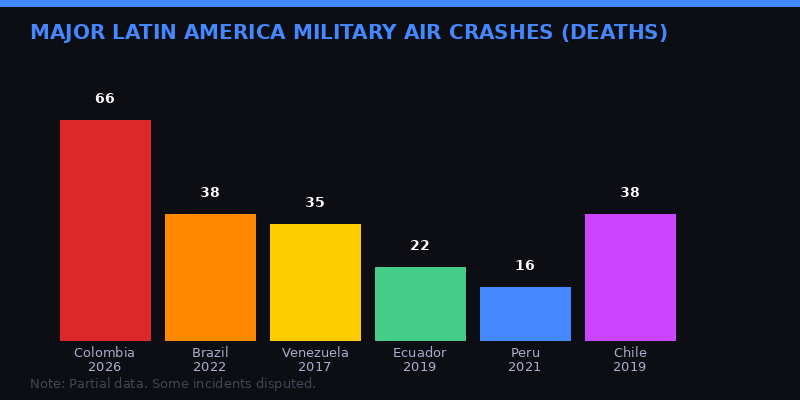
Major military aviation disasters in Latin America by death toll. Colombia's March 2026 crash is the deadliest on record for the region in recent years. [BLACKWIRE infographic]
Latin American armed forces have suffered a series of major aviation disasters in recent years, often linked to aging fleets, extreme terrain, and operational pressure. Colombia's crash on Tuesday stands among the worst.
In Chile in December 2019, a C-130 Hercules transport plane disappeared over Drake Passage with 38 people on board while carrying personnel and equipment to an Antarctic base. The aircraft and all aboard were never recovered - presumed lost to the notoriously violent South Atlantic weather. The Chilean Air Force subsequently grounded part of its Hercules fleet for inspection.
Venezuela's air force suffered a major crash in 2017 when a military transport went down, killing 35 soldiers and crew. Bolivia, Brazil, Ecuador, and Peru have each experienced significant military aviation incidents over the past decade, often tied to similar factors: weather, aging equipment, difficult terrain, or pilot fatigue from high operational tempos.
The underlying problem is structural. Most Latin American air forces receive American or Soviet-era aircraft as military assistance that enters a fleet and then remains in service far beyond original intended lifespans. Spare parts become difficult to source. Maintenance knowledge concentrates in a small number of trained technicians. Budgetary pressures in governments managing broader public spending demands mean aviation safety sometimes competes with other priorities for funding.
Military analysts who study Latin American defence note that the region's air forces tend to maintain operational capability at the cost of safety margins that NATO-standard air forces build in. Planes fly more hours per airframe. Maintenance windows get compressed. The result is not inevitably catastrophic - most flights complete safely - but the risk profile is elevated compared to Western standards.
The Petro Government: Political Fallout and Accountability Questions

Colombian government institutions face immediate accountability pressure following the crash. President Petro has built his political identity around protecting ordinary Colombians - military families will demand answers. [Pexels/Illustrative]
The crash places President Gustavo Petro in a politically sensitive position. His administration has sought to reduce military casualties through negotiated settlements with armed groups, framing less war as both moral progress and practical governance. A crash killing 66 military personnel will intensify scrutiny of the administration's handling of military readiness and equipment maintenance.
Opposition politicians - already critical of Petro's peace dialogues and his management of security - are likely to call for a full investigation and push for parliamentary hearings. Questions will center on: which aircraft was involved, how old the airframe was, when its last maintenance inspection occurred, what the mission was, and whether crew fatigue or operating conditions played any role.
For Petro personally, the politics are complicated. He is a former M-19 guerrilla who spent years opposing the military as a political and armed institution. His transformation into commander-in-chief has been awkward at times - some military leaders have clashed with the administration over policy direction. A mass military casualty event will test whether he can project the empathy, command authority, and institutional credibility that such a moment demands.
Colombian society processes military grief through well-worn rituals: state funerals, flag-draped coffins, presidential condolences. The question in the days ahead will be whether those rituals are accompanied by serious accountability - an investigation that produces real answers about what went wrong and who bears responsibility.
The families of 66 dead soldiers will be watching. They will want more than ceremony.
What Investigators Will Be Looking For

Military crash investigators will examine every recoverable piece of wreckage - flight recorders, engine components, structural elements - to reconstruct the final minutes of the flight. [Pexels/Illustrative]
Standard military aviation crash investigation protocol begins immediately after first responders secure the site. Investigators from the Colombian Air Force's safety branch, typically working alongside the national civil aviation authority, will attempt to recover the aircraft's flight data recorder and cockpit voice recorder if available - older military aircraft often lack modern flight recorders, which complicates reconstruction of events.
Physical evidence - engine components, structural fractures, fuel system elements - gets catalogued and analysed. Crew records are pulled, including recent flight hours, health status, and training logs. Air traffic control records and weather data for the flight path are secured. Witness accounts from survivors or ground observers are taken immediately.
The investigation will consider several broad categories of failure: airframe structural failure, engine failure, fuel system problems, crew error, weather encounter, bird strike, and - given Colombia's active conflict environment - whether any hostile action is involved. The minister's "tragic accident" framing points away from combat, but formal investigation must rule this out systematically.
Colombia's mountainous and jungle terrain creates particular challenges for crash investigations. Sites are often inaccessible by road, requiring helicopter insertion of investigators. Wreckage may be scattered over wide areas depending on the nature of the event. Environmental conditions - heat, rain, animal life - degrade evidence quickly. In past Colombian crashes, full investigation reports have taken months or years to complete.
Initial findings are typically released within days or weeks, giving a preliminary read on what happened. More definitive analysis follows over a longer timeline. For the families, the wait for definitive answers is one of the hardest parts.
What Comes Next - Investigation, Mourning, and Reform

Colombian communities will begin mourning processes as families are formally notified. The country has developed deep rituals around military grief through decades of conflict. [Pexels/Illustrative]
The next 24-48 hours will be defined by three parallel processes: the search and recovery operation at the crash site, formal notification of next of kin, and the opening of what promises to be one of Colombia's most scrutinised military investigations in years.
Colombia's military has protocols for mass casualty notifications that evolved through decades of conflict. Military chaplains, unit commanders, and specially trained notification officers will be deployed to families across the country. The process is achingly familiar to many communities that have been through it before.
In Bogota, the political response will crystallise quickly. Congressional opposition will file questions and demand hearings. Military leadership will brief the president. The defence minister will make further public statements as more is known. International partners - the United States, which has deep military ties with Colombia, and regional neighbours - will offer condolences.
Over a longer horizon, if the investigation points to fleet age or maintenance failures as contributing factors, the crash could trigger a broader review of military aviation safety standards and fleet modernisation priorities. Colombian military modernisation has been a recurring debate - the country has invested in upgrading some capabilities while other parts of the fleet age without replacement.
The Colombian air force has also been discussing the eventual replacement of aging C-130 Hercules aircraft with more modern transport platforms, a process that requires significant capital investment and political will. A high-profile crash tied to airframe age or maintenance would accelerate that conversation sharply.
For now, 66 families are receiving the worst news they will ever hear. The country that has survived 60 years of conflict is once again absorbing military loss - this time not from bullets or bombs, but from an aircraft gone down for reasons not yet known. The investigation begins. The mourning has already started.
KEY FACTS: Colombia Military Crash - March 24, 2026
- At least 66 dead - confirmed by Colombian Ministry of Defence
- Aircraft type not yet officially confirmed
- Crash location not yet publicly disclosed
- Cause unknown - investigation launched
- Defence minister: "Tragic accident" - no hostile action suggested at this stage
- President Petro had not yet issued a public statement as of time of publication
- Colombia has approximately 295,000 active military personnel
- Death toll makes this one of worst military air crashes in LatAm in recent years
Get BLACKWIRE reports first.
Breaking news, investigations, and analysis - straight to your phone.
Join @blackwirenews on Telegram