Four Gulf Capitals Burning Simultaneously: The Iran War Escalates Into Regional Firestorm on Day 28
Before Monday dawn, missiles were falling on Abu Dhabi, Riyadh, Kuwait City, and Bahrain at the same time Israel was launching new strikes on Tehran. The 28-day-old war has crossed a threshold that analysts have warned about for weeks. The Gulf is no longer a crisis zone - it is an active battlefield from the Strait of Hormuz to the Saudi interior.
MONDAY, MARCH 23, 2026 | 06:26 CET - DISPATCHED FROM DUBAI RELAY

The US-Iran war, which began February 28, has now spread to hit every major Gulf state simultaneously. (Pexels)
The news arriving from the Persian Gulf early Monday is not a single flash point. It is a cascade.
Air defenses in the United Arab Emirates intercepted a ballistic missile near Al Dhafra Air Base in Abu Dhabi, the massive American air installation that serves as one of the primary staging grounds for US operations over Iran. One person on the ground was injured by shrapnel when a piece of the intercepted missile fell. [AP News, Mar 23]
Warning sirens sounded simultaneously across Bahrain and Kuwait. Saudi Arabia's Defense Ministry confirmed it had intercepted a missile targeting Riyadh - the capital, the seat of government, the heart of the Saudi oil kingdom - and destroyed additional drones over the oil-rich Eastern Province, where the infrastructure that powers roughly 8% of global crude output is concentrated. [AP News, Mar 23]
While Iranian missiles were arcing toward four Arab capitals at once, Israel launched what its military called a "wide-scale wave of strikes" on infrastructure targets in Tehran. The strikes came without detailed elaboration from the Israeli Defense Forces, who said only that they had "begun" the wave. Tehran has endured Israeli air attacks at intervals throughout the 28-day conflict, but the language - "wide-scale," "infrastructure" - suggests a new level of systematic destruction in the Iranian capital.
And through all of it, the Strait of Hormuz remains functionally closed. Oil prices remain at $112 per barrel of Brent crude - up 55% from the moment the war started on February 28. Asian stock markets opened Monday to bloodbath conditions. Seoul's KOSPI fell 5.1%. Tokyo's Nikkei dropped 3.3%. Hong Kong's Hang Seng shed 3.1%. The war is no longer an abstraction that appears on commodity ticker screens. It is restructuring the global economy in real time.
Israel Hits Tehran, Iran Hits Everyone Else

Israel's military launched a new wave of infrastructure strikes on Tehran early Monday. (Pexels)
The pattern of Monday's escalation is deliberate and multi-directional. Israel is pressing its assault on Iran proper, while Iran simultaneously punishes the Gulf Arab states for hosting American bases and enabling US military operations. The strategy is transparent and brutal: Iran cannot currently defeat Israel and the United States in a direct fight, so it is attacking everyone adjacent to them.
The Revolutionary Guard - the IRGC - issued a direct statement on Monday that went beyond anything Tehran had said publicly in the four previous weeks of fighting. If the United States follows through on Trump's threat to bomb Iranian power plants, the IRGC said, Iran would respond by striking power plants across the entire Middle East region "that supply electricity to American bases, as well as the economic, industrial and energy infrastructures in which Americans have shares." [AP News, Mar 23]
"Do not doubt that we will do this." - IRGC statement read on Iranian state television, March 23, 2026
That sentence - five words, zero ambiguity - is the clearest statement of intent Iran has made since the war began. It is not a diplomatic protest. It is operational warning language. The IRGC statement identifies American economic and energy interests across the region as legitimate targets, which in practice encompasses most of the Gulf's major infrastructure - Saudi Aramco facilities, UAE petrochemical complexes, Qatari LNG terminals. All of it.
Iran's parliament speaker Mohammad Bagher Qalibaf had already issued a parallel threat over the weekend, warning that desalination facilities - the systems that produce drinking water for tens of millions of people in Kuwait, Saudi Arabia, Bahrain, the UAE and Qatar - would be considered "legitimate targets" if US strikes on Iranian power plants proceeded. On Sunday, Bahrain accused Iran of already damaging one of its desalination plants. [AP News, Mar 22-23]
Iran's Foreign Minister Abbas Araghchi offered a separate framing that cuts to the legal and diplomatic core of the crisis: the attack on Iran made insurance companies shut down shipping through the Strait of Hormuz, he said, not Iran itself. "The U.S. made insurance companies shut down shipping through the strait," Araghchi said - a legally sophisticated deflection that will matter enormously in any future war crimes proceedings or international arbitration.
Trump's Ultimatum: Legal Minefield, Military Puzzle

Trump issued the 51-word ultimatum via social media on Saturday. Legal scholars immediately flagged it as a probable war crime if executed. (Pexels)
The ultimatum itself is the story within the story. Saturday night, while spending the weekend in Florida, Donald Trump posted 51 words to social media - much of it in capital letters - threatening to destroy Iran's power plants if the Strait of Hormuz was not opened within 48 hours. The post named no specific military targets. It described no legal justification. It underwent none of the normal interagency review that should accompany threats to attack civilian infrastructure. [AP News, Mar 22]
Geoffrey Corn, a law professor at Texas Tech University and retired military lawyer, described the post's appearance as: "ready, fire, aim." The targeting of power plants that serve civilian populations is governed by strict international humanitarian law standards: such strikes are only lawful if the military advantage is demonstrably proportionate to the civilian harm caused. In Iran, a country of 88 million people, destroying the national power grid would shut off hospitals, water treatment, heating, refrigeration for medicines, and every other system that sustains civilian life.
"It certainly has a feeling of ready, fire, aim. He overestimated his ability to control the events once he unleashed this torrent of violence." - Geoffrey Corn, Texas Tech University law professor and retired Army military lawyer, AP News
Iran's United Nations ambassador wrote to the Security Council that the deliberate targeting of power plants would be "inherently indiscriminate and clearly disproportionate" - a direct invocation of the legal test that governs such attacks under the laws of armed conflict. That letter puts the legal record firmly on the table if strikes proceed. [IRNA/AP News, Mar 22]
On the political side, criticism crossed party lines. Senator Ed Markey (D-Mass.) called the threat "a war crime." Senator Chris Murphy (D-Conn.) said Trump "has lost control of the war and is panicking." More damaging for Trump's political position was the assessment from his own party: Senator Thom Tillis (R-N.C.) told ABC's "This Week" that "you can't all of a sudden walk away after you've kind of created the event and expect other people to pick it up." [AP News, Mar 22]
Trump's UN Ambassador Mike Waltz tried to provide legal cover on Sunday, arguing that Iran's Revolutionary Guard controls much of the country's infrastructure and uses it to power the war effort. "The president is not messing around," Waltz said on Fox News. The legal question is whether military utility - if IRGC uses power plants to power military operations - can overcome the burden of civilian harm caused by cutting electricity to 88 million people. Most legal scholars say the bar has not been cleared.
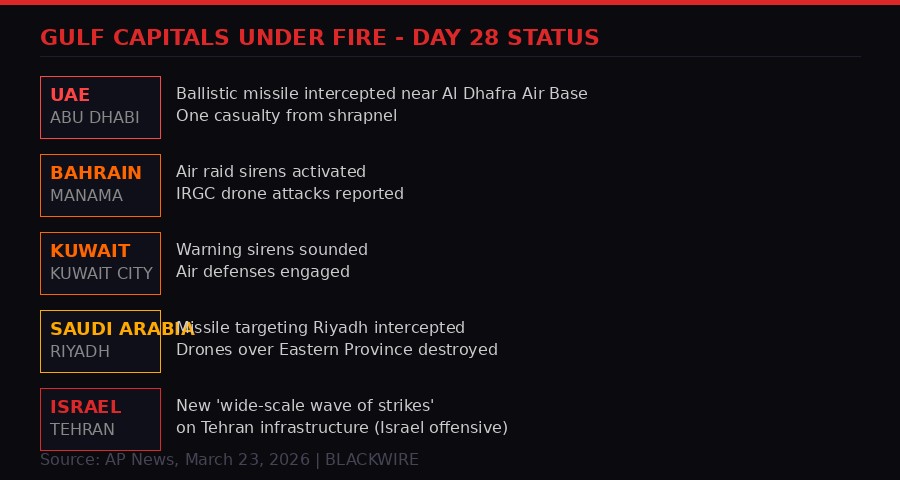
All four major Gulf states reported missile or drone attacks in the early hours of Monday, March 23. (BLACKWIRE)
The Strait of Hormuz and the Energy Catastrophe Building in Slow Motion

The Strait of Hormuz - through which roughly 20% of global oil supply passes - has been effectively closed since the war's first days. (Pexels)
The Strait of Hormuz question is the hinge on which the entire geopolitical crisis turns. The 21-mile-wide chokepoint connects the Persian Gulf to the Gulf of Oman and the open ocean. Roughly one-fifth of the world's daily oil supply passes through it, along with approximately one-fifth of global liquefied natural gas. When it effectively closes, the impact on every economy that depends on those energy flows is immediate and compounding. [AP News, Mar 21]
The Strait has been functionally closed to most international shipping since the war's early days. Iran formally controls passage and has indicated it is blocking vessels from the United States, Israel, and their allies. The practical result is that the global tanker fleet has been unable to move freely, insurance underwriters have suspended coverage for transits, and the estimated 20 million barrels per day that normally flow through the waterway have been reduced to a trickle.
Brent crude stood at $72.97 on February 27, the day before the war started. It rose to $88 in the first week. It crossed $100 in week two. It hit $119.50 at its peak before the market absorbed some volatility. On Monday morning, with simultaneous strikes across four Gulf capitals and Trump's power plant ultimatum expiring, Brent is trading at $111.92. The trajectory is clear to anyone watching.
Trump spent last week cycling through improvised responses. He tried to build an international naval coalition to escort shipping through the strait - allies turned him down. He suggested the US could manage alone. He hinted other countries would have to take over. He suggested the strait would "somehow open itself." Then on Friday his Treasury Department lifted sanctions on some Iranian oil - the first time in decades - in an attempt to flood markets with additional supply and suppress prices. [AP News, Mar 22]
The sanctions removal was politically remarkable: the administration was simultaneously bombing Iran and buying Iranian oil. The goal was to add millions of additional barrels to the global market. Whether it can offset the losses caused by the Hormuz closure is unclear. Whether it undermined America's primary leverage tool against Tehran is not unclear at all.
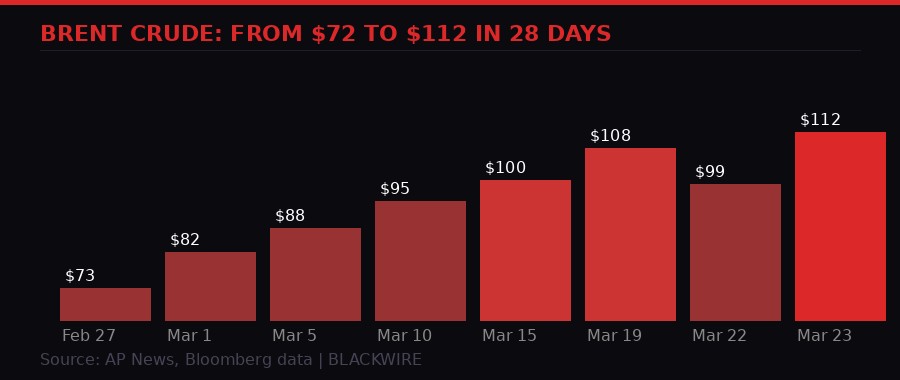
Oil prices have surged 55% since February 28. Brent crude was trading at $112 Monday morning. (BLACKWIRE)
Asian Markets in Freefall: What $112 Oil Does to Global Finance

Asian equity markets opened Monday to severe losses as Trump's threat against Iranian power plants and Iran's counter-threats roiled investor confidence. (Pexels)
Markets had opened for Monday trading across Asia before most Western analysts had finished their morning coffee. The verdict was swift and severe. South Korea's KOSPI dropped 5.1%. Japan's Nikkei fell 3.3%. Hong Kong's Hang Seng lost 3.1%. Taiwan's TAIEX shed 2.6%. Shanghai's Composite declined 2.1%. Australia's ASX fell 0.7%. [AP News, Mar 23]
"Trump's ultimatum and Iran's retaliatory warnings point to a widening conflict that keeps energy disruption and market volatility elevated with no clear off-ramp in sight." - Ng Jing Wen, analyst at Mizuho Bank Singapore, AP News
The week-four war toll on Wall Street is compounding. The S&P 500 fell 1.5% on Friday, closing its fourth straight losing week - the longest such losing streak in a year. The Dow Jones Industrial Average dropped 443 points. The Nasdaq composite tumbled 2%. In the bond market, the 10-year Treasury yield finished Friday at 4.38%, up from 3.97% before the war began. Higher yields reflect rising inflation expectations driven by oil. [AP News, Mar 22-23]
The Federal Reserve's room to maneuver is rapidly shrinking. Before the war, markets were pricing in at least two Federal Reserve rate cuts in 2026. Those expectations have been largely erased. Central banks in Europe, Japan, and the United Kingdom have all recently held rates steady rather than cut. The inflationary pressure from $112 oil makes rate cuts nearly impossible: they would add fuel to an already overheating cost-of-living crisis that is beginning to appear in grocery prices, airfares, utility bills, and fuel costs at the pump.
Qatar's Ras Laffan - the world's largest LNG export facility and a supplier of 20% of global liquefied natural gas - remains shut down under force majeure following drone strikes that interrupted operations. Qatar has told its contracted customers that it cannot supply gas due to circumstances beyond its control. The knock-on effect for Europe, which has been rebuilding its LNG reserves since the Russia-Ukraine war, is potentially severe. Gas purchasers in Asia feel the same pinch. [AP News, Mar 21]
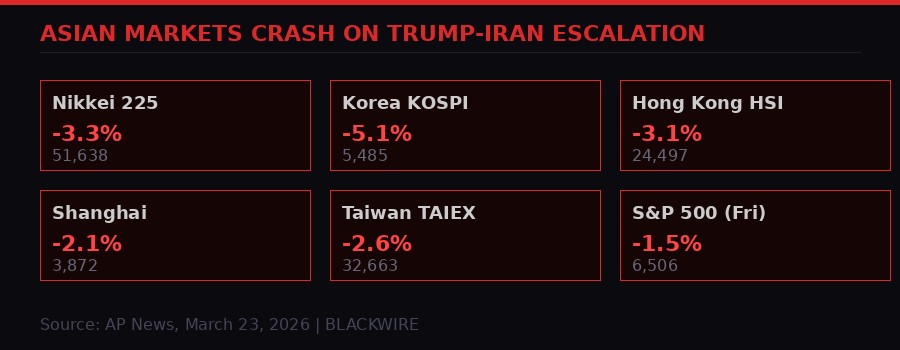
South Korea's KOSPI suffered the biggest single-day drop, falling 5.1% on Monday morning. (BLACKWIRE)
The Water Weapon: Desalination Plants as Targets

Gulf states depend on desalination for 70-90% of their drinking water. Iran has explicitly threatened to destroy this infrastructure. (Pexels)
Among the most alarming new dimensions of this escalation is the explicit targeting of desalination infrastructure - the systems that convert seawater into drinking water for tens of millions of people across the Gulf.
The numbers are stark. In Kuwait, roughly 90% of drinking water comes from desalination plants. In Oman, the figure is approximately 86%. In Saudi Arabia, around 70%. In the UAE and Qatar, the percentages are similarly high. These are not supplementary systems. They are the primary water supply for cities and populations that could not survive without them. Hundreds of desalination facilities line the Persian Gulf coast, each within range of Iranian drone or missile strikes. [AP News, Mar 22]
The Iranian parliament speaker's weekend statement was unambiguous: if Iranian power plants are hit, desalination facilities across the Gulf become legitimate targets and will be "irreversibly destroyed." On Sunday, Bahrain specifically accused Iran of damaging one of its desalination plants, though the Bahraini government said supplies had not yet gone offline. Earlier in the week, Iran said a US airstrike had damaged an Iranian desalination plant on Qeshm Island, cutting water to 30 villages. Iran's Foreign Minister framed that as "setting the precedent - not Iran." [AP News, Mar 22]
Michael Christopher Low, director of the Middle East Center at the University of Utah, has described Gulf states as not just petrostates but "saltwater kingdoms" - countries whose survival depends on fossil-fuel-powered water production systems. "It's both a monumental achievement of the 20th century and a certain kind of vulnerability," he said. That vulnerability is now being exploited as a weapon. [AP News, Mar 22]
Many Gulf desalination plants are physically co-located with power stations in combined generation facilities. This means attacks on electrical infrastructure - which Trump is threatening against Iran - can also disable water production. The escalatory logic is circular and catastrophic: Trump threatens Iran's power plants, Iran threatens Gulf power-and-water co-generation plants, Gulf states lose both electricity and drinking water simultaneously.
Israel's ambassador to Washington, Yechiel Leiter, publicly cautioned against Trump's power plant threat in a Sunday appearance on CNN. "We want to leave everything in the country intact, so that the people who come after this regime are going to be able to rebuild and reconstitute," Leiter said. The statement was remarkable: Israel, which has been conducting the bombing campaign against Iran for 28 days, is asking the United States not to destroy civilian infrastructure because it would leave nothing to work with after the war. [AP News, Mar 22]
What the US Military Actually Thinks

US Central Command's Adm. Brad Cooper gave his first one-on-one interview of the war Monday morning, claiming the campaign is "ahead or on plan." (Pexels)
US Central Command chief Admiral Brad Cooper gave his first one-on-one interview since the war began to Iran International, the Farsi-language satellite network, on Monday morning. The timing and venue were deliberate: a message directed at the Iranian civilian population, not Washington policy makers or Western audiences. [AP News, Mar 23]
"You need to stay inside for right now. There will be a clear signal at some point, as the president has indicated, for you to be able to come out." - Admiral Brad Cooper, US Central Command chief, Iran International interview, March 23, 2026
Cooper's language is carefully crafted. "Stay inside for right now" implies the bombardment is going to intensify, not ease. "A clear signal at some point" implies a future moment when conditions change - but it is not now, and he offers no timeline. Telling Iranian civilians to shelter suggests further strikes are imminent or ongoing. The interview functions simultaneously as a military advisory, a psychological operation against Iranian morale, and a tacit admission that there is no immediate ceasefire coming.
Cooper's public assessment of the campaign is optimistic - he said it is "ahead or on plan" and that the US and Israel are systematically destroying Iran's capacity to rebuild its military. "It's not just about the threat today," he said. "We're eliminating the threat of the future, both in terms of the drones, the missiles as well as the navy." [AP News, Mar 23]
He also suggested Iran could end the war quickly by stopping its return fire - though he pointedly did not say whether the US and Israel would stop their attacks before all infrastructure targets were destroyed. That asymmetry - Iran must stop fighting to end the war, but the US and Israel make no reciprocal commitment - is the strategic core of why the war keeps escalating. Iran has no incentive to cease fire if the result is further destruction with no guarantee of safety.
CENTCOM has been conducting strikes across Iran since February 28, targeting Iran's air force, navy, missile production facilities, and now broader infrastructure. Iran's military capability has been degraded - its missile launches have reportedly decreased since the war began, according to Israel's military - but the IRGC retains both the will and the means to strike Gulf Arab infrastructure with drones and cruise missiles. As Monday's simultaneous hits on four capitals demonstrate, Iran's drone-and-missile capacity is not yet exhausted.
Day 28 - Morning Situation Timeline
Lebanon and the Risk of a Second Ground Front

Lebanese President Joseph Aoun warned Israel's bridge-bombing campaign is "a prelude to a ground invasion" as southern Lebanon comes under renewed bombardment. (Pexels)
The Lebanon front has been an active but secondary theater since the war began. Hezbollah launched strikes on northern Israel shortly after the conflict started, describing it as retaliation for the killing of Iran's Supreme Leader Ayatollah Ali Khamenei. Israel has responded with sustained airstrikes and an expanded ground presence in southern Lebanon. The official Lebanese death toll has surpassed 1,000 people killed by Israeli strikes, with more than 1 million displaced - a staggering figure for a country of under 6 million. [AP News, Mar 22]
The critical development on Sunday was Israel's decision to expand its target list to include bridges over the Litani River. Defense Minister Israel Katz ordered the military to destroy bridges that Hezbollah is using to move fighters and weapons from northern Lebanon toward the southern front. Israel struck the Qasmiyeh bridge near the coastal city of Tyre on Sunday, providing one hour's advance warning before hitting it. The destruction of bridges physically severs communications, supply lines, and evacuation routes for civilians caught in the crossfire.
Lebanese President Joseph Aoun explicitly called Israel's bridge campaign "a prelude to a ground invasion." He is in a position to know - he commanded the Lebanese Armed Forces before taking the presidency this year. His warning came in the context of Israel also ordering "acceleration" of the destruction of Lebanese homes near the border. Israeli military spokesperson Brig. Gen. Effie Defrin confirmed: "More weeks of fighting against Iran and Hezbollah are expected for us." [AP News, Mar 22]
Iranian-backed Hezbollah has fired hundreds of rockets into northern Israel over the past four weeks. One Israeli civilian - 61-year-old farmer Ofer "Poshko" Moskovitz - was confirmed killed in his car in the northern town of Misgav Am on Sunday in what was initially called a rocket attack, though Israeli authorities were later investigating the possibility that his death was caused by Israeli soldiers' own fire. Two days before his death, Moskovitz had told a radio station that living near the Lebanese border was "like Russian roulette." He was right.
The Gulf Arab states struck Monday by Iranian missiles are simultaneously trying to manage the Lebanon crisis diplomatically. Kuwait and UAE have both hosted informal dialogue channels. None of those channels are producing results. The war is widening faster than any diplomatic process can contain it.
Where This Goes: No Off-Ramp in Sight

Iran's UN ambassador has warned that attacking power plants would be "a war crime." NATO Secretary General Rutte is attempting to prevent further escalation. (Pexels)
NATO Secretary General Mark Rutte spent the weekend trying to prevent full escalation. He said he understood Trump's anger about the Hormuz closure and confirmed that more than 20 countries were "coming together to implement his vision" of making the strait navigable. Rutte is walking an extremely narrow path: calming Trump while not alienating the Gulf Arab states who are themselves being bombed by Iran, and maintaining alliance cohesion while European allies have refused to commit military assets to Hormuz. [AP News, Mar 22]
The fundamental strategic problem has not changed in four weeks. Trump launched this war without a clear exit plan. His options for reopening the Strait of Hormuz are: bomb Iran into compliance (escalation), negotiate with Iran (which requires concessions Trump has not offered), allow the situation to continue (economic pain keeps mounting), or withdraw (which would look like defeat). None of these options is clean. All carry enormous costs.
The power plant ultimatum is the latest version of the same problem. Trump threatened it hoping Iran would capitulate. Iran responded by threatening to make the regional catastrophe worse - desalination plants, power stations across the Gulf, economic infrastructure in which "Americans have shares." The threat escalation has produced counter-escalation. The cycle has not broken in 28 days.
The Mizuho Bank analyst's assessment from Singapore captures the market's fundamental read: "Trump's ultimatum and Iran's retaliatory warnings point to a widening conflict that keeps energy disruption and market volatility elevated with no clear off-ramp in sight." When investment bank analysts in Singapore are describing a geopolitical crisis as having "no clear off-ramp," that is not commentary on a contained regional dispute. That is a verdict on a conflict that is restructuring global energy markets, testing the limits of international humanitarian law, and threatening to push oil to levels not seen since the 1970s. [AP News, Mar 23]
The 48-hour clock Trump set on Saturday expires today. What happens in the next few hours may determine whether this conflict narrows toward some form of negotiated pause - or whether the strikes on four Gulf capitals Monday morning are a preview of what a fully escalated regional war looks like.
The simultaneous targeting of four Gulf capitals - UAE, Saudi Arabia, Kuwait, Bahrain - marks a qualitative shift in the Iran war. Iran is no longer just defending itself or harassing shipping. It is demonstrating capacity for a coordinated multi-front assault on every US-allied state in the Gulf simultaneously. Combined with Israel hitting Tehran, the war has entered its most dangerous phase. Watch for whether Trump orders power plant strikes after his deadline expires - that decision will determine whether this conflict remains conventionally bounded or crosses into deliberate civilian infrastructure warfare with no clear legal or military ceiling.
Get BLACKWIRE reports first.
Breaking news, investigations, and analysis - straight to your phone.
Join @blackwirenews on Telegram