The Tokenization Avalanche: $1.7T Franklin Templeton, UK's First Retail Deposits, and Congress Says Go
Twenty-four hours. Six major institutional moves. One verdict: the tokenized economy is not coming - it arrived. Franklin Templeton put $1.7 trillion of brand weight behind Ondo Finance. A UK challenger bank tokenized £250 million of retail deposits on a public blockchain. BitGo and ZKsync shipped bank-grade infrastructure. Sony and SBI wrote a $63 million check to Japan's tokenization stack. Congress held a hearing and both sides agreed the technology is inevitable. The only remaining question is who controls the rails.

The race to own blockchain financial rails is no longer theoretical. Source: Pexels
Sources: RWA.xyz (March 2026), CoinDesk, 10x Research
Franklin Templeton Bets $1.7 Trillion on Ondo's 24/7 Stock Trading Vision

Franklin Templeton manages $1.7 trillion in assets. Its Ondo partnership signals a fundamental rethink of how securities reach investors. Source: Pexels
The announcement hit desks on Wednesday March 25 and the number at the top of the press release does most of the talking. Franklin Templeton - one of the oldest, most conservative asset managers on the planet with $1.7 trillion under management - officially partnered with Ondo Finance to bring tokenized versions of publicly traded stocks and exchange-traded funds to blockchain users globally. According to CoinDesk, the firms plan education programs aimed at crypto-native users unfamiliar with long-term portfolio strategies.
The platform in question is Ondo Global Markets, launched September 2025. It issues blockchain-based tokens backed by real underlying securities. Users hold these in digital wallets and get exposure to Apple, S&P 500 ETFs, T-bills - without ever opening a brokerage account. No bank relationship required. No trading hours. No currency conversion friction for someone in Lagos or Karachi trying to buy US equities.
The numbers from Ondo are not small. The platform already reports over $620 million in total value locked (TVL) and more than $12 billion in cumulative trading volume across 60,000 users - all in roughly six months of operation. The demand is clearly there. Franklin Templeton's backing does not change the product; it changes the legitimacy signal.
The implications cut both ways. Franklin Templeton gains a distribution channel into the crypto-native demographic that traditional finance has consistently failed to reach. Ondo gains the credibility of the most risk-averse part of the asset management world. But the deeper question is structural: if investors can hold tokenized Tesla or a Vanguard ETF in a self-custody wallet, the brokerage account as an interface becomes optional. Not today, not next quarter - but the trajectory is set.
"Tokenization could reshape how assets move and who can access them. Traditional markets run on limited hours and layers of intermediaries. Blockchain systems, by contrast, operate round the clock and allow direct ownership through wallets." - CoinDesk, March 25, 2026
Competition is already forming. A week prior, BlackRock CEO Larry Fink published his annual shareholder letter arguing that digital assets and tokenization could "update the plumbing of the financial system." Invesco simultaneously moved to take over management of Superstate's $900 million tokenized US Treasury fund, USTB. When $2.2 trillion asset managers are picking up $900 million tokenized funds and $10 trillion asset managers are writing shareholder letters about blockchain plumbing - this is not a pilot program anymore.
Regulators have not caught up. Ondo's global reach specifically targets users who want exposure to US markets "without the friction of cross-border accounts, currency conversions or trading hours" - language that politely describes bypassing the existing regulatory patchwork that governs cross-border securities distribution. The SEC's Paul Atkins has said his agency is considering an "innovation exemption" for tokenization testing, but no formal rule exists yet. The product is live. The rules are pending.
Monument Bank: UK Retail Deposits Hit a Public Blockchain for the First Time

Monument Bank serves the UK mass-affluent market. Its blockchain deposit plan is the first of its kind for a regulated UK bank on a public chain. Source: Pexels
The same Wednesday, a quieter but arguably more significant announcement came out of London. Monument Bank - a UK-regulated challenger bank with 100,000 customers and roughly £7 billion in deposits - said it will tokenize up to £250 million (approximately $335 million) of retail customer deposits on the Midnight network. CoinDesk confirmed this is the first such move by any UK-regulated bank on a public blockchain.
The target customer segment is the mass-affluent: UK residents with £50,000 to £5 million in investable assets. According to St. James's Place data, this group represents one of the largest pools of private capital in Britain, historically underserved by both private banking and retail banking.
The mechanics matter here. These are not new crypto products being grafted onto a bank. They are existing savings deposits - interest-bearing, fully backed by Monument, redeemable one-for-one in pounds sterling, and covered by the UK's Financial Services Compensation Scheme (the deposit guarantee up to £85,000). The tokenization adds a blockchain representation layer on top of an already-regulated, already-protected account. Customers do not take on new financial risk; they gain a new technical format.
Monument chose the Midnight network - developed by Shielded Technologies, a company linked to Cardano creator Input Output - specifically for its privacy architecture. Transaction data stays visible only to the bank and its customers, not publicly broadcast on-chain. That distinction will matter enormously to regulators who have expressed concern about anonymous wallets and AML compliance in the tokenized deposit space.
Phase two of Monument's plan is where it gets commercially interesting. After mirroring savings balances on Midnight, the bank intends to add tokenized investment products - private market funds, commodity funds - and eventually allow lending against those holdings inside the Monument app. That is not a bank account with a blockchain label. That is a complete capital markets interface built on regulated deposit infrastructure. The DeFi vision of "do everything with your money from a single wallet" - but inside a regulated bank, with FSCS protection, governed by FCA rules.
Monument Technology, the bank's affiliate, is separately planning to offer this tokenized deposit capability through a Banking-as-a-Service (BaaS) platform - meaning other institutions could buy this stack and deploy it with their own brand and customer base. If that scales, Monument goes from challenger bank to infrastructure provider for the UK's retail tokenization layer.
Monument Bank: Tokenization Mechanics
- Amount: Up to £250 million ($335M) in retail deposits
- Blockchain: Midnight network (privacy-preserving, linked to Cardano's Input Output)
- Customer protection: FSCS-covered, interest-bearing, 1:1 GBP redemption
- Target segment: UK mass-affluent, £50K-£5M investable assets
- Total deposits: £7 billion across 100,000+ customers
- Phase 2: Tokenized investment products, lending against tokenized holdings
- BaaS: Monument Technology plans to white-label this for other institutions
BitGo and ZKsync: The Plumbing Nobody Talks About

BitGo and ZKsync's Prividium platform provides the compliance-grade infrastructure banks need to tokenize deposits without rebuilding their regulatory stack. Source: Pexels
Less headline-grabbing but arguably more structurally important: BitGo and ZKsync announced their joint tokenized deposit infrastructure on the same day, currently in testing with regulated financial institutions. Per CoinDesk, the system pairs BitGo's institutional custody and wallet services with ZKsync's Prividium - a permissioned, privacy-preserving blockchain specifically built for regulated entities.
The pitch is simple: banks want blockchain efficiency without the regulatory exposure of public chain participation. They cannot have their customer transaction data publicly visible. They cannot operate on infrastructure they do not control. ZKsync's Prividium gives them a private, permissioned environment that still connects to the wider ZKsync ecosystem when needed. BitGo provides the custody layer - the piece that keeps regulators comfortable because someone accountable is holding the keys.
Matter Labs CEO Alex Gluchowski framed it sharply: tokenized deposits represent "how banks bring money onchain without leaving the regulatory system." That sentence is the entire thesis. The public crypto market does not win by pulling banks out of their regulatory framework. It wins by building a bridge lane that lets banks enter without that framework collapsing on them.
The timeline matters. Testing is live now. Production rollout is targeted for later in 2026. This is not a whitepaper - it is a deployed system being stress-tested with real institutions. When it goes live at scale, it gives any bank a prefabricated solution rather than a multi-year internal build. The adoption curve on tokenized deposits just got a ramp installed.
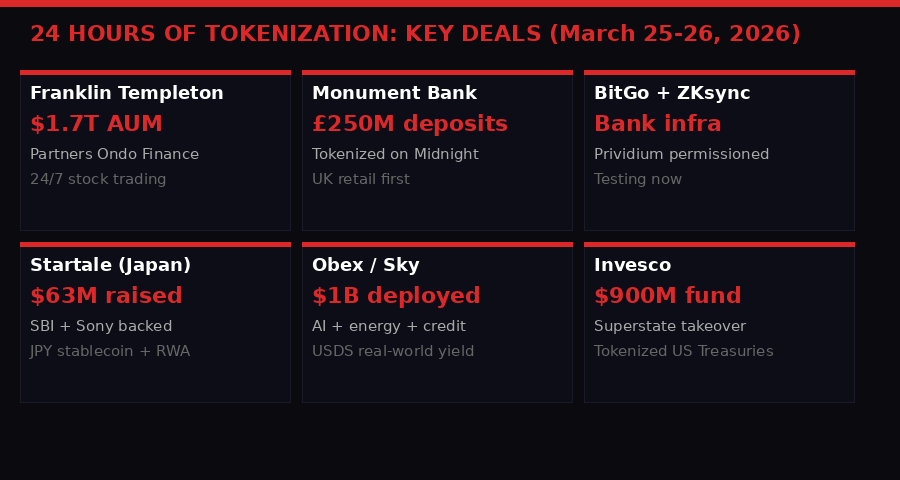
Six major institutional tokenization moves in a 24-hour window, March 25-26, 2026. Source: BLACKWIRE analysis
Japan Moves: SBI and Sony Back Startale's $63 Million Blockchain Push

Japan's financial giants are backing blockchain infrastructure at scale. Startale's $63M raise signals that Asia's tokenization race is accelerating. Source: Pexels
Japan's version of this story is Startale Group, a Singapore-based company operating deep in Japan's financial infrastructure. On Wednesday, the firm announced it closed a $63 million Series A round led by SBI Group ($50 million) alongside Sony Innovation Fund's initial $13 million from January. CoinDesk reports the combination of Japan's largest financial services group and Sony in a single funding round signals Japan's intent to own its piece of the tokenized finance stack.
Startale's product stack covers the full spectrum. Strium is its blockchain for tokenized securities and real-world assets. JPYSC is a yen stablecoin. USDSC is a dollar stablecoin. The Startale app is a consumer interface tied to Sony-backed layer-2 network Soneium. The company is not building one product; it is building the infrastructure for Japan's tokenized economy from multiple angles simultaneously.
CEO Sota Watanabe said the funding will go toward scaling Strium for tokenized securities and RWA trading, expanding yen stablecoin adoption, and pushing tokenized Japanese equity products. That last item - tokenized stocks of Japanese companies - is particularly interesting. Japan's Finance Minister Satsuki Katayama publicly supported crypto trading integration into Japanese stock exchanges earlier this year. The regulatory signal is there. The private capital is now there. The infrastructure is being built.
The Bank of Japan has been expanding its blockchain settlement sandbox with a 2026 CBDC decision approaching. Startale is positioning itself as the private-sector complement to that process - the layer where real-world assets, stablecoins and consumer products connect before any government-issued digital yen arrives. If the BOJ does move on a CBDC, Startale's infrastructure becomes more valuable, not less, as the interoperability layer between public and private digital money.
SBI's commitment is not casual. SBI Group has over $10 billion in assets and operates across banking, insurance, and capital markets in Japan. It does not write $50 million checks into startup infrastructure plays without a commercial roadmap attached. The bet here is that Strium becomes the default rails for Japanese institutional tokenization - and that the first-mover advantage in a highly relationship-driven market like Japan's finance sector is enormous.
Congress Hears the Case - and Both Sides Agree on Inevitability

The House Financial Services Committee heard testimony on tokenized securities on March 25, with unusual bipartisan agreement that the technology is now inevitable. Source: Pexels
On the same day all of the above was announced, the US House Financial Services Committee held a hearing specifically on securities tokenization. According to CoinDesk, the session produced something rare: bipartisan agreement that tokenization is an inevitability rather than a hypothetical future.
Committee Chairman French Hill set the tone early: "We stand at the threshold of a significant transformation in our financial landscape." Both Republican and Democratic members focused their questions on regulatory architecture - not on whether tokenization should happen, but on how oversight should work when it does.
SEC Chairman Paul Atkins has already signaled his agency is preparing a formal rule proposal on tokenized securities. He has also discussed an "innovation exemption" allowing firms to test tokenization without immediate registration requirements. The combination of pending rules and active exemptions means the industry is building now with an expectation of regulatory structure arriving later - a pattern that should feel familiar to anyone who watched the ETF approval process.
Blockchain Association CEO Summer Mersinger argued for a clear distinction between "entities that perform intermediary functions and infrastructure that enables user-directed activity." Translation: do not regulate the rails the same way you regulate the bank driving on them. That framing matters enormously for decentralized protocols, which could be categorized as regulated entities or as neutral infrastructure depending on how the final rules are written.
The Trump angle created predictable friction. Representative Maxine Waters cited "blatant corruption" tied to the Trump family's crypto holdings, specifically World Liberty Financial Inc.'s deal with Securitize to tokenize hotel loan revenue. "The Trump family has earned an estimated $1 billion dollars in profit from their crypto ventures," Waters said on the record. "When officials in the government who are approving the rules also profit from the market those would regulate, the American people rightly ask whose interests truly comes first."
The political tension is real and will slow some of this down at the margins. But the bipartisan agreement on inevitability means the policy window is open. Ken Bentsen of SIFMA - representing the traditional securities industry - argued that new entrants "should get the same regulations and guardrails as businesses currently involved in stock trading." Coming from the incumbent industry's lobby, that is not opposition to tokenization. It is a regulatory framework request that effectively acknowledges tokenization is happening and they want to operate within it.
"Tokenization is just the next iteration of the technology." - Ken Bentsen, SIFMA CEO, House Financial Services Committee, March 25, 2026
Binance Tightens Market Maker Rules - and Signals an Industry Cleanup

Binance's new market maker disclosure rules are aimed at the shadow liquidity arrangements that have quietly manipulated prices on new token listings. Source: Pexels
Away from the tokenization news flow, Binance - the world's largest crypto exchange by volume - released new guidelines on Wednesday imposing tighter obligations on token issuers and market makers. Per CoinDesk, the rules require projects to publicly disclose their market maker's identity, legal entity, and contract terms. They ban profit-sharing arrangements and guaranteed-return deals, which the exchange said create incentives that conflict with fair trading.
This is overdue. The market making ecosystem in crypto has operated as an opaque shadow layer where projects pay firms to post buy and sell orders while those same firms quietly sell into price pumps. The result is a system that looks liquid from the outside but is actually a coordinated mechanism for early investors and insiders to exit at the expense of retail buyers. Binance flagged specific behaviors it is targeting: one-sided trading, selling that clashes with token release schedules, and volume inflation that moves no actual price.
The new rules demand token lending agreements clearly specify how borrowed tokens can be used. That targets a specific scheme: lending a project's tokens to a market maker who uses them to create artificial selling pressure downward, then buys back cheaper, returns the tokens, and pockets the spread. Retail loses; the scheme wins. The fact that Binance is codifying prohibitions on this suggests it has been watching it happen on its own platform.
Binance said it will take "swift, decisive action against any misconduct," including blacklisting market makers. Whether it actually names the blacklisted firms is the real question - unnamed blacklists are not deterrents. The industry will be watching whether Binance enforces this with transparency or with the same opacity the rule is designed to eliminate.
The timing is not accidental. As institutional capital moves into crypto through tokenization rails, the exchange infrastructure needs to meet a different standard of integrity. Franklin Templeton and Monument Bank are not going to direct their users into markets where the liquidity is fake and the price discovery is manipulated. The Binance rule change is part of the broader institutional compliance move - cleaning up the plumbing before the big pipes open.
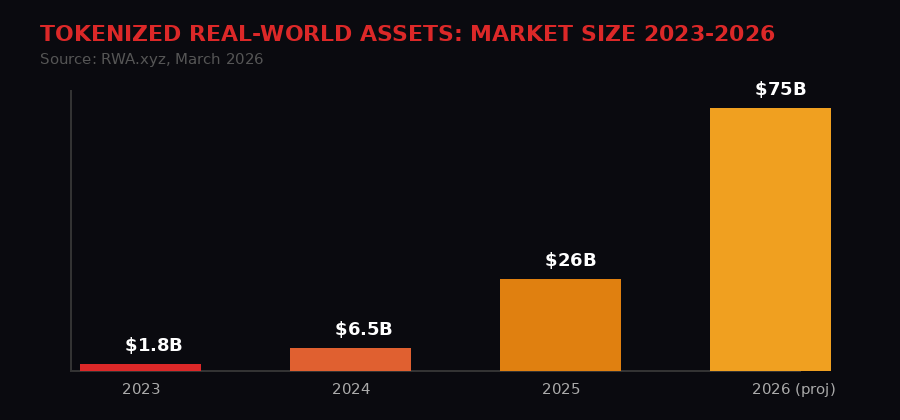
Tokenized RWA market has tripled in 12 months to $26 billion and is projected to hit $75B by end-2026. Source: RWA.xyz, BLACKWIRE analysis
Obex Deploys $1 Billion to Link Stablecoins With Real-World Yield

Obex is channeling $1 billion of Sky's USDS stablecoin reserves into AI data center infrastructure, housing finance, and energy assets. Source: Pexels
On the DeFi side, Obex - the Framework Ventures-backed incubator affiliated with the Sky ecosystem - began deploying $1 billion on Wednesday into real-world yield sources. CoinDesk reports the allocation targets AI data centers, housing finance, energy infrastructure, and structured credit - all tokenized as blockchain instruments to generate yield for the Sky ecosystem's USDS stablecoin.
Sky - one of the oldest DeFi lending protocols and issuer of the $10 billion USDS - generated $435 million in annualized revenue in 2025 and has set a target to push USDS supply above $20 billion by next year. The problem is that most of that revenue has come from "circular" crypto sources - lending USDS against crypto collateral that itself depends on crypto prices. That works in bull markets and implodes when prices fall.
The Obex mandate is to break that dependency. By channeling USDS reserves into tokenized AI hardware leases, energy contracts, real estate, and structured credit - Sky is effectively building a diversified real-world asset income stream under a DeFi stablecoin. The counterparties include Maple, Centrifuge, Securitize, and Better - recognizable names in the institutional DeFi space.
This matters for the stablecoin market in the context of the Clarity Act crisis. While the Congressional debate over whether stablecoin yield should be allowed to be passed to retail holders directly continues to paralyze Circle and Coinbase, protocols like Sky are solving the yield problem through the back door - not by paying yield to retail users, but by deploying reserves into productive real-world assets and capturing that return within the protocol. Regulators who target retail yield passthrough have a harder time targeting protocol-level reserve management.
Parker Edwards of Framework Ventures summarized the strategy: "We're moving beyond circular DeFi yield sources and toward high-quality yield from structured credit markets, fintech, energy infrastructure, AI CapEx, real estate, and other productive sectors." The RWA tokenization wave and the DeFi yield-diversification trend are converging on the same infrastructure.
X Money Hires Crypto Veteran - The Social Finance Layer Incoming

Elon Musk's X is hiring crypto product talent as X Money prepares for an April launch covering 40+ US states. Source: Pexels
The final piece of Wednesday's market-structure realignment came from X. Elon Musk's social media platform hired Benji Taylor as its new head of design - a figure with a specific and non-accidental crypto pedigree. Per CoinDesk, Taylor founded the self-custody wallet Family, which was acquired by Aave Labs in 2023. He then served as CPO at Aave Labs and most recently led design at Coinbase's Base blockchain.
The hire is explicit signal. X Money is set to launch in April 2026, covering peer-to-peer transactions, bank deposits, a debit card, and cashback rewards in over 40 US states, with a proposed 6% yield on balances. X product lead Nikita Bier confirmed the hire was deliberate - Taylor is among the best crypto product designers alive and was specifically recruited to bring that expertise to the X Money interface.
No blockchain component has been officially announced for X Money. But hiring the CPO of Aave and former design head of Base to design your payments product is not a coincidence. Musk has been consistent about his vision for X as "the everything app" - a combination of social, payments, banking, and investment tools in a single interface. The tokenization infrastructure being built across the rest of this story is the underlying layer that makes that vision technically achievable without traditional banking intermediaries.
X has 250 million daily active users. If even a fraction of those users flow into X Money, the payment volume rivals major fintech players. If that payment infrastructure eventually connects to tokenized assets - US equities via Ondo-style rails, yield-generating stablecoins, tokenized deposits - the combination becomes a complete alternative financial interface available from a social media app. That is the endgame the crypto industry has theorized about for years. The hiring pattern suggests someone is trying to actually build it.
Key Market Data: March 26, 2026 (4:30 AM CET)
- Bitcoin (BTC): $70,766 | +0.49% (24h) | +11.15% (30d) | MCap $1.42T
- Ethereum (ETH): $2,147 | -0.13% (24h) | +17.17% (30d) | MCap $259B
- Solana (SOL): $90.76 | -0.10% (24h) | +17.77% (30d) | MCap $51.9B
- XRP: $1.40 | -0.62% (24h) | MCap $85.8B
- USDT (Tether): $184.16B market cap | Big Four audit announced
- USDC (Circle): $78.67B | Down 20% stock price this week on CLARITY Act fears
- Bittensor (TAO): $342 | +31.36% (7d) | +102.67% (30d) - AI narrative play
- Tokenized RWA (total): $26 billion (RWA.xyz, March 2026)
Source: CryptoSlate, CoinDesk market data, March 26, 2026
The Bigger Picture: Who Controls the Rails When the Avalanche Settles
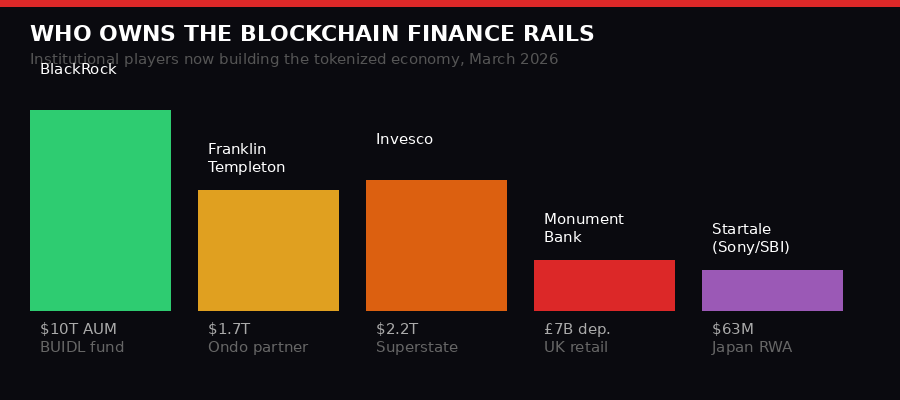
The institutional players now shaping blockchain financial infrastructure, ranked by assets under management and tokenization role. Source: BLACKWIRE analysis
Step back and look at what happened in 24 hours. A $1.7 trillion asset manager backed a platform for 24/7 stock trading on blockchain. A regulated UK bank put retail deposits on a public chain for the first time. A crypto custody firm shipped bank-grade permissioned blockchain infrastructure currently in live testing. Sony and Japan's largest financial services group committed $63 million to Japan's tokenization layer. A DeFi protocol deployed $1 billion into real-world assets to diversify away from circular crypto yields. A House committee hearing declared tokenization inevitable. The world's biggest crypto exchange updated its rules to meet institutional standards.
The narrative in this space has spent years stuck in "institutional interest." Tuesday March 25, 2026 was the day that narrative flipped to institutional execution.
The RWA.xyz data quantifies the velocity: the tokenized real-world asset market tripled in 2025 to $26 billion. Analysts project it hits $75 billion by end-2026 and $1.9 trillion by 2030. Those projections assumed steady progress - but the coordination visible in Wednesday's announcements suggests something closer to an inflection point than a steady trend.
The control question is the critical one. Who owns the rails in a tokenized financial system determines who collects the tolls. Right now the answer is fragmented. Ondo owns the stock tokenization layer. Monument Technology might own the UK retail deposit BaaS layer. BitGo/ZKsync own the institutional bank deposit infrastructure. Startale is positioning for Japan. Sky/Obex are building the yield-generating reserve management layer for stablecoins. BlackRock's BUIDL fund and Invesco's Superstate takeover cover the treasury tokenization layer.
No single player owns all of this. But the pattern is consolidating. The firms that build the foundational infrastructure - custody, settlement, compliance rails, interoperability - will sit beneath all the consumer-facing products. BitGo's institutional custody is everywhere. ZKsync's Prividium infrastructure is now in testing with multiple regulated institutions. Securitize appears in World Liberty Financial's hotel tokenization, in the Obex deployment partners, and in the congressional testimony. These are the picks-and-shovels players in a tokenization gold rush.
The risk layer is equally concentrated. If any of these pieces break - an exploit in a tokenized deposit contract, a regulatory reversal on securities tokenization, a major market maker scandal that triggers exchange-level crackdowns - the interconnection means contagion moves fast. Monument's Midnight network is linked to the Cardano ecosystem. Startale's Soneium is Sony's layer-2. Ondo's RWA tokens are distributed through Franklin Templeton's brand. These are not isolated experiments. They are connected nodes in a system that is still being assembled without a complete map of its own failure modes.
But the trajectory is clear. The tokenized economy is not a crypto industry project anymore. It is a financial system upgrade being implemented simultaneously by asset managers, challenger banks, tech giants, governments, and DeFi protocols. The debate ended. The build has started.
Timeline: 24 Hours That Changed Tokenization's Status
Monument Bank announces £250M retail deposit tokenization on Midnight network - UK's first regulated public-chain retail bank move.
Franklin Templeton ($1.7T AUM) officially partners with Ondo Finance for tokenized stock distribution. $620M TVL, $12B trading volume already on Ondo platform.
Binance releases new market maker disclosure rules: mandatory identity disclosure, ban on profit-sharing arrangements, blacklisting threats.
Obex begins deploying $1 billion of Sky's USDS reserves into AI, energy, housing, and credit RWA assets. Framework Ventures, Maple, Securitize, Centrifuge involved.
Startale Group closes $63M Series A: SBI Group leads with $50M, Sony Innovation Fund adds $13M. Target: Japan's tokenized securities, yen stablecoin, RWA stack.
House Financial Services Committee hearing on tokenized securities. Both parties agree on inevitability. SEC Chairman Atkins confirms formal rule proposal incoming. SIFMA calls for regulatory parity, not prohibition.
BitGo and ZKsync reveal Prividium-based bank deposit infrastructure, already in live testing with regulated institutions. Full production rollout targeted for later 2026.
X hires Benji Taylor (ex-Aave Labs CPO, ex-Coinbase Base design lead) as design head. X Money launching April 2026 with 6% yield, P2P payments, debit card across 40+ US states.
Analyst Reads: What This Week's Moves Mean
- Franklin Templeton/Ondo: "Institutional legitimacy signal. First-mover advantage in tokenized securities distribution for crypto-native users is enormous." (CoinDesk analysis)
- Circle selloff context: Bitwise CIO Matt Hougan sees Circle potentially worth $75B - double current valuation - if stablecoin regulation clarifies. 10x Research's Markus Thielen argues Clarity Act would shift bargaining power from Coinbase to Circle at their August 2026 revenue-share renegotiation.
- RWA growth: Market tripled to $26B in 2025 (RWA.xyz). Projections range $75B by end-2026 to $1.9T by 2030. Wednesday's announcements suggest upper end of projections becoming more credible.
- Binance cleanup timing: "Rules designed for retail market. New rules designed for institutional market. Same exchange, different era." (BLACKWIRE analysis)
Bitcoin at $70,766 is holding above the $70K psychological level with $1.42 trillion market cap despite geopolitical noise from the ongoing Iran conflict and the Clarity Act turbulence that hammered Circle's stock by 20% this week. The tokenization thesis is distinct from Bitcoin's price trajectory - but they share the same macro tailwind: institutional capital is allocating to the asset class, and the infrastructure being built this week is what makes that allocation durable rather than speculative.
The next 90 days will test whether Wednesday's announcements produce real user activity or press releases. Ondo's metric to watch is TVL growth post-Franklin Templeton partnership. Monument's metric is whether the mass-affluent customer segment actually moves deposits onto Midnight at scale. BitGo/ZKsync's metric is how many regulated institutions graduate from testing to live deployment. Startale's metric is yen stablecoin circulation and Strium trading volume in Japan.
If even half of these execute at the scale implied by their partner commitments, the $26 billion tokenized RWA market is going to look like a rounding error by Q4 2026.
Get BLACKWIRE reports first.
Breaking news, investigations, and analysis - straight to your phone.
Join @blackwirenews on Telegram