The Colonel and the Deadline: US Rescue Mission Extracts Airman from Deep Inside Iran as Gulf Burns and Hormuz Clock Hits Zero
A US Air Force colonel was pulled from the mountains of southern Iran on Sunday morning after 36 hours behind enemy lines - the culmination of one of the most complex combat search-and-rescue operations in American military history. The rescue landed hours before Trump's Hormuz deadline expires. Iran is not blinking.

BLACKWIRE - US combat search and rescue forces completed extraction from southern Iran's mountainous Kohgiluyeh province on Sunday. (BLACKWIRE/PULSE)
The operation began Friday evening when Iran's Islamic Revolutionary Guard Corps (IRGC) shot down a US F-15E Strike Eagle over southern Iran - the first American aircraft to crash on Iranian soil since the US and Israel launched the war on February 28. Two crew members ejected. One was recovered quickly. The other, a colonel and weapons systems officer, vanished into the rugged highlands of Kohgiluyeh province, roughly 360 miles south of Tehran, with Iranian search parties and nomadic riflemen closing in.
"This brave Warrior was behind enemy lines in the treacherous mountains of Iran, being hunted down by our enemies, who were getting closer and closer by the hour," President Trump wrote on social media Sunday morning. "He is now SAFE and SOUND!" AP News, April 5
Trump said his location had been monitored "24 hours a day" and that "dozens of aircraft" were dispatched into Iranian airspace to execute the extraction. The president claimed no Americans were killed or wounded in the operation. Iranian state media told a different story, and the full cost of the mission remains contested and unclear.
The fighter jet was the first American aircraft to have crashed in Iranian territory since the conflict began in late February. That baseline fact alone marks Sunday as a different kind of day in the Iran war - not just another exchange of strikes, but an active, contested combat operation deep inside enemy territory that lasted more than 36 hours.
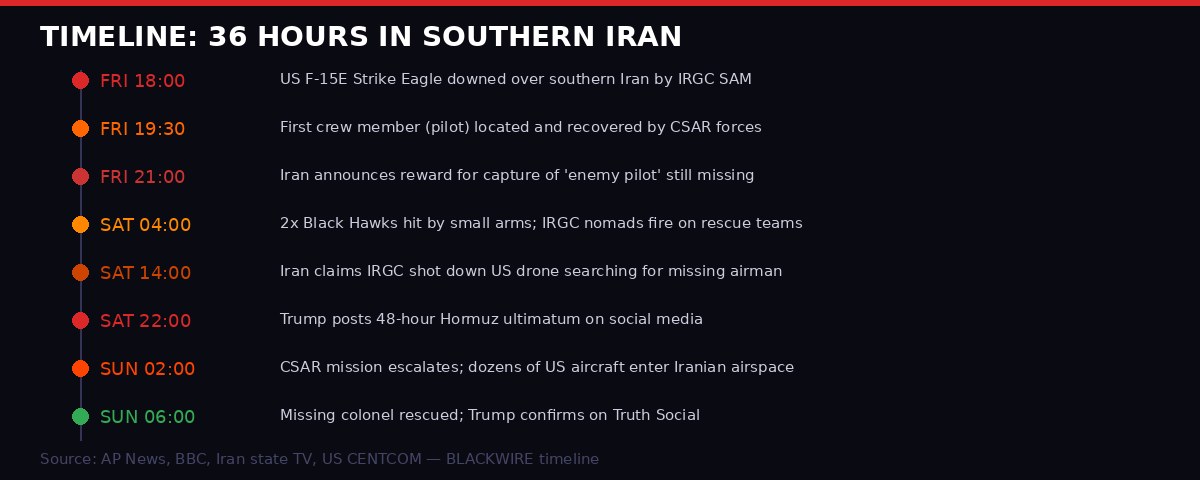
36-hour timeline: From the F-15E shootdown Friday evening to the colonel's confirmed rescue Sunday morning. (BLACKWIRE infographic)
How the Rescue Unfolded
Combat Search and Rescue (CSAR) operations are among the most high-risk and specialized missions in modern warfare. (BLACKWIRE/PULSE)
The exact mechanics of the extraction are still emerging. What is confirmed: it was a multi-phase operation spanning two days, involving helicopter insertions, overhead drone surveillance, strike aircraft providing air cover, and the eventual landing of combat rescue forces in an active threat environment.
The BBC reported, citing a person familiar with the operation, that there was "engagement" between US and Iranian forces during the rescue. An A-10 Warthog attack aircraft was also struck over the Persian Gulf during the broader mission set, with its pilot ejecting and being separately recovered. BBC, April 5
Iranian state TV broadcast footage Sunday claiming that IRGC forces had shot down an American transport aircraft and two Black Hawk helicopters during a failed attempt to reach the missing colonel. However, a senior regional intelligence official speaking to AP on condition of anonymity said the US military itself destroyed two transport planes that suffered technical malfunctions, forcing additional aircraft into the operation. The competing narratives - US destroys its own disabled planes versus Iran shoots down rescue aircraft - have not been independently resolved.
The colonel is described as injured - Trump said he "will be just fine." One Black Hawk helicopter carrying the first recovered pilot was hit by small arms fire during an earlier rescue phase, injuring crew members, though the aircraft landed safely. Iran's IRGC has credited nomadic tribespeople living in the highland region with firing on at least two of the helicopters. BBC Verify confirmed video footage from Friday showing armed individuals firing on US helicopters.
"Their number-one priority is to stay alive and to avoid capture. They're trained to - assuming they're physically capable and not so injured they can't move - to try to get away from the ejection site as quickly as possible." Jennifer Kavanagh, Director of Military Analysis, Defense Priorities think tank - BBC
The complexity of extracting a downed crew member from hostile territory - one of the highest-stakes tasks military planners train for - made this operation especially significant. CSAR missions require coordination across multiple aircraft types: HH-60G Pave Hawk rescue helicopters, A-10s or AC-130s for suppression, ISR platforms for real-time tracking, and often tanker support for the extended range requirements of deep operations. Flying dozens of aircraft into Iranian airspace is not a discreet operation - it is a statement of intent and capability.
The colonel survived 36 hours evading capture in Kohgiluyeh province - a mountainous southwestern region home to more than 700,000 people, including nomadic communities who carry weapons routinely in the highlands. Iran had promised a reward for the capture of the "enemy pilot." The terrain, the active Iranian search, and the time elapsed made this recovery genuinely difficult - not a clean extraction but a contested combat operation from start to finish.
WHAT IS COMBAT SEARCH AND RESCUE (CSAR)?
- Specialized mission to recover downed personnel from hostile territory
- Typically involves HH-60G Pave Hawk helicopters and pararescue jumpers (PJs)
- Requires air superiority assets, suppression of enemy air defenses, and ISR overhead
- Crew members trained to evade, survive, resist, and signal rescuers for days
- One helicopter assault is often not enough - multiple packages with divert routes required
- CSAR units among the most highly trained special operations forces in the US Air Force
- Notable precedents: Scott O'Grady (Bosnia, 1995), Colt 26 crew (Iraq, 2003)
The F-15E That Started It All
The F-15E Strike Eagle is a two-seat multirole combat aircraft capable of air-to-air and precision ground strike missions. Iran claims its new air defense systems downed the jet. (BLACKWIRE/PULSE)
The F-15E Strike Eagle was the first US aircraft to crash on Iranian soil since the February 28 opening strikes. Iran's joint military command, quoted by state-affiliated IRNA, credited "new Iranian air defense systems" with the kill. The specific weapon used to down the aircraft has not been confirmed by US sources. IRNA, April 4
The F-15E carries a two-person crew: the pilot and a weapons systems officer, known as a "Wizzo" - responsible for targeting, weapons programming, and systems management. It is capable of laser-guided and GPS-precision munitions and dual air-to-air and ground-attack roles. In Iran, these aircraft have most likely been used in defensive capacities - intercepting Iranian drones and cruise missiles targeting Gulf states, US naval assets, and Israeli territory.
That an Iranian surface-to-air missile system brought down the aircraft represents a notable development. US planners have consistently assessed Iran's air defense capability as degraded following the opening strikes on February 28 and subsequent operations. The ability to target and destroy an F-15E at operational altitude - if confirmed - suggests elements of the Iranian integrated air defense network (IADS) remain functional in the country's southwest, despite weeks of sustained strikes aimed at suppressing them.
Iran's top joint military command also said its forces downed another US aircraft, the A-10 Warthog, in the same operational theater. The A-10 is a low-altitude close air support platform - slower and less capable of defensive maneuvers than the F-15E, but heavily armored and designed for battlefield persistence. Its presence in the skies over southwestern Iran suggests active air-ground coordination in the Khuzestan and Kohgiluyeh corridor where Iranian ground targets have been struck repeatedly since late February.
The loss of two US aircraft in the same theater within hours of each other is the most significant kinetic setback for US forces since the war began. The administration has not yet issued a formal statement addressing the aircraft losses - Trump's communications have focused exclusively on the colonel's rescue and the Hormuz deadline.
Gulf Energy Infrastructure in Flames

Kuwait, Bahrain, and the UAE all reported drone strikes on energy and industrial infrastructure on Sunday, April 5. (BLACKWIRE/PULSE)
While the rescue drama played out in southern Iran's highlands, Iranian drones carved through Gulf Arab energy infrastructure with remarkable simultaneous reach. Kuwait, Bahrain, and the UAE were all hit within hours on Sunday morning.
In Kuwait, the Ministry of Electricity confirmed an Iranian drone strike that caused significant damage to two power plants and knocked out a water desalination station. No injuries were reported. Kuwait's power grid is already under stress from sanctions-related supply disruptions - this attack will compound pressure on civilian power supply as summer temperatures approach. The loss of desalination capacity in a country that relies on the Gulf for drinking water is a direct threat to civilian infrastructure. AP News, April 5
In Bahrain, the national oil company confirmed a fire at one of its storage facilities following a drone strike. The Bahrain News Agency, citing Gulf Petrochemical Industries Company, reported a second attack on a petrochemical plant. Firefighters contained the blaze. Bahrain's Defense Ministry said 13 separate drones had attacked the country over the preceding 24 hours. That figure - 13 drones in 24 hours against a country the size of a city - suggests Iran is running systematic saturation campaigns rather than isolated strikes. AP News / Bahrain News Agency, April 5
In the United Arab Emirates, Abu Dhabi authorities responded to multiple fires at the Borouge petrochemicals complex in Ruwais - a joint venture of the Abu Dhabi National Oil Company and Austria's Borealis. Abu Dhabi said air defense systems intercepted the incoming munitions, and falling debris ignited the fires. Production at Borouge has been halted. The facility sits near the UAE's western border with Saudi Arabia - one of the most energy-dense industrial corridors on the planet.
"Authorities say a fire has broken out at a petrochemicals plant in the United Arab Emirates following an attack." AP News - Breaking Alert, April 5, 2026
These strikes carry clear strategic signaling. Iran is demonstrating that even with its conventional military under sustained pressure, it retains the reach and volume of drone assets needed to threaten Gulf Cooperation Council (GCC) energy infrastructure simultaneously. A day earlier, Israel had struck a petrochemical plant inside Iran that Prime Minister Benjamin Netanyahu said generated revenue used to fund the war - Sunday's attacks read as a direct symmetrical response.
The pattern is not new, but its simultaneous three-country scope is. Kuwait, Bahrain, and the UAE have historically been regarded as somewhat insulated from direct Iranian attack because of the economic interdependence between Iran and Gulf Arab states, and because attacking them broadens the war beyond its US-Israel-Iran core. Sunday's operations suggest Iran no longer considers that calculus binding.
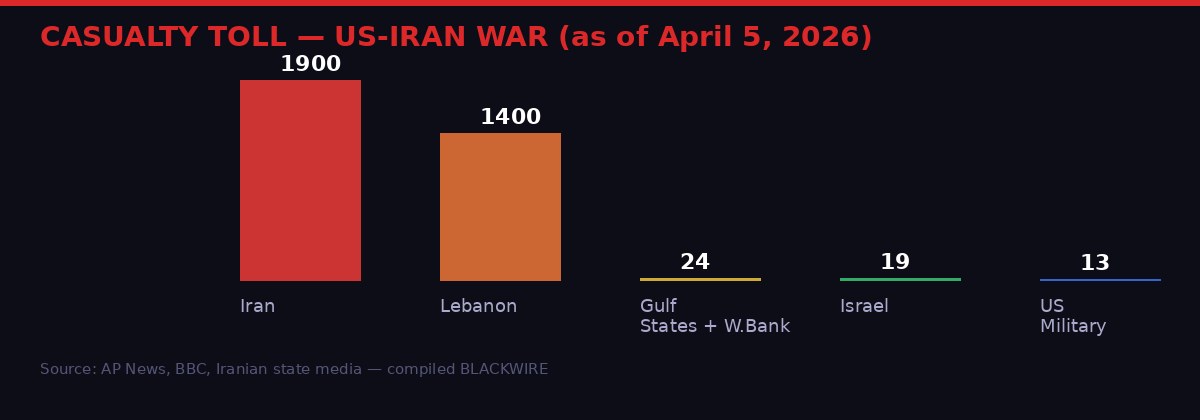
Running death toll since the US-Israel strikes on Iran began February 28, 2026. Iran has suffered the most casualties by far; more than 1,900 confirmed dead. (BLACKWIRE data infographic)
Trump's Hormuz Ultimatum Expires Monday

The Strait of Hormuz carries roughly 20% of the world's oil supply. Trump's ultimatum to reopen the waterway expires Monday. (BLACKWIRE/PULSE)
Trump renewed his threat Saturday night in a social media post with unusual specificity: "Remember when I gave Iran ten days to MAKE A DEAL or OPEN UP THE HORMUZ STRAIT. Time is running out - 48 hours before all Hell will reign down on them." AP News, April 4
That 48 hours expires Monday morning. Iran has given no indication it intends to reopen the waterway. The Strait of Hormuz - 33 kilometers wide at its narrowest point between Iran and Oman - is the single most important energy chokepoint on Earth. An estimated 20% of global oil supply transits it daily, along with approximately 30% of global liquefied natural gas exports. Every day it remains closed, the economic pressure on oil-importing nations in Europe and Asia intensifies.
Iran's parliamentary speaker, Mohammad Bagher Qalibaf, issued a separate veiled threat Friday to also disrupt the Bab el-Mandeb strait - the 32-kilometer passage between Yemen and Djibouti that links the Red Sea with the Indian Ocean. More than a tenth of seaborne global oil and roughly a quarter of container ships pass through Bab el-Mandeb. Houthi forces in Yemen - aligned with Tehran - previously disrupted this chokepoint during 2023 and 2024. The Qalibaf statement is widely read as a threat to activate Houthi capabilities again, compounding the Hormuz blockade with a second chokepoint closure.

The Bab el-Mandeb strait is the secondary chokepoint Iran has now publicly threatened - linking the Red Sea to the Indian Ocean and global container shipping routes. (BLACKWIRE/PULSE)
Iran's General Ali Abdollahi Aliabadi issued a counter-ultimatum Saturday: "The doors of hell will be opened to you" if Iran's infrastructure is attacked further. The general promised retaliation against all US military infrastructure in the region. Iranian state media, via AP, April 5
The war has already killed more than 1,900 people in Iran, more than 1,400 in Lebanon, and 13 US service members. It has shaken global markets, cut key shipping routes, and spiked fuel prices across Europe and Asia. Both sides have struck civilian infrastructure, drawing warnings of possible war crimes from international legal observers. AP News, April 5
The approaching Hormuz deadline has created a compressed decision window with no clean options. If Trump follows through on the threat, the strikes required to force Hormuz reopening would need to be qualitatively different from what has already occurred - deeper, larger, aimed at Iran's naval and missile infrastructure in the Gulf theater. That means higher risk of Iranian retaliation against oil tankers, US naval vessels, and Saudi infrastructure. If he backs down, the credibility of every subsequent ultimatum in the conflict collapses.
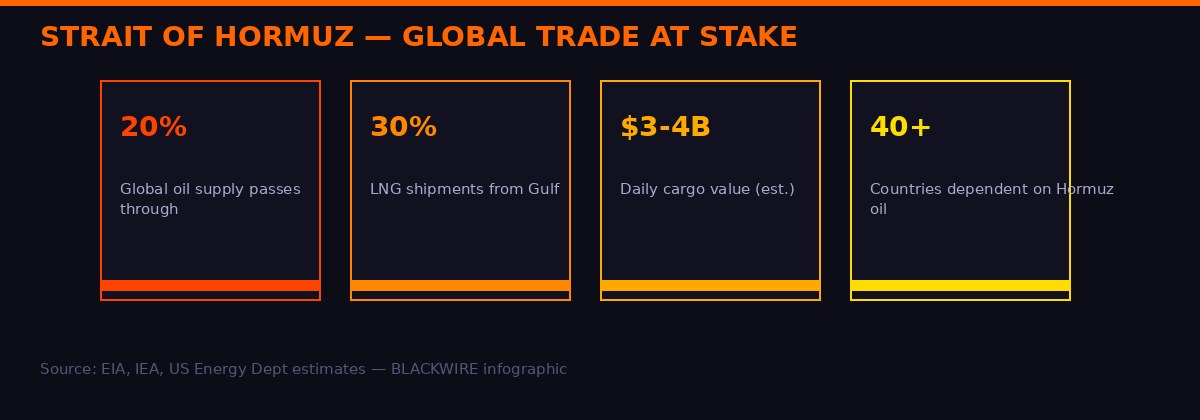
Global trade exposure through the Strait of Hormuz. Disruption at this scale would trigger an immediate oil price shock and supply chain cascade across Europe and Asia. (BLACKWIRE data infographic)
Pakistan, Egypt, and Turkey Race to Broker a Deal
Pakistan's foreign ministry is leading a three-nation diplomatic push to bring the US and Iran to the negotiating table before the Hormuz deadline hits. (BLACKWIRE/PULSE)
Behind the explosions and the social media threats, a parallel diplomatic operation is running. Pakistan's Foreign Ministry spokesperson Tahir Andrabi told AP Sunday that Islamabad's ceasefire brokering efforts are "right on track." Pakistan, Turkey, and Egypt are collectively working to bring Washington and Tehran to a negotiating table, with Pakistan offering to host direct talks in Islamabad.
Egypt's foreign minister, Badr Abdelatty, spoke by phone with US special envoy Steve Witkoff and Iranian Foreign Minister Abbas Araghchi on Sunday - one day before the Hormuz deadline. He also consulted his Turkish and Pakistani counterparts. The Egyptian Foreign Ministry issued a statement saying Abdelatty discussed "ideas and proposals to achieve the required calm" and warned of an "unprecedented explosion" if diplomacy fails. It declined to elaborate on specifics. AP News, April 5
Pakistan's Foreign Ministry added that Islamabad conveyed to Iranian Foreign Minister Araghchi that Pakistan "supports all efforts aimed at de-escalation." The two foreign ministers "agreed to remain in close contact." The proposed framework, per two regional officials speaking anonymously to AP, involves a mutual cessation of hostilities as a precondition for a diplomatic settlement - meaning both sides stop shooting before any formal talks begin.
What the framework does not yet contain is a path for Iran to reopen the Strait of Hormuz in a way that allows Tehran to claim it was not forced to back down under military threat. That face-saving component is the core problem mediators have failed to resolve across multiple rounds of diplomacy. Trump has made Hormuz reopening the central, non-negotiable demand. Iran has made resisting that demand a symbol of national sovereignty and military capability.
"Trump said last week that the US had 'decimated' Iran and would finish the war 'very fast.' Two days later, Iran shot down two US military planes - showing the ongoing perils of the bombing campaign and the ability of a degraded Iranian military to continue to hit back." AP News analysis, April 5, 2026
The timeline for diplomacy is essentially: now or never. The 48-hour Hormuz deadline expires sometime Monday. If Iran does not open the strait - or if mediators cannot produce a credible face-saving formula before Monday - the United States will be confronted with its own ultimatum: absorb the diplomatic humiliation of backing down, or escalate into the most consequential strikes of the war so far. Neither option comes without serious cost.
DIPLOMACY TRACK - WHO IS INVOLVED
- Pakistan: Offering to host direct US-Iran peace talks in Islamabad; says process "on track"
- Turkey: Envoy engaged with both Tehran and Washington, backing ceasefire framework
- Egypt: FM Abdelatty in contact with US envoy Witkoff and Iranian FM Araghchi
- Proposed framework: Mutual cessation of hostilities as precondition for diplomatic settlement
- Core sticking point: Iran reopening Hormuz without appearing to capitulate to US demands
- Trump's position: Hormuz reopens - no exceptions, no substitutes on this demand
- Iran's position: No concessions under military threat; counter-threat to widen war
The War's Toll: Five Weeks of Combat
The war is now five weeks old. The US and Israel struck Iran on February 28, targeting nuclear infrastructure, missile production facilities, and IRGC command nodes. Iran retaliated immediately - hitting US naval assets in the Gulf, striking Israeli territory via missile and drone, and activating Hezbollah in Lebanon for renewed ground operations along the Israeli border.
Iran has suffered the heaviest human toll: more than 1,900 confirmed dead since the opening strikes, with the strikes in Dehdasht county Sunday adding 10 more - including, Iran's Nournews noted, two tourists killed in an area near where the missing US colonel had been hiding. That detail highlights the civilian cost of the rescue operation alone - US military activity in the area attracted strikes that killed non-combatants. Nournews, April 5
Lebanon has seen more than 1,400 deaths and more than one million people displaced as Israeli-Hezbollah fighting has intensified along the southern Lebanese front. The Israeli military has made significant inroads into areas around Tyre, with reporting indicating a shift toward what looks like a long-term occupation posture in parts of southern Lebanon.
The Gulf Arab states, theoretically not direct belligerents, have now accumulated more than two dozen dead from missile and drone attacks. Israel has reported 19 deaths from Iranian and Hezbollah strikes. The US military casualty figure stands at 13 service members killed - a number that will be scrutinized against the Sunday extraction operation once full details emerge.
Economic damage compounds the human cost. Global oil prices are elevated. Shipping insurance rates through the Persian Gulf have surged. Iran's civilian economy is contracting under the combined pressure of strikes and intensified sanctions. The US has revoked green cards and visas of Iranian nationals connected to the Tehran government - a signal that economic warfare is accelerating alongside military operations. AP News, April 4
What Happens Next
Monday is the pivot point. By Trump's own public commitment, something significant must happen: Iran opens Hormuz, a credible ceasefire framework is announced, or the United States escalates. Past Trump ultimatums in this conflict have been extended when mediators claimed progress - the original Hormuz deadline was pushed after Pakistan's Andrabi announced the peace talks were "on track."
But each extension costs credibility. Iranian commanders watching the pattern have a clear data set: Trump issues a deadline, mediators appear, deadline shifts. If that pattern holds Monday, Iran's strategic calculus will adjust accordingly. The IRGC's willingness to shoot down US aircraft, attack Gulf energy infrastructure in three countries simultaneously, and mobilize nomadic tribes to fire on rescue helicopters suggests a military leadership that does not currently fear American escalation beyond what has already occurred.
The rescue of the colonel - a genuine military and human success - gives Trump a political moment: he can declare a win, announce a pause for diplomacy, and restart the clock without looking weak on the specific rescue operation. Whether that framing holds domestically is a separate question. Multiple Senate Republicans have privately warned the White House that an open-ended war with Iran, now entering its sixth week with no clear endgame, is not sustainable politically. AP News analysis, April 5
For the Gulf states, the Sunday attacks are the clearest signal yet that proximity to US operations makes them permanent targets. Kuwait, Bahrain, and the UAE all host US military installations. All three were hit Sunday. Saudi Arabia, which hosts the largest US regional military footprint at Prince Sultan Air Base, has not been struck - yet. Any expansion to Saudi targets would dramatically reshape the conflict's geometry and could trigger a collective defense response from GCC member states.
Iran, meanwhile, faces its own impossible arithmetic. The country has absorbed more than 1,900 military and civilian deaths, substantial infrastructure damage, and renewed economic isolation - yet its government shows no sign of moving toward the terms Washington is demanding. The IRGC's ability to down US aircraft and strike three Gulf countries in 24 hours is being packaged domestically as proof that Iran can absorb punishment and still project power. Supreme Leader Khamenei has not wavered publicly. The Revolutionary Guard has not stood down.
The colonel is safe. The deadline has not moved. The war has not ended. Somewhere in the gap between Trump's next social media post and Tehran's next drone launch, the world's most consequential standoff is edging toward a reckoning that neither side appears prepared to back away from. The next 24 hours will determine whether this story is about how the diplomats bought more time - or how the bombs got bigger.
Get BLACKWIRE reports first.
Breaking news, investigations, and analysis - straight to your phone.
Join @blackwirenews on Telegram