
Markets in freefall: Friday, March 27, 2026. (Pexels)
The number is $17 trillion. That is how much market capitalization has been erased from peak values across the Magnificent Seven tech stocks, precious metals, and Bitcoin since their respective highs. On Friday, March 27, 2026, the bleeding accelerated. The Nasdaq 100 - the benchmark for American technology and growth investing - officially crossed into correction territory, trading more than 10% below its January all-time high. The broader S&P 500 is 8.5% off its peak, inching toward its own correction threshold.
For crypto, the session was surgical in its brutality. Bitcoin, which reached an all-time high of $126,000 in early October 2025, slid back to $66,000 during Friday's session - a 45% decline from peak. Ethereum, which had been clinging to the $2,000 psychological support for weeks, finally gave it up. ETH/USD printed $1,975 intraday, down 5% in 24 hours, with $111 million in long liquidations flushing out the bulls who had been betting on a bounce. Crypto-linked equities were hit even harder, with Gemini down nearly 9%, Coinbase off 6.8%, and miners posting 5-8% single-day losses.
The trigger is not a hack, not a rug pull, not a regulatory crackdown. It is a war. The Iran conflict that began in late February has created a macro environment that nobody's playbook was built for: rising oil prices, a fractured Fed mandate, $17 trillion in asset value incinerated, and no clear exit in sight from the Strait of Hormuz standoff.
Friday Snapshot - March 27, 2026
- BTC: $66,000 (-4.2% on day, -45% from $126K ATH)
- ETH: $1,975 (-5.1%, broke $2K support)
- ETH Long Liquidations: $111 million in 24hrs
- COIN (Coinbase): -6.8%
- GEMI (Gemini): -8.9%
- MSTR (Strategy): -6.2%
- Nasdaq 100: -10.2% from January ATH (correction)
- S&P 500: -8.5% from ATH
- 10-Year Treasury Yield: ~4.48% (intraday high)
- Total Market Cap Wiped (Mag7+BTC+metals): ~$17 trillion
The Iran War's Market Toll: How a Regional Conflict Became a Global Financial Crisis

The Strait of Hormuz situation continues to suppress risk appetite globally. (Pexels)
When Israel's strikes expanded into Iran in late February 2026 and the IRGC moved to tighten control over the Strait of Hormuz, most market participants assumed a brief shock followed by de-escalation. That playbook is dead. Five weeks in, markets have discovered that a persistent, unresolved conflict near the world's most critical oil chokepoint does not produce a one-time shock - it produces a grinding, weekly erosion of risk appetite.
The pattern has become almost clockwork. According to CoinDesk's tracking of Bitcoin's daily returns since the conflict began, Mondays average around +3% gains - relief rallies driven by the absence of a catastrophic weekend event, by hope that the Strait of Hormuz will fully reopen. Then, as the week progresses and optimism fades, the market gives it all back. By Thursday and Friday, performance deteriorates sharply as traders reduce risk ahead of the weekend, unwilling to sit through two days of potential geopolitical headlines with no ability to react.
Friday, March 27 followed the script precisely. The session opened with residual weakness from Thursday's failed recovery attempt, then accelerated lower through the afternoon as institutional sellers pressed their advantage into illiquid Friday conditions.
The Federal Reserve is watching from the sidelines in an impossible position. Richmond Fed President Tom Barkin acknowledged on Friday that higher gas costs - a direct consequence of the Iran-driven oil shock - could dent consumer spending while describing hiring conditions as "fragile." Philadelphia Fed President Anna Paulson went further, stating the Iran war has created "new risks to both inflation and growth." That is a central banker's way of saying: we have no idea what to do next.
The 10-year Treasury yield, a key barometer of inflation expectations and long-term risk appetite, hit nearly 4.5% earlier Friday before pulling back after the Fed officials' comments. The 2-year yield, more sensitive to near-term rate policy, swung from 4.03% to 3.91% in hours - a sign of a market actively repricing what the Fed will do next. The consensus has shifted from cuts to uncertainty, with some participants now pricing in hikes if inflation continues to accelerate.
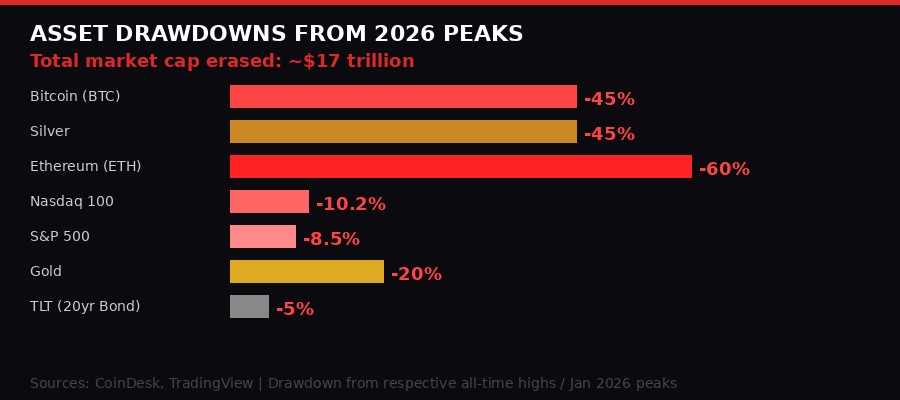
Drawdowns from 2025-2026 peaks across major asset classes. BTC and silver both off 45%. (BLACKWIRE/VOLT)
Gold, historically the haven of choice in geopolitical crises, has not been immune. The yellow metal is roughly 20% off its own peak - an unusual dynamic that reflects broader forced selling as institutions raise cash to meet margin calls and redemptions in other parts of their portfolio. The iShares 20+ Year Treasury Bond ETF (TLT) is down 5% over the past month - meaning the classic 60/40 portfolio (60% stocks, 40% bonds) has underperformed both components, offering zero protection during the selloff.
ETH Below $2K: The Psychological Line That Held for Weeks - Until It Didn't

Ethereum's $2,000 psychological support cracked Friday under sustained selling pressure. (Pexels)
Ethereum had been fighting to stay above $2,000 for weeks. Multiple analysts flagged the level as critical - lose it, and the next support cluster sits at $1,750-$1,850. On Friday, the bulls ran out of ammunition.
Data from TradingView showed ETH/USD trading at $1,975, down 5% over 24 hours. That drop came accompanied by more than $111 million in long ETH liquidations, according to Coinglass data - leveraged traders who had bet on a bounce getting flushed out when the support failed. It is a cascade dynamic: price falls, longs get liquidated, sell pressure from liquidations drives price lower, triggers more liquidations.
"$ETH keeps pressing into the same resistance, but the story sits beneath price action. Even with strong long-term narratives, short-term demand still looks thin." - Trader Onur (@0xc06), X post, March 27, 2026
The weakness is not just a chart phenomenon. It has fundamental backing. Capriole Investments' Ethereum Apparent Demand metric - which measures net new ETH demand entering the network - has been negative since March 3. It bottomed at approximately -58,000 ETH on March 16, a 16-month low not seen since October 2024. As of Friday it had improved slightly to -23,475 ETH, but the metric remains firmly negative.
Spot Ethereum ETFs have recorded net outflows for seven consecutive days, totaling $391.8 million, according to SoSoValue data cited by Cointelegraph. Global Ether exchange-traded products also saw $27.2 million in outflows last week. Institutional investors, the buyers who were supposed to anchor ETH's recovery narrative, are voting with their feet.
Earlier in the week, ETH had failed to crack resistance at $2,200. Spot ETF outflows, falling decentralized exchange volumes, and declining ETH futures premium had all undermined the recovery attempt. Analyst CryptoWZRD warned on Friday that ETH could see "further decline" toward the $1,800 support zone after the altcoin closed below $2,200 on Thursday. Trader Ted Pillows suggested the price path goes to $1,800 first, then potentially to $1,750 before any meaningful bounce.
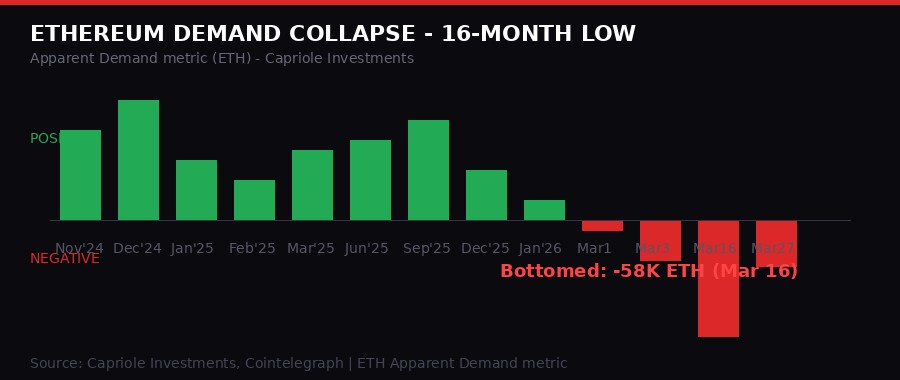
Ethereum's Apparent Demand metric has been negative since March 3, bottoming at -58K ETH on March 16. (BLACKWIRE/VOLT, source: Capriole Investments)
The ETH narrative in 2025 had centered on ETFs, staking yield, and institutional adoption. None of those catalysts have disappeared - but they cannot override a macro environment where every high-beta, risk-on asset is being sold. ETH, trading at roughly 0.03 BTC, is underperforming Bitcoin significantly since the start of the conflict. The market is once again running the "ETH lags BTC in risk-off" playbook.
Crypto Stocks Hammered: Gemini, Coinbase, Miners All in the Red

Crypto-linked equities tracked the broader market selloff with outsized losses Friday. (Pexels)
Gemini, the exchange that went public earlier this year, posted the steepest loss in the crypto equity space on Friday - down nearly 9%. The exchange has struggled to differentiate itself in a post-listing environment where the broader sector is moving in lock-step with macro risk appetite. When risk goes off, everything goes off.
Coinbase (COIN) fell nearly 7%, dragged down by both the broader risk selloff and specific concerns about its declining trading volumes as market participants reduce activity. Robinhood (HOOD), which had hoped a $1.5 billion stock buyback announced earlier in the week would provide support, found that buybacks cannot fight a $17 trillion macro wave - the stock fell nearly 6%.
Bitcoin treasury plays - companies that have adopted the Strategy (formerly MicroStrategy) playbook of holding Bitcoin as their primary corporate asset - were similarly crushed. Strategy (MSTR) fell about 6.2%. Twenty One Capital (XXI), a newer entrant to the Bitcoin treasury space, also dropped roughly 6%. Ethereum-focused treasury names like Bitmine Immersion (BMNR) and Sharplink Gaming (SBET) were off around 5%.
Miners, which trade as leveraged bets on both Bitcoin's price and the AI infrastructure buildout, extended their losses from earlier in the week. Riot Platforms (RIOT), CleanSpark (CLSK), IREN, HIVE Digital, and Hut 8 (HUT) all posted losses in the 5-8% range. MARA (Marathon Digital) and Bitdeer (BTDR), which had outperformed Thursday, gave back all their gains and added losses on Friday - down 6% and 8% respectively.
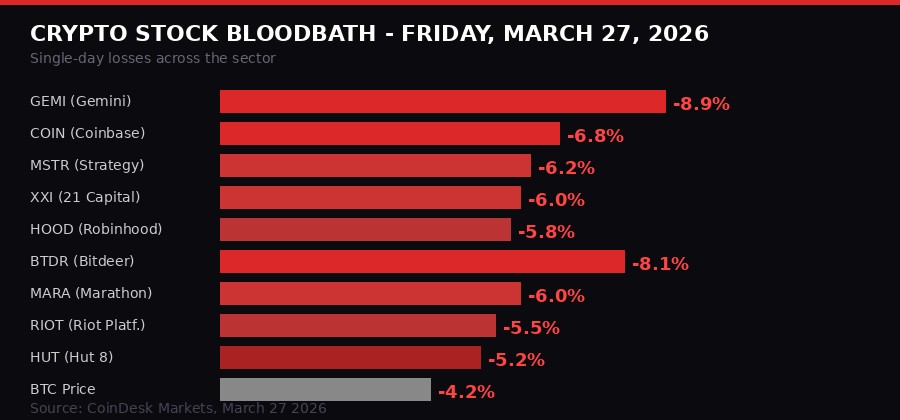
Single-day losses across crypto-linked equities, Friday March 27, 2026. (BLACKWIRE/VOLT, source: CoinDesk Markets)
The symmetry of losses across the sector underscores that this is not company-specific weakness - it is sector-wide forced selling. When the Nasdaq corrects, leveraged retail positions across high-beta names get margin-called. Crypto stocks, which historically show beta of 2x-3x relative to Bitcoin, are amplifiers in both directions. Right now the amplification is pointing down.
The Anthropic Curveball: How a Leaked AI Model Helped Sink Software Stocks

Anthropic's leaked "Claude Mythos" model spooked cybersecurity investors, rippling into crypto. (Pexels)
Not all of Friday's pain came from the Iran war. An Anthropic data store left publicly accessible exposed internal materials - including draft blog posts referring to a new, unreleased AI model internally called "Claude Mythos." According to Fortune, which broke the story, around 3,000 assets linked to Anthropic's blog became temporarily available online, including draft announcements and internal content never meant to be public.
The leaked documents described Claude Mythos as "the most capable we've built to date" and "a step change in performance." But what rattled markets was a specific warning buried in the internal materials: the model poses serious cybersecurity risks due to its ability to rapidly identify and exploit software vulnerabilities. The phrase "cyber arms race" appeared in the documents, signaling Anthropic's own awareness that they are building something with significant dual-use potential.
Cybersecurity stocks sold off sharply on the news. Palo Alto Networks (PANW), CrowdStrike (CRWD), and Fortinet (FTNT) all fell 4-6%. The iShares Expanded Tech-Software Sector ETF (IGV) dropped 2.5%. The logic is counterintuitive - cybersecurity companies should benefit from increased threat environment. But the market read this differently: if AI can automate vulnerability discovery at scale, the human-intensive security audit model is disrupted, and existing moats get questioned.
Bitcoin's correlation to software stocks, which has strengthened significantly through 2025 as institutional adoption made crypto a "risk-on tech adjacent" trade, meant the Anthropic shock rippled through into crypto prices. Bitcoin briefly flirted with $70,000 earlier Friday before the Anthropic leak hit the wires - the subsequent tumble back to $66,000 coincided with the software sector selloff. According to CoinDesk, the AI news contributed to BTC's intraday reversal.
The leaked model specifications mention a new tier called "Capybara" - larger and more capable than Opus, Anthropic's current flagship. If accurate, Anthropic is preparing a generational leap in AI capability that could compress the timeline for AI-enabled cyberattacks. The security community is already modeling what happens when vulnerability discovery goes from "weeks of human expert analysis" to "minutes of AI inference."
ICE Doubles Down on Polymarket: NYSE Owner Commits $2 Billion to Prediction Markets

Intercontinental Exchange, owner of the NYSE, has now committed nearly $2 billion to Polymarket. (Pexels)
Amid the carnage, one story ran counter to the dominant narrative of fear and liquidation: Intercontinental Exchange (ICE), the parent company of the New York Stock Exchange, added another $600 million to its investment in Polymarket - the crypto-native prediction market platform. ICE's total commitment now approaches $2 billion, following a $1 billion initial investment made in October 2025. The company also plans to purchase up to $40 million in shares from existing holders.
This is not a small, exploratory bet from a peripheral player. ICE operates the world's most important equity exchange and a sprawling network of derivatives markets, clearing houses, and data businesses. When ICE writes a $2 billion check into a crypto-native prediction market, it is making a statement about where financial infrastructure is heading.
The timing matters. Rival platform Kalshi recently raised more than $1 billion at a $22 billion valuation - roughly double its previous mark - according to Bloomberg reporting. Kalshi is already generating an estimated $1.5 billion in annual revenue, a figure that makes most crypto "infrastructure" projects look like science projects. The prediction market sector has transformed from a niche curiosity into a mainstream financial product category in less than two years.
"If prediction markets gain broader regulatory approval, they could sit alongside stocks and futures as another way for traders to express views on forthcoming events." - CoinDesk analysis, March 27, 2026
Polymarket has moved proactively to position itself for the regulatory scrutiny that comes with scale. Earlier this year, the platform acquired a licensed exchange and clearinghouse - transforming from a crypto-native gambling app into a regulated financial market operator. It also announced a surveillance partnership with Palantir and TWG AI to build systems for detecting suspicious trading and manipulation in sports prediction markets, anticipating the congressional criticism that was inevitable once volumes grew large enough to attract attention.
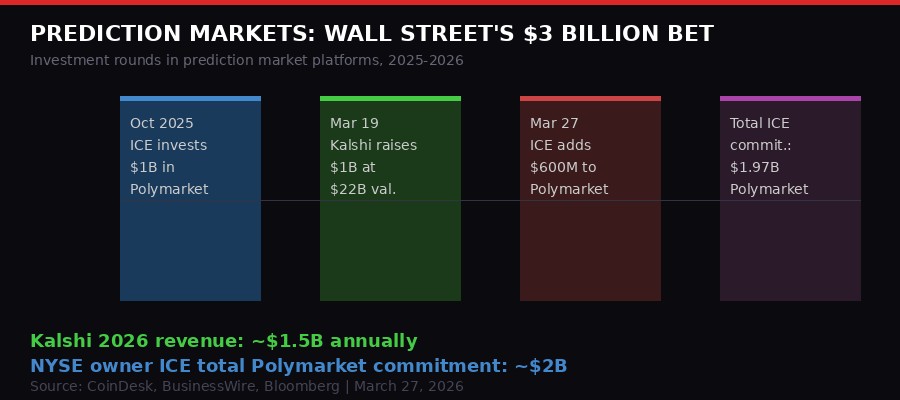
Prediction market investment surge: ICE at $2B total, Kalshi valued at $22B. (BLACKWIRE/VOLT)
The ICE investment does something beyond providing capital - it provides legitimacy. Polymarket, despite its crypto-native roots and Ethereum-based settlement architecture, can now point to one of the world's foremost exchange operators as its financial backer. That relationship matters enormously when the CFTC starts asking questions about market manipulation, position limits, and surveillance obligations. Having the NYSE's parent as your primary institutional investor is a different conversation than having anonymous crypto VCs.
Lawmakers have raised concerns about whether prediction markets are vulnerable to insider information - someone trading on a geopolitical event they have advance knowledge of, for instance. Those concerns are legitimate. But the combination of Palantir's surveillance technology, ICE's institutional credibility, and Kalshi's regulatory licensing push suggests the industry is taking the compliance question seriously rather than hoping regulators look the other way.
The Crypto Tax Bill Nobody Asked For: PARITY Act Exempts Stablecoins, Ignores Bitcoin

US lawmakers published a crypto tax discussion draft on Thursday - but Bitcoin holders were left out. (Pexels)
While markets were melting on Friday, Congress was doing what Congress does: publishing a 40-page discussion draft that will please exactly no one. Representatives Max Miller and Steven Horsford released the Digital Asset PARITY Act on Thursday, a proposed overhaul of how the Internal Revenue Code treats digital assets. The reaction from the crypto community was split along predictable fault lines.
The bill's headline provision: stablecoins would be exempt from capital gains recognition provided they maintain a peg within $0.01 of $1.00. A de minimis exemption would also shield stablecoin transactions below $200 from tax and reporting requirements. These are genuinely useful provisions - the current IRS position requires reporting even trivial stablecoin-to-stablecoin swaps, creating compliance nightmares for anyone who uses DeFi protocols regularly.
Transaction costs incurred to acquire or move regulated dollar-pegged stablecoins cannot be counted toward cost basis under the bill. Income from lending, staking, or "passive" validator services would be treated as gross income at fair market value each year - codifying what the IRS has long asserted but never formally legislated.
"We need digital asset tax clarity or activity will never fully onshore." - Cody Carbone, CEO, Digital Chamber, March 27, 2026
But the bill's biggest problem is what it leaves out. Bitcoin has no de minimis exemption under the PARITY Act. Neither does it under the pending CLARITY crypto market structure bill, which also conspicuously skips BTC tax relief. Bitcoiners noticed immediately.
"This is the wrong direction to go in. It's Bitcoin that should have a de minimis tax exemption. Stablecoins are not decentralized, and they are not permissionless. They're not real money - they're just fiat." - Pierre Rochard, CEO, The Bitcoin Bond Company, March 27, 2026
The omission of Bitcoin from the de minimis framework is not an oversight - it is a deliberate political choice. The stablecoin lobby (Tether, Circle, Paxos) has spent years building relationships on Capitol Hill. The result is legislation that codifies stablecoin-friendly tax treatment while leaving Bitcoin's tax complexity intact. For Bitcoin maximalists, this reads as stablecoin issuers - companies that benefit from regulatory clarity about dollar-pegged tokens - capturing the legislative process at Bitcoin's expense.
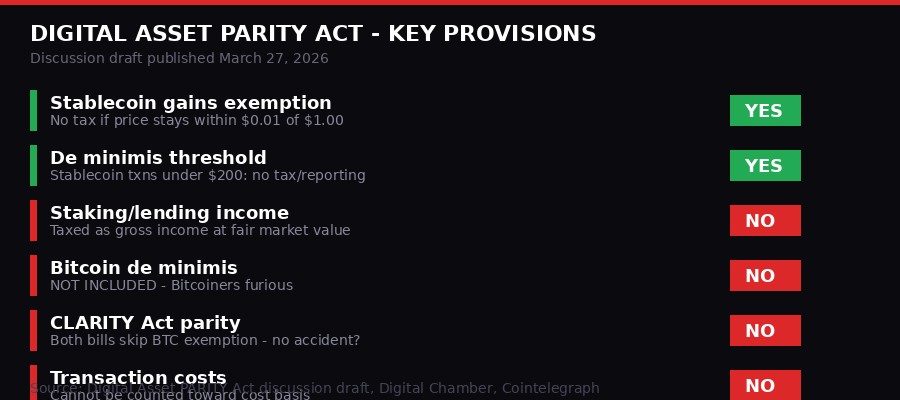
Key provisions of the Digital Asset PARITY Act discussion draft, published March 27, 2026. (BLACKWIRE/VOLT)
The bill has not been formally introduced to Congress - it was released as a discussion draft, inviting comment from industry stakeholders before a formal introduction. That process could take weeks or months, and the final language will almost certainly be different from what was published Thursday. But the direction is clear: Washington is moving toward digital asset tax clarity, and stablecoins are winning the first round.
The Bitcoin Policy Institute has been targeting an August deadline for BTC tax relief, warning that time is running out in the current legislative cycle. If the PARITY Act's framework becomes the template - stablecoin exemptions yes, Bitcoin exemptions no - Bitcoiners will need to redouble their lobbying pressure before the fall.
The Fed's Impossible Math: Oil Inflation, Weak Labor, and a $17 Trillion Hole

The Federal Reserve faces its most difficult policy environment since the 2020s inflation surge. (Pexels)
Every bear market needs a villain, and right now there are two: geopolitics and the Federal Reserve's inability to respond to geopolitics. The Iran conflict has created a stagflationary pressure cooker - rising energy prices that push headline inflation higher while simultaneously squeezing consumer spending power and dampening growth. The Fed's dual mandate (price stability + maximum employment) cannot solve both problems at once.
Richmond Fed President Tom Barkin's Friday comments capture the dilemma precisely. Higher gas costs - running directly from the Hormuz standoff's impact on oil supply - could "dent consumer spending." Hiring is "fragile." Meanwhile, Philadelphia Fed President Anna Paulson acknowledged "new risks to both inflation and growth." Two Fed officials, same day, essentially saying: we are seeing inflation AND slowing simultaneously.
The market's rate expectations have shifted dramatically since the conflict began. At the start of 2026, consensus was three-to-four rate cuts over the course of the year. Today, many participants have moved to pricing in zero cuts. Some desks are running scenarios for a rate hike if inflation accelerates further. The 10-year Treasury yield's move toward 4.5% intraday on Friday - before pulling back on the Fed comments - reflects that uncertainty.
For crypto and risk assets, the Fed's paralysis is poison. Rate cuts historically provide fuel for speculative assets. When the market believed cuts were coming, Bitcoin ran from its post-halving base to $126,000 in ten months. Now, with cuts off the table and hikes on the table, the reverse is playing out. Bitcoin is not just losing to the Iran war headline risk - it is losing to the macro repricing that the war has triggered.
The broader picture from the drawdown data is striking: Bitcoin is down 45% from its October ATH. Silver is also down 45%. Gold is off 20%. The Magnificent Seven tech stocks - Nvidia, Apple, Microsoft, Alphabet, Amazon, Meta, Tesla - have all entered double-digit drawdowns from their January peaks. The Nasdaq 100 is in correction. The S&P 500 is approaching it. The traditional 60/40 portfolio has underperformed both its components simultaneously as equity losses coincide with rising yields on the bond side.
There is no safe harbor that is working. Cash is the only asset class that has not declined. For crypto investors accustomed to "digital gold" or "inflation hedge" narratives, the correlation breakdown is jarring. Bitcoin is not acting like gold. It is acting like a leveraged tech stock - and leveraged tech stocks are getting destroyed.
Timeline: Five Weeks of War, Five Weeks of Market Erosion
What Comes Next: Three Scenarios for Crypto's Q2

The path forward depends almost entirely on geopolitical resolution - or its absence. (Pexels)
Three scenarios are on the table for the next six to eight weeks, and the outcome of each is almost entirely dependent on geopolitics rather than on-chain fundamentals or crypto-specific catalysts.
Scenario 1 - Ceasefire and Hormuz Reopening (Probability: 25-30%). A de-escalation framework gets hammered out, the Strait of Hormuz reopens to full traffic, and oil prices collapse back toward $70/barrel. The Fed pivots back to cuts. Risk assets - including Bitcoin - stage a sharp recovery. ETH potentially recovers above $2,500. Crypto stocks regain most of Friday's losses within two weeks. This is the bull case, and it requires political will from parties who have shown limited inclination toward compromise.
Scenario 2 - Continued Grinding Conflict (Probability: 55-60%). The base case. Neither side achieves a decisive outcome. Hormuz remains partially disrupted. Oil stays elevated. The Fed stays frozen. Crypto oscillates between $60K-$75K on Bitcoin, with ETH struggling to hold $1,750-$2,000. The Monday relief rally / Friday selloff pattern continues. Total market cap continues bleeding slowly. This is the scenario markets are currently pricing.
Scenario 3 - Major Escalation (Probability: 15-20%). A significant escalation - US military involvement, a catastrophic attack on Gulf oil infrastructure, or a third-party regional entry - produces a "Black Monday" scenario that multiple analysts have warned about but markets have so far avoided. Bitcoin breaks below $50,000, potentially to $40K. ETH revisits $1,200-$1,400. Crypto stocks lose 30-40% in a single session. This is the tail risk that nobody wants to price but everyone is hedging against by maintaining reduced position sizes.
The positioning data suggests institutional players are firmly in Scenario 2 mode - reducing risk but not panic-selling. Bitcoin's options market shows elevated put/call ratios indicating hedging activity, but not the extreme fear spikes that preceded major crypto capitulation events like the FTX collapse or the May 2021 crash. Whoever holds through Scenario 2 and emerges into a Scenario 1 resolution will look very smart in hindsight. The problem is that Scenario 3 could happen first.
One number anchors the longer-term view: $126,000. That is where Bitcoin was five months ago. The asset's architecture has not changed. The halving cycle has not reversed. The institutional adoption narrative - 11 spot Bitcoin ETFs, corporate treasury adoption, sovereign-level discussion - has not collapsed. What has happened is that a geopolitical black swan landed directly on top of the most favorable macro environment Bitcoin had seen in its 15-year history. When the macro clears - and macro always clears eventually - the underlying demand story reasserts itself.
Whether that reassertion comes at $60K, $50K, or $40K first is the question nobody has a reliable answer to. What is certain: Friday, March 27, 2026 will be remembered as the day the Nasdaq entered correction, ETH lost $2,000, and $17 trillion in global market cap became a number people actually believe.
Key Levels to Watch - Week of March 30
- BTC Critical Support: $63,000-$65,000 (if broken, $55K-$58K in play)
- BTC Resistance: $70,000 (failed 3x this week)
- ETH Support Zone: $1,750-$1,850 (analysts' next target)
- ETH Recovery Trigger: Close above $2,200 + ETF inflow reversal
- Nasdaq 100: Already -10.2% from ATH - watch for -15% (deeper correction)
- S&P 500: -8.5% from ATH - watch for -10% official correction
- 10Y Treasury: 4.5% ceiling - break higher = more crypto selling
- Key Macro Events: US jobs report (April 3), Fed speakers next week
Get BLACKWIRE reports first.
Breaking news, investigations, and analysis - straight to your phone.
Join @blackwirenews on Telegram