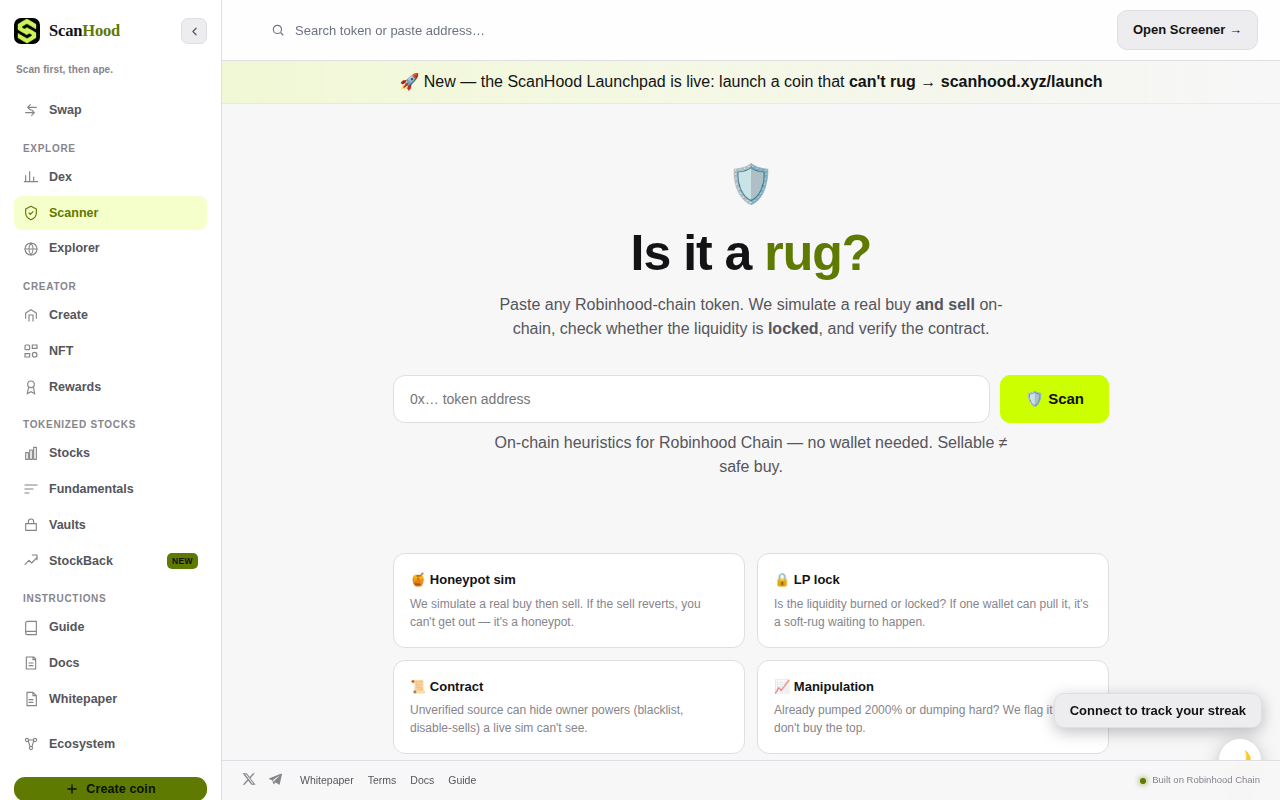
ScanHood's live scanner tallied 198 passes, 518 cautions, and 30 DANGER flags on November 12, 2026.
SCANHOOD FLAGS 30 DANGER TOKENS AMID 746 ROBINHOOD-CHAIN SCAN
*ScanHood processed every Robinhood‑Chain token on 2026‑11‑12, flagging risk in real time. *198 passed, 518 cautioned, 30 marked DANGER – a stark warning for investors and developers.
On November 12, 2026, ScanHood's live scanner processed every token on the Robinhood Chain, totaling 746 contracts. The platform simulated real buys and sells, checked liquidity locks, and verified contract sources in a single on‑chain pass. The tally shows 198 tokens cleared, 518 raised a caution flag, and 30 earned a DANGER label. The 30 DANGER tokens represent 4.0% of the batch and signal a hard rug‑pull risk. Investors and developers now have a hard data point to avoid costly losses.
How many Robinhood-chain tokens failed ScanHood's safety scan?
The scanner recorded 30 tokens as DANGER on the day, a figure the platform lists as 4.0% of the total batch. Those contracts triggered a sell‑revert in the honeypot simulation, meaning a buyer cannot exit. The DANGER label is the highest risk tier, indicating a hard rug‑pull is imminent. All 30 tokens failed the Rug Check, the metric ScanHood uses to flag outright malicious contracts. This outcome sits alongside 198 tokens that passed every test and 518 that raised a caution flag, illustrating a landscape where only a minority are clean.
What does a "caution" flag mean on ScanHood?
A caution flag appears when the scanner detects potential red flags without a full sell‑revert. It may indicate liquidity that is not fully locked, a contract source that is unverified, or recent price manipulation. The platform notes that a single wallet capable of pulling liquidity constitutes a soft‑rug risk. Unverified contracts can hide owner powers such as blacklisting or disabling sells, which a live simulation cannot expose. Caution therefore signals investors to dig deeper before committing capital, as the token may still harbor hidden vulnerabilities.
Why does a "pass" not guarantee safety?
ScanHood defines a pass as a token that survived the simulated buy‑and‑sell test, the liquidity‑lock check, and the contract verification step. However, the platform warns that sellable does not equal safe. Even if a token can be sold in the simulation, the contract may contain hidden owner controls that could be activated later. Liquidity could be burned but later re‑locked by a single address. The scanner’s heuristics cannot predict future governance changes. Investors must treat a pass as a baseline, not a guarantee, and continue monitoring on‑chain activity.
What tools does ScanHood provide to developers?
Beyond the safety scanner, ScanHood launched a dedicated Launchpad. The service lets creators deploy a new Robinhood‑Chain coin that cannot rug by embedding lock‑in mechanisms from the start. Developers can run the same honeypot simulation and LP‑lock verification before public release. The platform’s on‑chain heuristics run without a wallet, streamlining compliance checks. By integrating these tools, projects can pre‑emptively address the very issues that generate caution or DANGER flags, reducing the likelihood of future investor loss.
Frequently asked questions
How many Robinhood-chain tokens were scanned on 2026-11-12?
ScanHood scanned 746 Robinhood‑Chain tokens on that date.
What percentage of scanned tokens failed the Rug Check?
4.0% of the scanned tokens failed the Rug Check.
How many tokens passed ScanHood's safety scan?
198 tokens passed the safety scan.
The ScanHood snapshot paints a sobering picture: the majority of Robinhood‑Chain tokens carry at least a caution warning, and a measurable slice are outright dangerous. As DeFi markets expand, real‑time on‑chain vetting becomes a non‑negotiable defense against fraud. Stakeholders who ignore these signals risk capital loss, while those who integrate ScanHood's tools can build more resilient projects. The data from November 12 will likely shape risk assessments for weeks to come.
Sources: [ScanHood live scan data]