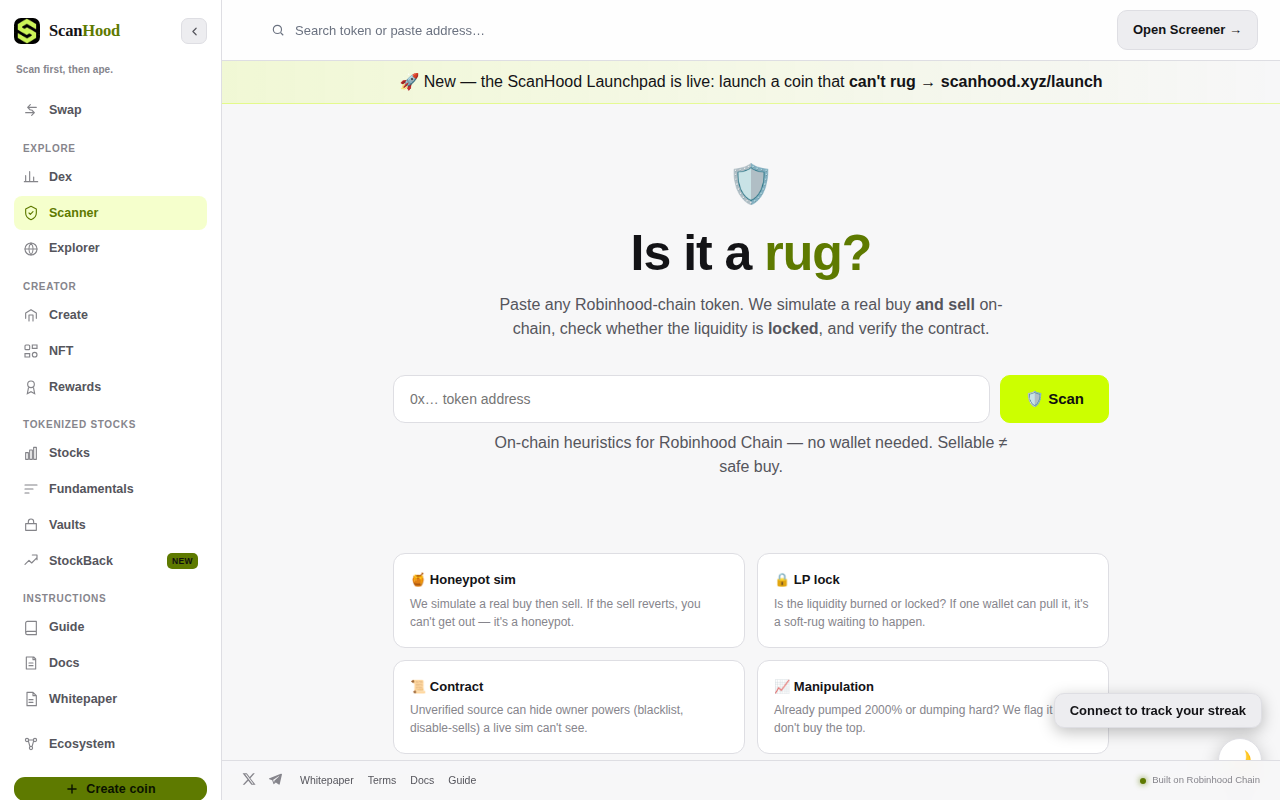
ScanHood’s live scanner categorized 779 Robinhood-chain tokens on 2026‑11‑11, highlighting the prevalence of risk flags.
SCANHOOD FLAGS 3.5% OF 779 ROBINHOOD-CHAIN TOKENS AS RUG RISKS
*ScanHood’s live scanner evaluated every Robinhood‑Chain token on 2026‑11‑11. Only a fraction passed; the majority carry caution or danger flags. Investors face a stark safety landscape.*
On 2026‑11‑11 ScanHood released its daily safety scan for the Robinhood chain. The live scanner examined every token on the network, delivering a stark snapshot of risk. Only a small slice passed the Rug Check, while the overwhelming majority were flagged for caution or outright danger. The results arrive as investors scramble for reliable data amid a flood of new DeFi projects. ScanHood’s tool simulates real‑world trades, checks liquidity locks, and verifies contract sources, offering a hard‑line assessment of each token’s safety. The numbers paint a clear picture: the Robinhood chain hosts more risk than reward for the average trader.
What did ScanHood’s daily tally reveal?
The scanner processed 779 tokens on the Robinhood chain. Of those, 169 cleared the Rug Check, 583 received a caution flag, and 27 were marked as danger. The caution flag indicates potential issues such as unverified contracts or liquidity concerns, while the danger flag signals high‑risk conditions like honeypot behavior or soft‑rug exposure. The 3.5% failure rate reflects the proportion of tokens that did not meet the basic safety criteria. ScanHood’s methodology simulates real‑world buys and sells, checks liquidity locks, and inspects contract verification, offering a granular view of each token’s risk profile.
Can investors trust Robinhood‑Chain tokens after ScanHood’s latest scan?
The data suggests trust is limited. With only a minority of tokens passing, the majority exhibit red flags that could trap buyers or enable sudden value loss. The scanner’s honeypot simulation reveals whether a token can be sold after purchase; a revert indicates a trap. Liquidity lock checks expose whether a single wallet can withdraw funds, a classic soft‑rug scenario. Unverified contracts hide owner powers that can blacklist users or disable sales. Investors must treat a passed token as sellable, not safe, and approach flagged tokens with extreme caution.
How does ScanHood’s launchpad aim to change the risk equation?
The new launchpad promises to issue coins that cannot rug. By mandating a successful Rug Check before launch, it forces creators to lock liquidity and verify contracts. This pre‑emptive barrier could reduce the pool of high‑risk tokens entering the market. However, the launchpad’s effectiveness will depend on adoption and enforcement. If developers bypass the system, the underlying risk environment remains unchanged. For now, the launchpad offers a controlled pathway for projects seeking credibility, but it does not retroactively protect existing tokens flagged by the scanner.
What are the broader implications for the Robinhood ecosystem?
A high volume of caution and danger flags signals systemic vulnerability. Traders may face unexpected losses if they ignore the scanner’s warnings. The prevalence of unverified contracts and soft‑rug setups could erode confidence in the chain, prompting users to shift to platforms with stronger safety nets. Regulators and exchanges might take note, potentially tightening listing standards. Meanwhile, the scanner’s transparent methodology equips analysts with data to spot manipulation patterns, such as rapid price spikes followed by dumps. The ecosystem’s health now hinges on whether developers respond to these signals or continue exploiting loopholes.
Frequently asked questions
How many Robinhood-chain tokens did ScanHood scan on 2026-11-11?
ScanHood scanned 779 tokens on that date.
What percentage of tokens failed the Rug Check?
3.5% of the scanned tokens failed the Rug Check.
How many tokens were marked as danger?
27 tokens received a danger flag.
The ScanHood report forces a reality check on the Robinhood chain’s token landscape. With the majority of assets flagged, investors cannot rely on superficial metrics or hype. The scanner’s transparent, on‑chain simulations provide a decisive tool for separating viable projects from potential scams. As the ecosystem evolves, the pressure will mount on developers to meet higher safety standards or risk being sidelined. Until then, the data warns that every trade carries a hidden hazard, and due diligence must move beyond price charts to the underlying contract mechanics.
Sources: ScanHood live scan data