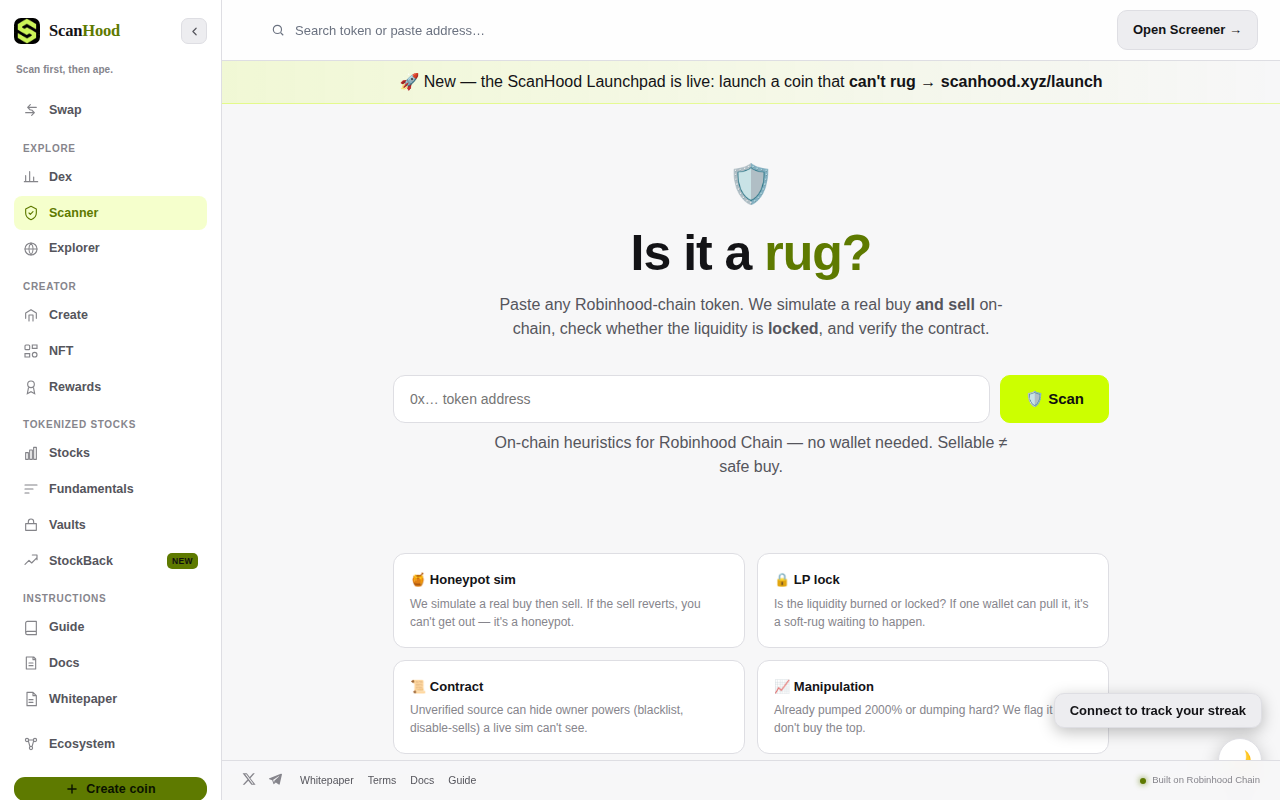
ScanHood’s dashboard on November 17, 2026, displaying 181 passes, 426 cautions, and 45 danger flags among 652 tokens.
SCANHOOD FLAGS 6.9% OF 652 ROBINHOOD-CHAIN TOKENS AS RUG RISKS
*ScanHood’s live scanner processed 652 Robinhood‑Chain tokens on 2026‑11‑17. *Only 181 passed unscathed; 426 raised caution and 45 were marked danger. *The data spotlights a volatile ecosystem where a single misstep can trap investors.
ScanHood released its daily safety scan for Robinhood‑Chain tokens on November 17, 2026. The live scanner evaluated 652 tokens, delivering a granular risk breakdown in real time. Only 181 tokens cleared every test, while 426 raised caution and 45 were marked DANGER. The scanner’s 6.9% failure rate quantifies how many projects could rug or act as honeypots. In a space where price manipulation can inflate a token by 2000%, these figures are a stark reminder that not every listed asset is safe to buy. Investors relying on quick gains now have a data‑driven lens to separate fleeting hype from genuine utility.
What does the ScanHood daily tally reveal about Robinhood‑Chain token safety?
On November 17, 2026 ScanHood scanned 652 tokens on the Robinhood chain. The scanner classified 181 tokens as passed, meaning they cleared the simulated buy‑sell test, liquidity‑lock check, and contract verification. 426 tokens triggered a caution flag, indicating potential issues such as soft‑rug conditions or unverified contracts. The highest alert, DANGER, applied to 45 tokens that failed the sell simulation or showed clear liquidity‑withdrawal risk. The overall failure rate sits at 6.9%, a figure that quantifies the proportion of tokens that could rug or act as honeypots. These numbers provide a snapshot of systemic risk across the chain on a single day.
How does ScanHood detect honeypots and soft rugs?
ScanHood runs an on‑chain simulation that mimics a real purchase and immediate resale. If the resale transaction reverts, the token is flagged as a honeypot—buyers cannot exit. The tool also inspects liquidity status: a locked or burned LP passes, while a single wallet that can withdraw liquidity triggers a soft‑rug warning. Contract verification adds another layer; unverified source code may conceal owner powers like blacklisting or disabling sells, which the live simulation cannot see. By combining these heuristics, ScanHood delivers a multi‑dimensional risk profile without requiring a wallet connection.
Why does a 6.9% failure rate matter for investors?
A 6.9% failure rate translates to roughly one in fifteen tokens that could trap capital. For traders chasing high‑return DeFi projects, that risk is material. The 45 DANGER tokens represent the most severe threat: a failed sell simulation or open liquidity means investors may lose their entire position. Even the 426 caution flags signal tokens that have either unverified contracts or liquidity that could be withdrawn, raising the probability of a future rug. In a market where 2000% pumps are flagged as manipulation, the failure metric serves as an early warning that the price surge may be unsustainable.
What tools does ScanHood offer to prevent future rug pulls?
Beyond the daily scanner, ScanHood launched a dedicated launchpad that promises to mint coins that cannot rug. The platform provides a one‑click “Is it a rug?” check: users paste any Robinhood‑chain token address and receive a full simulation report. The service also highlights whether liquidity is locked or burned and flags contracts with hidden owner powers. By surfacing manipulation signals—such as tokens that have already pumped 2000%—the launchpad aims to keep investors from buying at the top. The combination of real‑time heuristics and a vetted launch environment creates a defensive layer for the DeFi community.
Frequently asked questions
How many Robinhood‑Chain tokens did ScanHood scan on 2026‑11‑17?
ScanHood scanned 652 tokens on that date.
What percentage of the scanned tokens failed the Rug Check?
6.9% of the 652 tokens failed the Rug Check.
How many tokens were flagged as DANGER in the ScanHood report?
45 tokens were flagged DANGER.
The ScanHood report underscores a fragile Robinhood‑Chain ecosystem where a sizable minority of tokens pose outright rug risks. As DeFi participants chase outsized returns, the scanner’s hard data forces a pause and a deeper due‑diligence step. With the launchpad promising rug‑proof coin creation, the industry may see a shift toward pre‑vetted projects. Until then, the daily tally remains a critical barometer for anyone willing to stake capital on the chain.
Sources: ScanHood live scan data, https://scanhood.xyz/scanner/